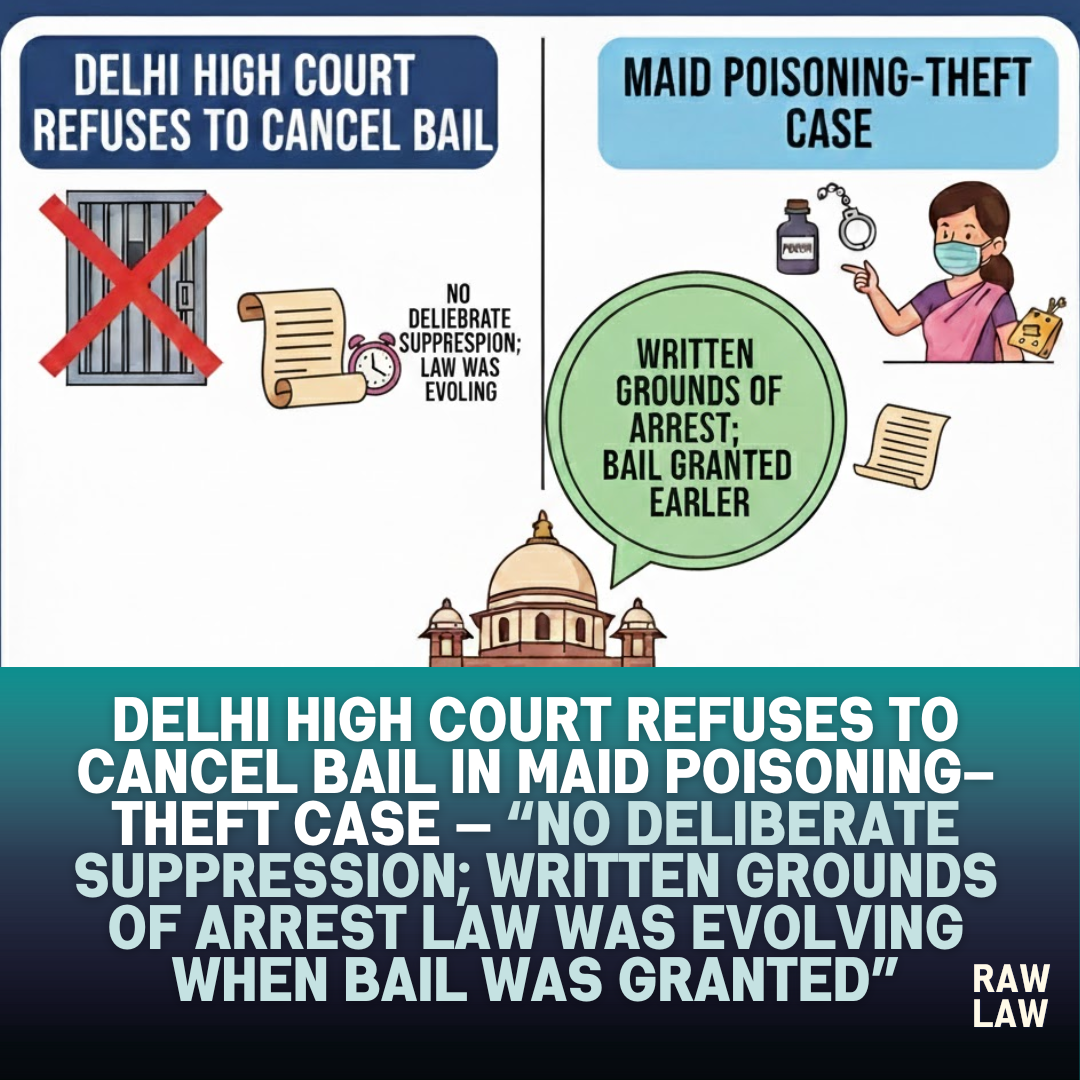
Delhi High Court refuses to cancel bail in maid poisoning–theft case — “No deliberate suppression; written grounds of arrest law was evolving when bail was granted”

Court’s decision
The Delhi High Court dismissed a petition seeking cancellation of bail granted to a domestic help accused of theft and administering stupefying substances, holding that the bail order did not suffer from perversity, fraud, or abuse of process. The Court ruled that there was no deliberate suppression of previous bail orders and that, at the time bail was granted, binding precedent required written communication of grounds of arrest. Subsequent Supreme Court decisions diluting that position could not be applied retrospectively to invalidate a bail order that was legally correct when passed.
Court’s decision
The High Court upheld the trial court’s order granting bail to the accused house-help, rejecting the complainant’s plea for recall and cancellation. The Court held that cancellation of bail stands on a far higher threshold than rejection of bail and can be ordered only where bail was obtained by fraud, suppression of material facts, or where the accused misuses liberty after release. None of these grounds were established. The Court further held that the trial court’s reliance on non-supply of written grounds of arrest was legally sustainable on the date the bail order was passed.
Facts
The case arose from an FIR registered in April 2024 on the complaint of the petitioner, who alleged that the respondent, employed as a domestic help, had stolen jewellery worth over ₹10 lakh from his residence. After initially leaving employment, the respondent returned in late 2023 to take care of the petitioner’s aged parents. During this period, the petitioner, his mother, and his father allegedly fell ill under suspicious circumstances.
It was alleged that the respondent administered unknown stupefying substances to the family members with the intent to facilitate theft and possibly eliminate witnesses. The petitioner’s father, who suffered from Parkinson’s disease, passed away in February 2024. The respondent was arrested in May 2024, and jewellery was partially recovered from loan establishments. A charge-sheet was filed under multiple penal provisions, including conspiracy, while investigation against the respondent’s absconding husband continued.
Issues
The principal issues before the High Court were whether the bail order dated 06 May 2025 was liable to be set aside on grounds of suppression of material facts, fraud on the court, or incorrect application of law, and whether non-supply of written grounds of arrest could justify grant of bail. The Court also examined whether the complainant’s right to be heard as a victim had been violated and whether subsequent Supreme Court judgments warranted recall of the bail.
Petitioner’s arguments
The petitioner argued that the accused had filed multiple bail applications and deliberately concealed dismissal of earlier applications, including one dismissed by the High Court and another withdrawn. It was contended that the trial court was misled into granting bail solely on the technical ground of non-supply of written grounds of arrest, despite the remand order recording that grounds of arrest were communicated.
The petitioner further submitted that later Supreme Court judgments clarified that non-supply of written grounds of arrest is at best a curable irregularity and does not automatically entitle an accused to bail. It was argued that the respondent was a flight risk, had no permanent residence in Delhi, and posed a serious threat to the petitioner and his aged mother, who were key witnesses.
Respondent’s arguments
The respondent denied any deliberate concealment, asserting that any omission regarding earlier bail orders was inadvertent and occurred due to miscommunication while she was in custody. It was submitted that even the prosecution’s status report failed to disclose the earlier High Court dismissal, demonstrating absence of mala fides.
The respondent argued that at the time bail was granted, binding precedent from the Supreme Court required written communication of grounds of arrest as a constitutional safeguard. The bail was therefore not granted on a mere technicality but on violation of substantive rights. It was also contended that she had cooperated throughout, never misused liberty, and that no post-bail conduct justified cancellation.
Analysis of the law
The High Court reiterated the settled distinction between rejection of bail and cancellation of bail. While bail can be refused on a prima facie assessment, cancellation requires supervening circumstances such as misuse of liberty, interference with trial, or fraud in obtaining bail. The Court emphasised that bail once granted should not be lightly recalled, as it directly implicates personal liberty under Article 21.
On the issue of grounds of arrest, the Court traced the evolution of law from decisions requiring communication of grounds, to later rulings mandating written communication, and finally to judgments holding that absence of written grounds may be a curable defect absent demonstrable prejudice.
Precedent analysis
The Court examined Pankaj Bansal v. Union of India, which underscored the importance of communicating grounds of arrest, and Prabir Purkayastha v. State (NCT of Delhi), which elevated the requirement to written communication as a constitutional safeguard.
The Court noted that later decisions such as State of Karnataka v. Sri Darshan diluted this position by holding that non-supply of written grounds may not automatically invalidate arrest or justify bail in the absence of prejudice. However, these later rulings were delivered after the impugned bail order and could not retrospectively render it illegal.
Court’s reasoning
The Court found that the bail application disclosed that it was the second regular bail application before the trial court and did not completely suppress prior proceedings. Any incorrect statement regarding appellate bail was attributed to inadvertence rather than fraud, particularly as the accused was in custody and the prosecution also failed to highlight the earlier dismissal.
On merits, the Court held that when bail was granted in May 2025, Prabir Purkayastha and Vihaan Kumar represented the prevailing law, mandating written grounds of arrest. The trial court’s reliance on that legal position could not be faulted. Subsequent clarifications by the Supreme Court could not be used to cancel bail already granted.
The Court also rejected the plea that absence of notice to the complainant vitiated the bail, holding that bail proceedings are between the State and the accused, and the complainant was adequately represented through the prosecution.
Conclusion
The Delhi High Court concluded that no case for cancellation of bail was made out. There was no deliberate suppression, no fraud on the court, and no post-bail misconduct by the accused. The bail order was legally sustainable on the date it was passed. Accordingly, the petition was dismissed, with liberty reserved to the complainant to seek appropriate remedies if the accused misuses liberty in future.
Implications
This judgment provides important clarity on bail cancellation jurisprudence, particularly in cases involving evolving constitutional safeguards around arrest. It reinforces that bail orders must be assessed based on the law prevailing at the time they are passed and cannot be undone merely because later judgments take a different view. The ruling also underscores judicial caution against using cancellation proceedings as a forum for re-arguing bail on merits.
Case law references
- Pankaj Bansal v. Union of India
Held: Grounds of arrest must be communicated to enable effective legal remedy.
Applied: Basis of evolving arrest jurisprudence. - Prabir Purkayastha v. State (NCT of Delhi)
Held: Written grounds of arrest are a constitutional requirement.
Applied: Binding law when bail was granted. - State of Karnataka v. Sri Darshan
Held: Non-supply of written grounds may be a curable defect absent prejudice.
Distinguished: Decided after the impugned bail order.
FAQs
Q1. Can bail be cancelled because earlier bail orders were not fully disclosed?
Only if non-disclosure is deliberate and amounts to fraud. Inadvertent omission is insufficient for cancellation.
Q2. Does non-supply of written grounds of arrest automatically entitle an accused to bail?
It depended on the law at the relevant time. Courts assess bail based on prevailing precedent when the order was passed.
Q3. Can later Supreme Court judgments invalidate an earlier bail order?
No. Bail orders are tested against the law existing on the date they are passed, not retrospectively.