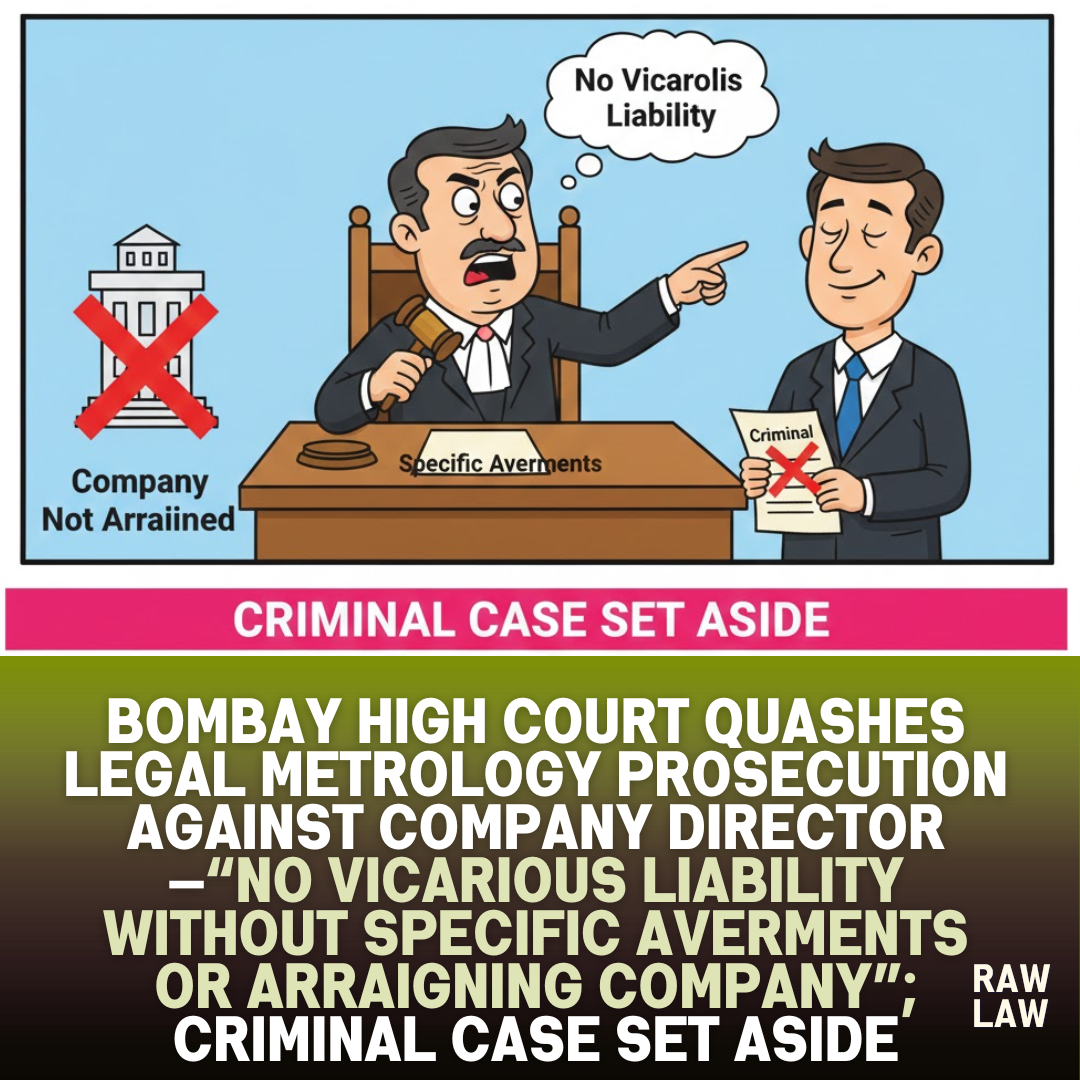
Bombay High Court quashes Legal Metrology prosecution against company director—“No vicarious liability without specific averments or arraigning company”; criminal case set aside

Court’s decision
The Bombay High Court (Nagpur Bench) quashed criminal proceedings initiated under the Legal Metrology Act, 2009 against a non-executive director of a company, holding that the complaint failed to disclose the essential ingredients required to fasten vicarious criminal liability. The Court ruled that in the absence of specific averments showing that the director was in charge of and responsible for the day-to-day conduct of the company’s business—and where the company itself was not arraigned as an accused—the continuation of criminal proceedings would amount to abuse of process. Accordingly, the criminal application was allowed and the prosecution was set aside to the extent of the applicant.
Facts
The prosecution arose from an inspection conducted by the Inspector of Legal Metrology at the premises of a large retail outlet, where packaged commodities of a toothpaste brand were found allegedly violating statutory labelling requirements. The complaint alleged non-compliance with provisions relating to disclosure of manufacturer details and other mandatory declarations under the Legal Metrology Act and the Packaged Commodities Rules.
The present applicant, a senior citizen residing in New Delhi, was arrayed as an accused in his capacity as an independent director of the manufacturing company. The complaint alleged commission of offences punishable under the Legal Metrology Act on the premise that the applicant was a director of the concerned company. Significantly, the company itself was not made an accused. The Magistrate took cognizance and issued process against the applicant, prompting him to approach the High Court seeking quashing of proceedings.
Issues
The primary issues before the High Court were whether a director could be prosecuted for offences under the Legal Metrology Act without specific averments establishing his role in the conduct of the company’s business, whether vicarious liability could be fastened when the company itself was not arrayed as an accused, and whether the Magistrate had applied his mind while issuing process against the applicant.
Petitioner’s arguments
The applicant contended that the complaint was completely silent on his role in the alleged offence. Merely describing him as a director, without stating that he was in charge of or responsible for the day-to-day affairs of the company, was insufficient to attract criminal liability. It was argued that the Legal Metrology Act contains a specific provision governing offences by companies, and unless the statutory requirements were strictly met, prosecution of directors could not be sustained.
The applicant further submitted that the company itself had not been made an accused, which was fatal to the prosecution. In the absence of the principal offender, the question of vicarious liability of directors did not arise. Reliance was placed on consistent Supreme Court and High Court jurisprudence holding that bald and mechanical allegations against directors are insufficient to initiate criminal proceedings.
Respondent’s arguments
The State opposed the application, contending that the applicant, being a director of the manufacturing company, was responsible for compliance with statutory requirements. It was submitted that the Magistrate had rightly issued process and that the question of the applicant’s actual role could be examined during trial. According to the State, the mere designation of director was sufficient at the stage of issuance of process to proceed against the applicant.
Analysis of the law
The High Court examined Section 49 of the Legal Metrology Act, which provides a complete mechanism for fixing liability when an offence is committed by a company. The provision makes it clear that vicarious liability of directors or officers arises only if they were in charge of and responsible for the conduct of the business of the company at the relevant time, or if they had been specifically nominated under the Act.
The Court reiterated that criminal liability cannot be inferred or presumed. In statutes creating vicarious liability, strict compliance with statutory conditions is mandatory. A complaint must contain clear and specific averments explaining how and in what manner the director sought to be prosecuted was responsible for the alleged contravention.
Precedent analysis
Relying on a long line of Supreme Court decisions, the High Court emphasised that a bald statement that a person is a director is not enough to prosecute him. The Court referred to binding precedent holding that when allegations primarily concern acts of a company, the company must be arraigned as an accused, failing which prosecution of directors alone is unsustainable.
The Court also relied on jurisprudence stressing that summoning an accused in a criminal case is a serious matter, and the Magistrate must record satisfaction reflecting application of mind to the facts and law. Mechanical issuance of process without examining whether statutory requirements are met renders the order vulnerable.
Court’s reasoning
Applying these principles, the High Court found that the complaint did not contain any averment that the applicant was in charge of or responsible for the conduct of the business of the company. No role whatsoever was attributed to him in the alleged violation. The complaint also failed to disclose whether any person had been nominated under the Act to be responsible for compliance.
Crucially, the company itself was not made an accused, despite the allegations being essentially against the manufacturer. In such circumstances, the Court held that vicarious liability could not be invoked against the applicant. The Magistrate’s order issuing process did not reflect any independent application of mind to these legal requirements. Continuing the prosecution would therefore amount to misuse of criminal law.
Conclusion
The Bombay High Court held that the criminal complaint, even if taken at face value, did not disclose any offence against the applicant. In the absence of specific averments and without arraigning the company as an accused, the prosecution against the director was unsustainable. The criminal application was accordingly allowed, and the proceedings were quashed to the extent of the applicant.
Implications
This judgment reinforces settled principles governing vicarious liability of company directors in regulatory offences. It sends a clear message that directors cannot be routinely prosecuted merely by virtue of their designation. For enforcement agencies, the ruling underscores the necessity of careful drafting of complaints, strict adherence to statutory requirements, and arraigning the company as the principal accused. For independent and non-executive directors, the decision provides important protection against mechanical criminal prosecution in compliance-related matters.
Case law references
- Sharad Kumar Sanghi v. Sangita Rane: Held that when a company is not arraigned as an accused, prosecution of directors alone is not maintainable.
- Pepsi Foods Ltd. v. Special Judicial Magistrate: Emphasised that summoning an accused is a serious matter requiring application of mind.
- Ravindranatha Bajpe v. Mangalore SEZ Ltd.: Reiterated that specific averments are mandatory to fasten vicarious liability on directors.
- Gautam Hari Singhania v. State of Maharashtra: Affirmed that bald allegations against directors are insufficient in the absence of statutory compliance.
FAQs
1. Can a company director be prosecuted under the Legal Metrology Act without specific allegations?
No. The complaint must specifically state that the director was in charge of and responsible for the conduct of the company’s business at the relevant time.
2. Is it mandatory to make the company an accused in such cases?
Yes. When the alleged offence is committed by a company, the company must ordinarily be arraigned as an accused before vicarious liability of directors can arise.
Can criminal process be issued mechanically against directors?
No. Courts have consistently held that Magistrates must apply their mind and cannot issue summons mechanically based on designation alone.