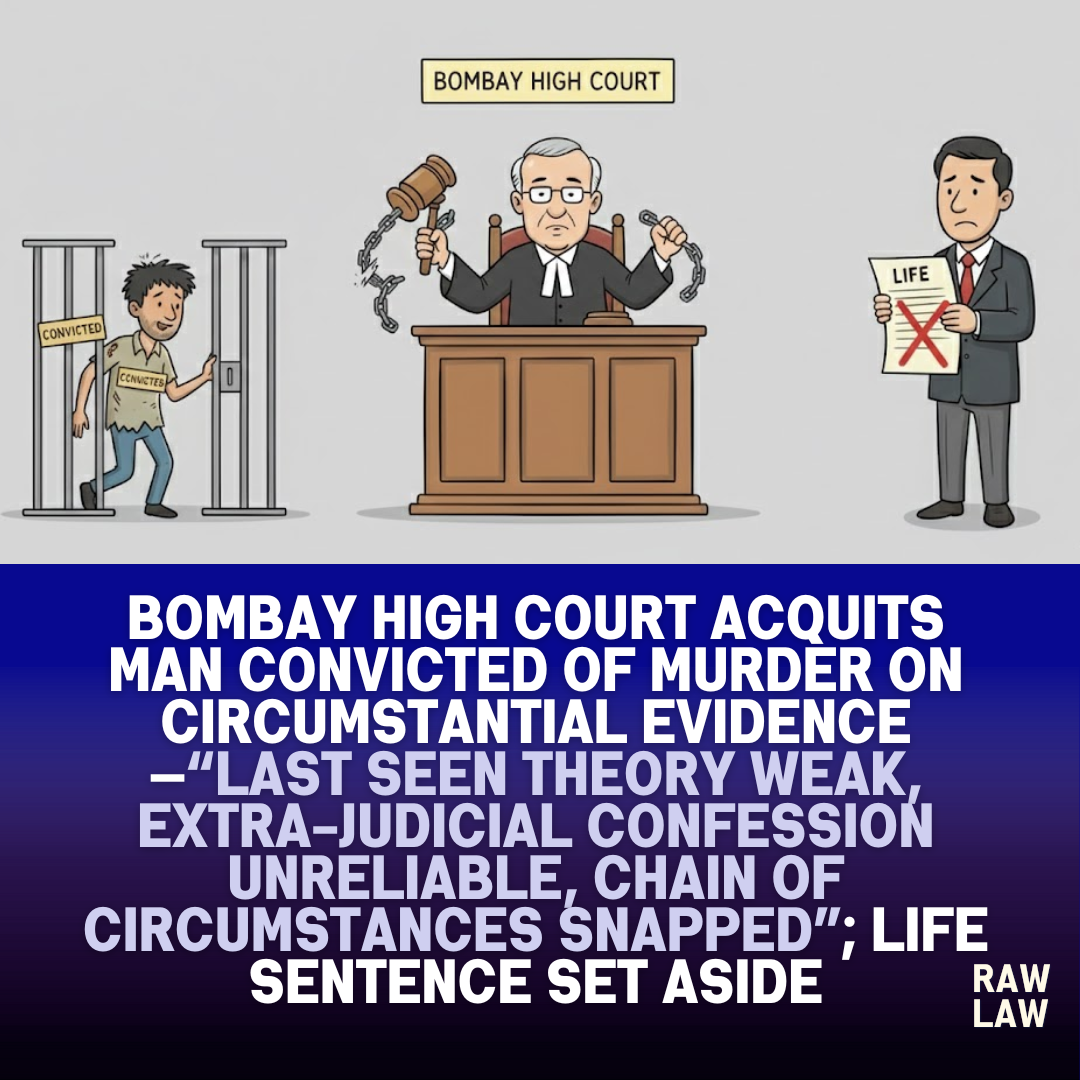
Bombay High Court acquits man convicted of murder on circumstantial evidence—“Last seen theory weak, extra-judicial confession unreliable, chain of circumstances snapped”; life sentence set aside

Court’s decision
The Bombay High Court allowed a criminal appeal and acquitted a man who had been convicted for murder and destruction of evidence, holding that the prosecution failed to prove a complete and unbroken chain of circumstances. The Court ruled that suspicion, however grave, cannot substitute proof beyond reasonable doubt, particularly in a case resting entirely on circumstantial evidence. Finding that crucial links such as last seen together, extra-judicial confession, motive, and recovery of incriminating articles were not proved in accordance with law, the Court set aside the conviction and sentence of life imprisonment.
Facts
The prosecution case stemmed from the discovery of a woman’s dead body with a crushed face under a tamarind tree near a school in Virar in January 2010. An offence was registered and investigation commenced to ascertain the identity of the deceased, which was later established through her parents. During investigation, call detail records of the deceased’s mobile phone were analysed, leading the police to a friend of the accused and, eventually, to the accused himself.
The accused was arrested, charge-sheeted, and tried for offences of murder and causing disappearance of evidence. The trial court convicted him under Sections 302 and 201 of the Indian Penal Code, primarily relying on circumstantial evidence including last seen theory, an alleged extra-judicial confession, motive, recovery of blood-stained clothes, and call records. Challenging this conviction, the accused preferred an appeal before the High Court.
Issues
The High Court was required to determine whether the prosecution had successfully proved all incriminating circumstances forming a complete chain pointing exclusively towards the guilt of the accused. The key issues included whether the “last seen together” theory was conclusively established, whether the alleged extra-judicial confession was reliable and legally admissible, whether motive was proved, whether recovery of clothes and forensic evidence were credible, and whether call detail records could independently sustain the conviction.
Petitioner’s arguments
The appellant contended that the entire prosecution case was built on conjectures and weak circumstantial links. It was argued that the last seen theory was not applicable because there was a significant time gap between when the accused was allegedly last seen with the deceased and when the body was found. The appellant further submitted that the alleged extra-judicial confession was a weak piece of evidence, riddled with omissions, and unsupported by independent corroboration.
It was also argued that the prosecution failed to prove motive, as the evidence suggesting an alleged relationship or jealousy was speculative and based on omissions. The recovery of blood-stained clothes was challenged on the ground that seizure witnesses did not support the prosecution and that the recovery was not proved in a credible manner. The appellant emphasised that mere suspicion cannot replace proof beyond reasonable doubt and sought acquittal.
Respondent’s arguments
The State defended the conviction, asserting that the prosecution had established all necessary circumstances forming a complete chain. It was argued that the accused was last seen with the deceased on the night preceding the discovery of the body and that his conduct thereafter was suspicious. The State relied heavily on the alleged extra-judicial confession made to a close friend, contending that it was voluntary and truthful.
The prosecution also pointed to recovery of blood-stained clothes allegedly belonging to the accused and forensic evidence suggesting a connection with the deceased. The State submitted that call detail records showed frequent communication between the accused and the deceased, thereby corroborating other circumstances and justifying the conviction.
Analysis of the law
The High Court reiterated the settled principles governing cases based solely on circumstantial evidence. It emphasised that each circumstance relied upon by the prosecution must be fully established and all such circumstances must collectively form a chain so complete that it excludes every hypothesis except the guilt of the accused. If even one link in the chain is missing or capable of an alternative explanation, the accused is entitled to the benefit of doubt.
The Court also reiterated that extra-judicial confession is a weak form of evidence and must be approached with great caution. Such confession must inspire confidence, be free from material omissions, and be corroborated by independent evidence before it can form the basis of conviction.
Precedent analysis
The Court relied on authoritative Supreme Court jurisprudence, including the principles laid down in Sharad Birdhichand Sarda, which set out the “five golden principles” for cases based on circumstantial evidence. It also referred to recent decisions emphasising that last seen theory applies only when the time gap between last seen and death is so small that no other hypothesis is possible.
On extra-judicial confessions, the Court referred to Supreme Court rulings reiterating that such confessions are inherently weak and cannot be relied upon where they suffer from omissions, contradictions, or lack of corroboration. The Court also drew support from decisions cautioning courts against allowing suspicion to harden into conviction.
Court’s reasoning
Applying these principles, the High Court found that the prosecution failed on multiple counts. The last seen theory was rejected because the time gap between the alleged last meeting and discovery of the body was too wide to rule out involvement of another person. The Court held that this circumstance, by itself, was weak and uncorroborated.
The alleged extra-judicial confession was found unreliable, as crucial details attributed to the accused were absent in earlier statements and emerged as omissions during trial. The Court held that such evidence could not be treated as credible. The motive suggested by the prosecution was also found to be speculative and not conclusively proved.
The recovery of clothes was disbelieved because seizure witnesses did not support the prosecution version and admitted that the recovery was not made in their presence. The forensic evidence was found inconclusive. The Court held that call detail records, at best, showed contact between the accused and the deceased but did not establish the commission of murder.
Conclusion
The Bombay High Court concluded that the prosecution failed to establish a complete chain of circumstances pointing unerringly to the guilt of the accused. With several missing and unreliable links, the conviction could not be sustained. The appeal was allowed, the conviction and sentences were quashed, and the accused was acquitted of all charges.
Implications
This judgment reinforces the high evidentiary threshold required in criminal cases based on circumstantial evidence. It reiterates that courts must be vigilant against the risk of conviction based on suspicion, moral belief, or incomplete chains of circumstances. The ruling serves as a reminder that extra-judicial confessions and last seen theory require strict scrutiny and corroboration, and that failure to prove even one crucial link entitles the accused to benefit of doubt.
Case law references
- Sharad Birdhichand Sarda v. State of Maharashtra: Laid down the foundational principles governing conviction based on circumstantial evidence.
- Abdul Nassar v. State of Kerala: Reiterated the requirement of a complete and unbroken chain of circumstances.
- Sahadevan v. State of Tamil Nadu: Clarified the weak evidentiary value of extra-judicial confession and need for corroboration.
- Ramanand v. State of Uttar Pradesh: Cautioned against conviction based on suspicion rather than proof beyond reasonable doubt.
FAQs
1. Can a murder conviction be based only on circumstantial evidence?
Yes, but only if all circumstances are fully proved and form a complete chain pointing exclusively to the accused’s guilt.
2. Is extra-judicial confession sufficient for conviction?
No. Extra-judicial confession is a weak form of evidence and must be voluntary, reliable, and corroborated by independent material.
3. What happens if one link in circumstantial evidence is not proved?
If even one crucial link is missing or doubtful, the accused is entitled to the benefit of doubt and acquittal.