

Court’s decision
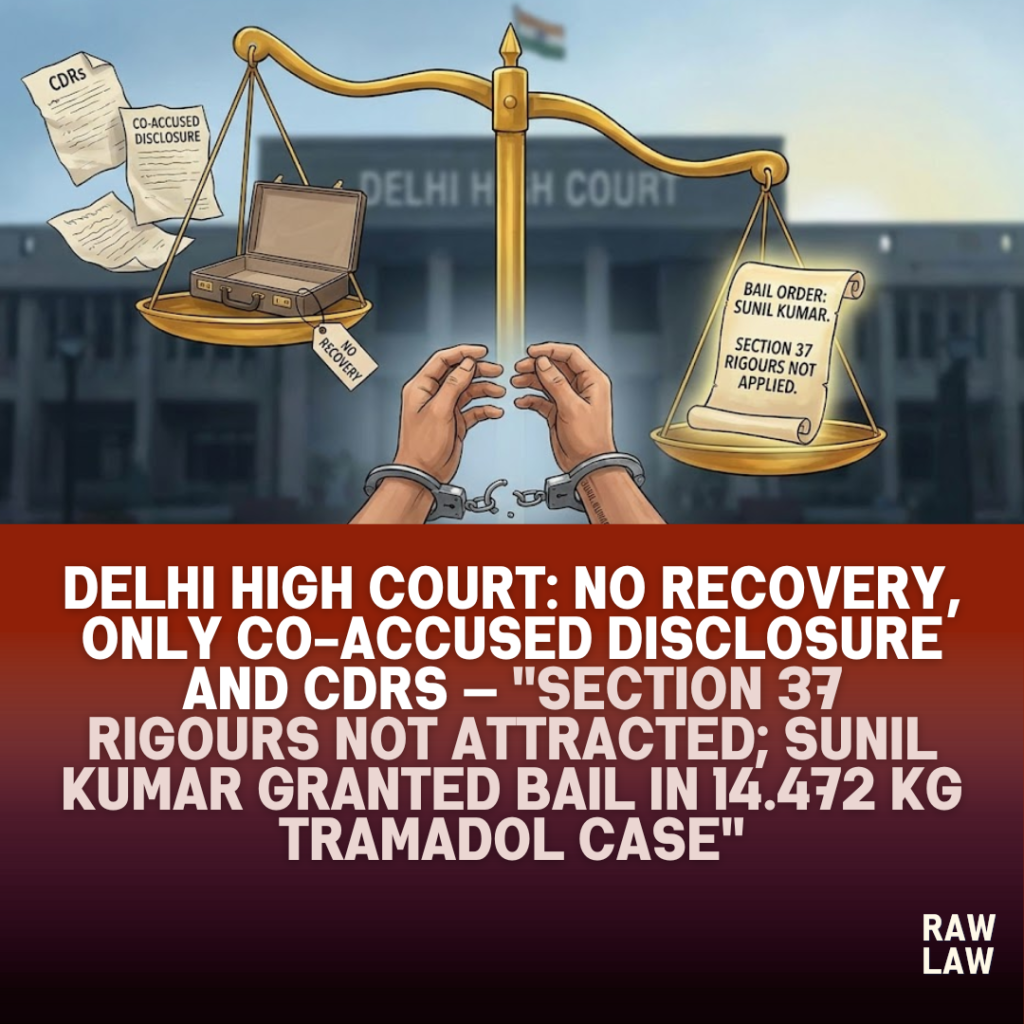
The Delhi High Court granted regular bail to an applicant arrested in connection with recovery of 14.472 kg of Tramadol Hydrochloride tablets, holding that in the absence of recovery from the applicant and with investigation still at a preliminary stage, the twin conditions under Section 37 of the NDPS Act were satisfied. The Court observed that reliance solely on disclosure statements of co-accused and Call Detail Records (CDRs) is insufficient to establish prima facie guilt at the bail stage. The applicant was enlarged on bail subject to stringent conditions.
Facts
The case arose from FIR No.296/2025 dated 08.10.2025 registered at PS Crime Branch under Sections 22/25 of the NDPS Act. Acting on secret information, the police conducted a raid on 07.10.2025 and recovered 270 packets containing 54,000 tablets of Tramadol Hydrochloride, weighing approximately 14.472 kg — classified as commercial quantity.
The contraband was recovered from the residence of one co-accused. Subsequent disclosures allegedly linked the present applicant as the source of supply. A search of the applicant’s warehouse was conducted on 01.11.2025; however, no contraband or incriminating material was recovered. The applicant was arrested on 02.11.2025. His bail application was rejected by the Trial Court on 02.12.2025, prompting the present application before the High Court.
Issues
The primary issue was whether the embargo under Section 37 of the NDPS Act barred grant of bail in a case involving commercial quantity, particularly when no recovery was made from the applicant.
The Court also examined whether disclosure statements under Section 67 of the NDPS Act and CDR connectivity could constitute sufficient material to deny bail at the pre-charge stage.
Additionally, the relevance of a prior FIR under the Delhi Excise Act in assessing the likelihood of reoffending was considered.
Applicant’s arguments
The applicant contended that no recovery was effected from him or his warehouse and that the prosecution’s case rested entirely on disclosure statements of co-accused. Relying on Tofan Singh v. State of Tamil Nadu, it was argued that such statements cannot form the sole basis of conviction and, therefore, cannot independently justify denial of bail.
It was further submitted that mere CDR connectivity does not establish conspiracy. The applicant maintained that he operates a warehouse facility and had no knowledge of the contents of packages stored temporarily during transit.
The prior FIR under the Delhi Excise Act, it was argued, bore no nexus to NDPS offences and could not be used to deny bail.
State’s arguments
The State opposed bail, emphasizing that the recovered quantity constituted commercial quantity, attracting the rigours of Section 37. It relied upon Supreme Court precedents including State of M.P. v. Kajad, Union of India v. Rattan Mallik, and Union of India v. Ram Samujh to argue that bail in commercial quantity cases must be granted sparingly.
The prosecution further pointed to a warehouse register allegedly showing entry of 40 boxes of Tramadol tablets, out of which only 8 were dispatched, leaving 32 unaccounted for. This, it was argued, corroborated the co-accused disclosures and established involvement of the applicant.
The State expressed apprehension that release on bail could result in repetition of similar offences.
Analysis of the law
The Court reiterated the principle laid down in Tofan Singh v. State of Tamil Nadu (2021) 4 SCC 1, that statements recorded under Section 67 of the NDPS Act cannot be treated as substantive evidence of guilt. At best, such statements may lend assurance to independent admissible evidence.
It noted that no recovery was made from the applicant and that his name did not figure in the FIR. The chargesheet had not yet been filed, and investigation was at a preliminary stage.
While Section 37 imposes twin conditions for grant of bail in commercial quantity cases, the Court observed that absence of direct recovery and lack of independent incriminating material weakened the prosecution’s prima facie case.
Precedent analysis
The Court relied on Tofan Singh to evaluate the evidentiary value of disclosure statements.
It also referred to Prabhakar Tiwari v. State of Uttar Pradesh (2020) 11 SCC 648, reiterating that gravity of offence and pendency of other cases cannot be the sole basis for rejecting bail.
Although the State relied on Kajad, Rattan Mallik, and Ram Samujh to stress the strict approach under Section 37, the Court distinguished the present case on facts, particularly the absence of recovery and independent corroboration.
Court’s reasoning
The Court held that disclosure statements of co-accused and existence of CDR connectivity are not per se sufficient to establish complicity at the stage of bail.
The entry of 40 boxes in the warehouse register was found insufficient to conclusively link the applicant to the seized contraband.
The prior FIR under the Delhi Excise Act was held not determinative. Applying a holistic view, the Court concluded that the applicant satisfied the twin conditions under Section 37 for grant of bail at this stage.
Conclusion
The Delhi High Court granted regular bail to the applicant upon furnishing a personal bond of ₹50,000 with one surety, subject to strict conditions including surrender of passport, monthly reporting to the Investigating Officer, and non-interference with investigation. The Court clarified that observations were limited to the bail stage and shall not influence trial proceedings.
Implications
This ruling underscores that even in commercial quantity NDPS cases, courts will scrutinize the quality of evidence at the bail stage. Disclosure statements and CDRs, absent recovery or independent corroboration, may not suffice to deny bail under Section 37.
The judgment reflects a nuanced application of the twin conditions test, reinforcing that severity of offence alone cannot override deficiencies in prima facie material.
For defence practitioners, the decision reaffirms the strategic importance of challenging reliance on Section 67 statements post-Tofan Singh.
Case law references
- Tofan Singh v. State of Tamil Nadu (2021) 4 SCC 1 – Section 67 statements inadmissible as confessions.
- State of M.P. v. Kajad (2001) 7 SCC 673 – Strict approach in commercial quantity bail matters.
- Union of India v. Rattan Mallik (2009) 2 SCC 624 – Twin conditions under Section 37 mandatory.
- Union of India v. Ram Samujh (1999) 9 SCC 429 – Bail in NDPS cases to be granted cautiously.
- Prabhakar Tiwari v. State of U.P. (2020) 11 SCC 648 – Gravity of offence alone insufficient to deny bail.
FAQs
1. Can bail be granted in commercial quantity NDPS cases?
Yes, but courts must be satisfied that there are reasonable grounds to believe the accused is not guilty and is unlikely to commit further offences, as per Section 37 of the NDPS Act.
2. Are disclosure statements under Section 67 sufficient to deny bail?
Post-Tofan Singh, such statements cannot independently establish guilt and require corroboration.
3. Does absence of recovery from an accused strengthen the case for bail?
Yes. Where no contraband is recovered from the accused and the prosecution relies solely on co-accused disclosures, courts may consider bail appropriate depending on facts.


