

Court’s decision
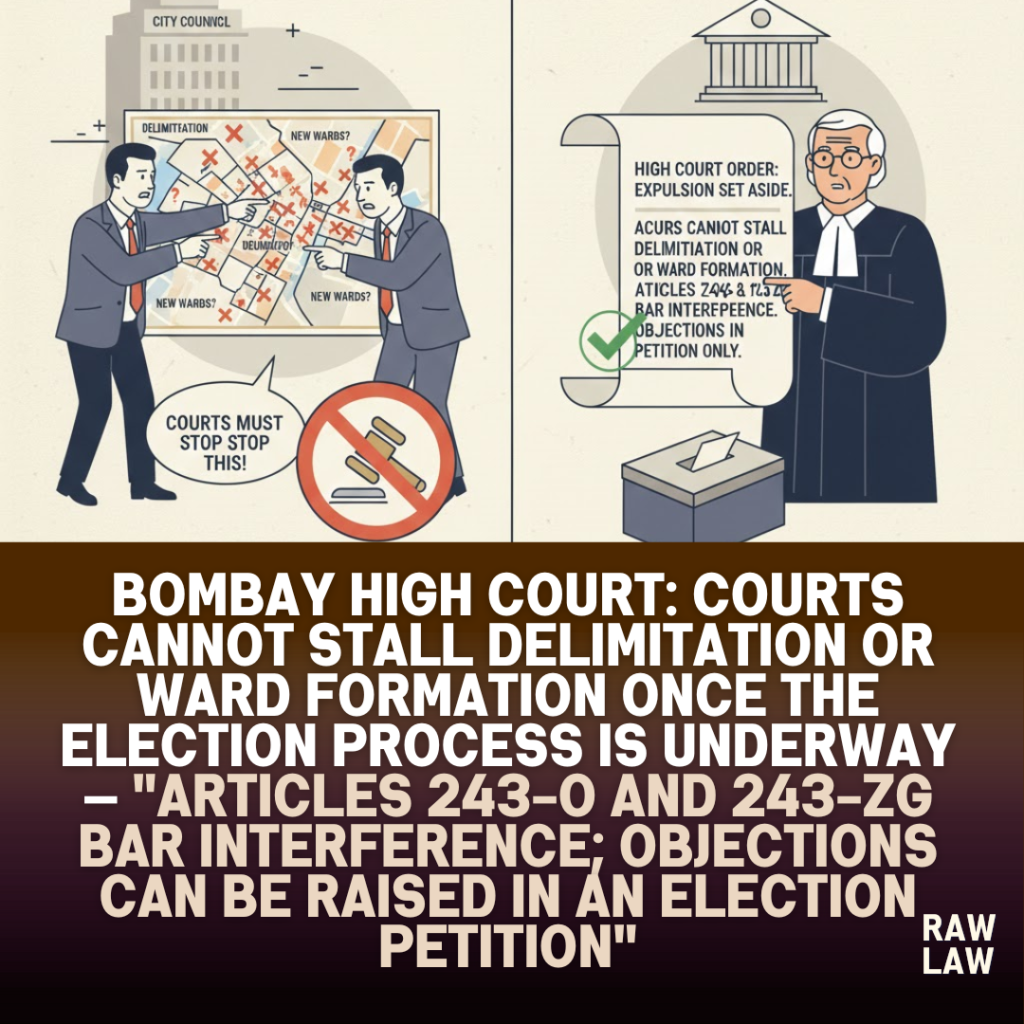
The Bombay High Court dismissed a batch of writ petitions challenging ward formation, reservation rotation and delimitation notifications issued for Zilla Parishads, Panchayat Samitis and Municipal Councils across Maharashtra. The Court held that once the election process has commenced, judicial interference under Article 226 is barred by Articles 243-O and 243-ZG of the Constitution. It ruled that alleged violations of government guidelines, population ratios, or rotation rules do not justify stalling elections. Aggrieved parties may pursue remedies through an election petition after conclusion of elections.
Facts
The writ petitions challenged ward formation notifications, delimitation exercises and reservation rotation carried out under the Maharashtra Zilla Parishads and Panchayat Samitis Act, 1961 and allied municipal statutes. Petitioners alleged that objections filed against draft ward formations were either ignored or improperly decided.
In several matters, petitioners contended that enumeration blocks were shifted contrary to guidelines, Scheduled Caste population percentages were altered, or wards were reserved inconsistently with the draft notifications.
The State defended the exercise citing significant territorial and demographic changes, compliance with Urban Development Department guidelines dated 10 June 2025, and the Supreme Court’s directive in Rahul Ramesh Wagh mandating completion of local body elections before 31 January 2026.
Issues
The principal issue was whether the High Court could interfere with delimitation, ward formation or reservation rotation once the election process had commenced.
A related issue concerned the validity of the 2025 Rotation of Reservation Rules, particularly Rule XII, and whether dispensing with prior publication under Section 274 of the 1961 Act was lawful.
The Court also examined whether alleged breaches of executive guidelines or minor population deviations could justify quashing final ward notifications at a pre-election stage.
Petitioners’ arguments
Petitioners argued that delimitation was conducted arbitrarily, ignoring government guidelines and constitutional mandates under Articles 243-C and 243-D. It was submitted that rotation rules were misapplied, enumeration blocks were shifted in violation of clauses 5.5.3 and 5.5.4, and Scheduled Caste settlements were divided contrary to community interest norms.
Some petitioners relied on earlier Supreme Court observations in Rahul Ramesh Wagh contending that previous delimitation exercises should govern future elections. Others challenged Rule XII of the 2025 Rules as unconstitutional and violative of the rotation principle.
It was urged that failure to consider objections rendered the ward formation notifications illegal.
Respondents’ arguments
The State and State Election Commission raised a preliminary objection of non-maintainability. They argued that Articles 243-O and 243-ZG create a constitutional bar against judicial interference in electoral matters once the process has begun.
It was submitted that delimitation became necessary due to changes in territorial boundaries, inclusion of rural areas into municipal limits, and altered population figures.
The State contended that Rule XII and the 2025 Rules were validly notified. The proviso to Section 274(3) empowered the Government to dispense with prior publication in urgent circumstances, particularly given the Supreme Court’s deadline for completing elections.
Analysis of the law
The Court undertook an extensive review of Part IX and Part IX-A of the Constitution governing Panchayats and Municipalities. Article 243-K vests superintendence and control of elections in the State Election Commission.
Articles 243-O and 243-ZG bar courts from interfering in electoral matters except by way of election petitions.
Relying on Mohinder Singh Gill, Lakshmi Charan Sen and A.C. Jose, the Court reiterated that “election” is a wide term encompassing the entire process from notification to declaration of results. Courts must avoid interventions that may derail or delay elections.
The Court observed that minor population deviations within permissible ±10% limits, shifting of enumeration blocks for geographical contiguity or community interest, and application of rotation rules are matters within administrative discretion unless shown to be manifestly arbitrary.
Precedent analysis
The Court relied on Mohinder Singh Gill v. Chief Election Commissioner to emphasize that election disputes should ordinarily be resolved after completion of the electoral process.
In Lakshmi Charan Sen v. A.K.M. Hassan Uzzaman, the Supreme Court held that elections cannot be postponed merely because claims or objections remain pending.
The Court also noted earlier Division Bench judgments upholding ward formation exercises in Vidarbha and dismissal of similar challenges.
These precedents reinforced the principle that election timelines, especially when fixed by the Supreme Court, cannot be frustrated by pre-election litigation.
Court’s reasoning
The Court held that ward formation and reservation are integral parts of the election process. Entertaining writ petitions at this stage would obstruct elections mandated to be completed within the Supreme Court’s timeline.
It found no material demonstrating patent illegality or constitutional violation in the delimitation exercise. Executive guidelines do not confer enforceable rights warranting judicial intervention at a pre-election stage.
The Court clarified that grievances regarding improper reservation, population imbalance, or ward boundary manipulation may be raised in an election petition under the relevant statute after the elections are concluded.
Accordingly, the writ petitions were dismissed.
Conclusion
The Bombay High Court reaffirmed that courts must exercise restraint in electoral matters. Once the election process is set in motion, judicial review under Article 226 is extremely limited. Delimitation and ward formation challenges must ordinarily await the outcome of elections and be agitated through statutory election petitions.
Implications
This ruling strengthens the constitutional bar on pre-election interference in local body elections. It signals that allegations of guideline violations or minor deviations will not justify halting elections.
The judgment also upholds the State’s power to undertake fresh delimitation in light of demographic and territorial changes.
For future electoral disputes in Maharashtra, the decision clarifies that challenges to ward formation and reservation must generally be pursued post-election.
Case law references
- Mohinder Singh Gill v. Chief Election Commissioner (1978) 1 SCC 405 – Election process cannot be interrupted; disputes to be raised post-election.
- Lakshmi Charan Sen v. A.K.M. Hassan Uzzaman (1985) 4 SCC 689 – Elections cannot be postponed due to pending objections.
- A.C. Jose v. Sivan Pillai (1984) 2 SCC 656 – Election Commission has plenary powers subject to statutory provisions.
- Union of India v. Association of Democratic Reforms (2001) 10 SCC 211 – “Conduct of election” is of wide amplitude.
FAQs
1. Can ward formation be challenged before elections are completed?
Generally, no. Articles 243-O and 243-ZG bar courts from interfering once the election process has begun.
2. What remedy is available against wrongful reservation or delimitation?
An aggrieved candidate may file an election petition after conclusion of elections under the relevant statute.
3. Does violation of government guidelines automatically invalidate ward formation?
No. Unless there is clear constitutional or statutory violation, minor deviations or guideline disputes will not justify pre-election interference.


