

Court’s decision
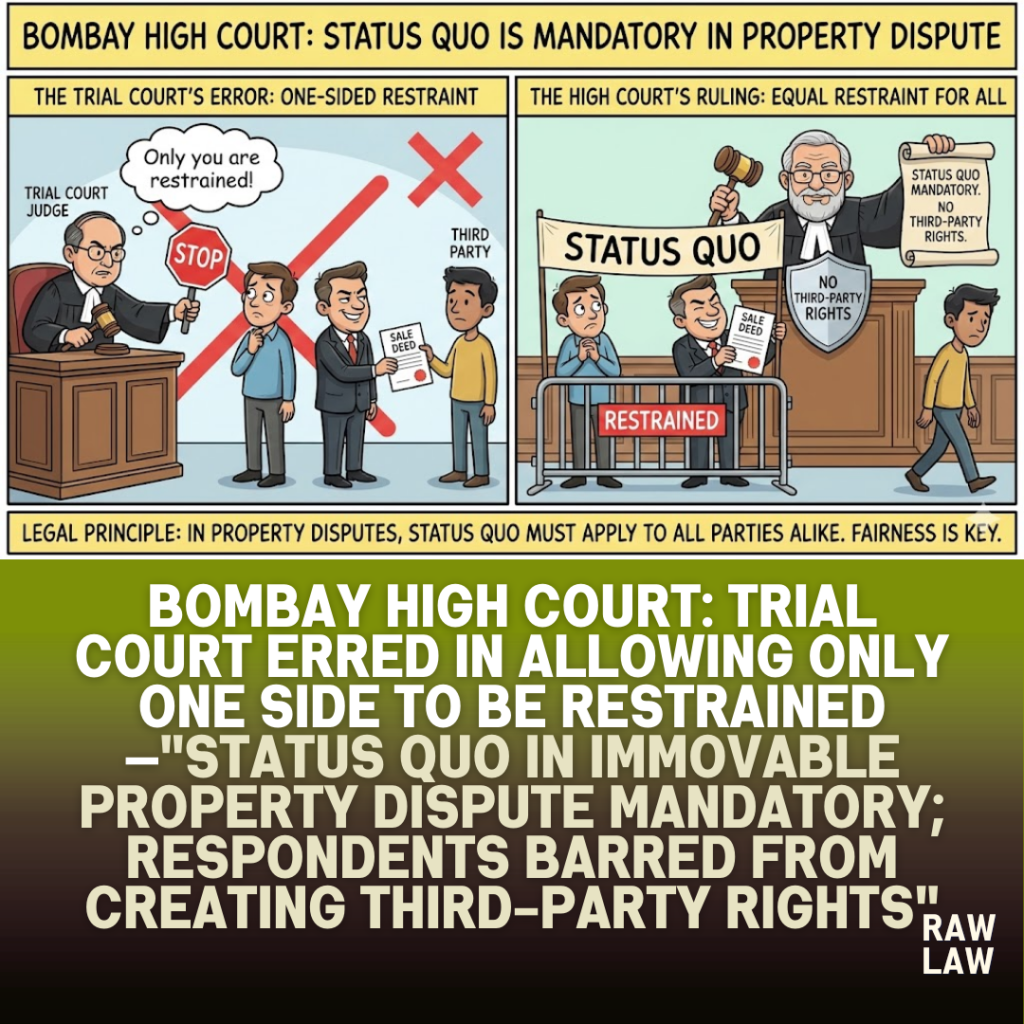
The Bombay High Court set aside the trial court’s order refusing interim injunction in favour of landowners and held that when rival title suits over the same immovable property are pending, equity demands parity of interim protection. The Court ruled that restraining one party from creating third-party rights while allowing the other to freely alienate the property creates imbalance and risks multiplicity of proceedings. Accordingly, the respondents were restrained from creating any third-party rights, title or interest in the suit property pending final adjudication.
Facts
The appellants, joint owners of agricultural land at Village Chikanghar, Kalyan West, acquired the larger property under a registered conveyance dated 28 August 2014.
Two lease deeds executed in 1968 and 1971 had granted leasehold rights to Respondent No.1 over portions of the land for 50 years and 75 years respectively. The 50-year lease expired on 23 April 2018. The appellants sought recovery of possession and permanent injunction.
Respondent No.1 had earlier filed Special Civil Suit No.194 of 2017 seeking specific performance of an alleged 1994 agreement and declaration that the appellants’ sale deed was void. In that suit, the trial court restrained the appellants from creating third-party rights.
Subsequently, in the appellants’ suit for possession, the trial court refused to similarly restrain the respondents from creating third-party interests, prompting the present Appeal from Order.
Issues
- Whether interim protection should operate symmetrically when both parties assert competing rights over the same immovable property.
- Whether refusal to restrain respondents from alienating property during pendency of suits would result in multiplicity of proceedings.
- Whether alleged suppression of the 1994 agreement disentitled appellants from interim relief.
Appellants’ arguments
The appellants contended that the trial court adopted a contradictory approach—restraining them from alienation while permitting respondents to create third-party interests.
They argued that the lease expired in 2018 and the respondents were unauthorized occupants. The alleged 1994 agreement was unregistered and fabricated. As bona fide purchasers under a registered conveyance, their rights required interim protection.
They further submitted that allowing alienation would cause irreparable harm and render the final decree infructuous.
Respondents’ arguments
The respondents argued that the appellants suppressed the 1994 agreement and were aware of prior litigation. They contended that suppression of material facts disentitled appellants from discretionary relief.
It was submitted that there was no concrete evidence showing intention to create third-party rights and that the appellants had knowledge of respondents’ possessory claims.
Analysis of the law
The High Court applied the three settled principles governing temporary injunction—prima facie case, balance of convenience, and irreparable injury, as laid down in Dalpat Kumar v. Prahlad Singh.
Relying on Maharwal Khewaji Trust v. Baldev Dass, the Court reiterated that in disputes concerning immovable property, status quo must ordinarily be maintained to preserve the subject matter of litigation.
The Court invoked Wander Ltd. v. Antox India (P) Ltd. to clarify that appellate interference is justified where discretion is exercised on erroneous principles.
On the issue of the unregistered 1994 agreement, the Court referred to Suraj Lamp & Industries Pvt. Ltd. v. State of Haryana and K.B. Saha & Sons Pvt. Ltd. v. Development Consultant Ltd., emphasizing that unregistered documents cannot confer proprietary rights enforceable in law.
Precedent analysis
The Court harmonized principles from Supreme Court jurisprudence emphasizing preservation of property during litigation and parity in interim protection.
It distinguished suppression cases such as S.P. Chengalvaraya Naidu and Ramjas Foundation, holding that mere non-reproduction of the 1994 agreement in detail did not amount to deliberate suppression sufficient to deny interim relief.
The enforceability of the 1994 agreement was left to be adjudicated in the pending suit.
Court’s reasoning
The Court found that restraining only the appellants while permitting respondents to alienate would upset balance of convenience and create irreversible consequences.
Where both parties assert competing rights and litigation is pending, neither should be allowed to alter the property’s status.
The alleged suppression was not material enough to deny interim relief, especially when the prior suit was disclosed.
Permitting alienation at this stage would effectively grant substantive relief without trial.
Conclusion
The appeal was allowed. The impugned order dated 3 May 2023 was set aside. The respondents were restrained from creating any third-party rights, title or interest in the suit property pending final disposal of the suit.
All other issues were kept open for adjudication. The trial court was directed to dispose of the suit expeditiously.
Implications
This judgment reinforces judicial consistency in granting interim injunctions in immovable property disputes. It clarifies that parity of protection is essential to prevent multiplicity and preserve subject matter.
The ruling underscores that unregistered agreements cannot override registered conveyances at the interim stage and that status quo must be maintained until final adjudication.
Case Law References
- Dalpat Kumar v. Prahlad Singh (1992) 1 SCC 719
- Maharwal Khewaji Trust v. Baldev Dass (2004) 8 SCC 488
- Wander Ltd. v. Antox India (P) Ltd. (1990 Supp SCC 727)
- Suraj Lamp & Industries Pvt. Ltd. v. State of Haryana (2012) 1 SCC 656
- K.B. Saha & Sons Pvt. Ltd. v. Development Consultant Ltd. (2008) 8 SCC 564
FAQs
1. Can one party be restrained from alienating property while the other is not?
Generally no. Courts aim to maintain parity to preserve the subject matter of litigation.
2. Does an unregistered agreement create enforceable property rights?
No. Transfer of immovable property requires a registered instrument.
3. When will an appellate court interfere with interim injunction orders?
When discretion is exercised on erroneous principles or results in inequitable imbalance.


