

Court’s decision
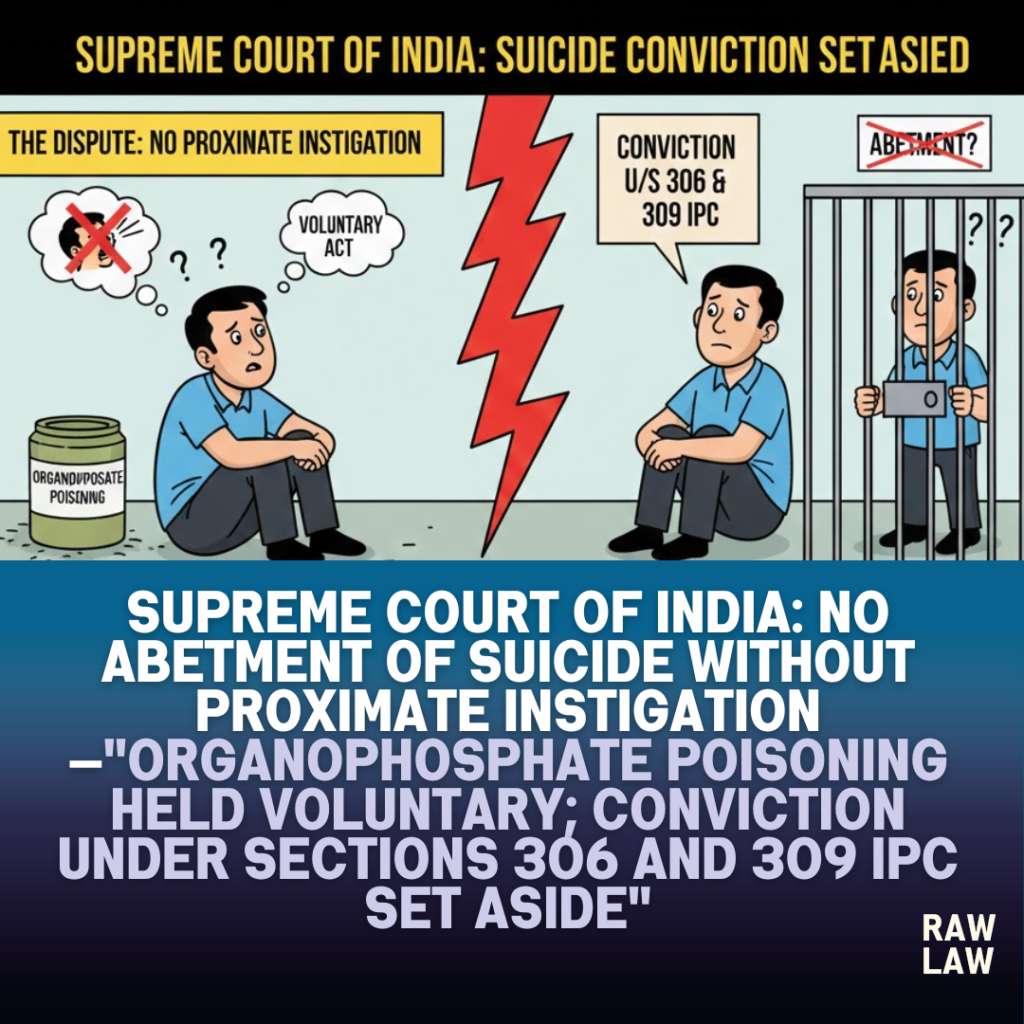
The Supreme Court of India allowed the appeals filed by Gudipalli Siddhartha Reddy and set aside his conviction under Sections 306 and 309 of the Indian Penal Code. The Court held that the prosecution failed to establish the essential ingredient of “abetment” under Section 107 IPC, namely instigation or intentional aiding of suicide. Relying on medical, forensic and scientific evidence, the Court concluded that the deceased died due to organophosphate poisoning and not manual strangulation or sexual assault. It ruled that mere presence and purchase of poison, absent proof of active instigation, does not constitute abetment of suicide.
Facts
The case concerned the death of a young actress who consumed poison along with the appellant, with whom she had a long-standing romantic relationship. On 23 February 2002, both were admitted to CARE Hospital, Hyderabad, after ingesting pesticide. The deceased succumbed the next day, while the appellant survived.
The initial postmortem opinion by a forensic doctor suggested death due to manual strangulation and possible sexual assault. However, subsequent reports by the Andhra Pradesh Forensic Science Laboratory detected organophosphate insecticide in the viscera. A three-member expert committee and later an AIIMS medical board concluded that the cause of death was organophosphate poisoning and that alleged injuries were therapeutic artefacts misinterpreted as strangulation marks.
The CBI investigation ultimately filed a charge sheet under Sections 306 and 309 IPC, alleging abetment of suicide.
Issues
- Whether the prosecution proved beyond reasonable doubt that the appellant abetted the suicide of the deceased under Section 306 IPC.
- Whether purchase of poison and presence at the scene constituted instigation or intentional aiding.
- Whether the conviction under Section 309 IPC for attempt to suicide could be sustained.
Appellant’s arguments
The appellant contended that the deceased voluntarily consumed poison and there was no evidence of coercion, instigation, or mens rea to abet suicide. It was argued that the couple acted impulsively due to familial opposition to marriage. The defence relied heavily on forensic reports confirming poisoning and absence of strangulation or sexual assault. It was further submitted that mere purchase of pesticide and joint consumption does not establish abetment under Section 107 IPC.
Respondent’s arguments
The prosecution argued that the appellant had aided the deceased by procuring poison and accompanying her, thereby facilitating suicide. It contended that such conduct attracted Section 306 IPC. The State relied on circumstantial evidence, including the emotional circumstances preceding the incident.
Analysis of the law
The Supreme Court reiterated that conviction under Section 306 IPC requires proof of abetment as defined under Section 107 IPC—instigation, conspiracy, or intentional aiding. Mere association or passive presence is insufficient.
The Court emphasized the requirement of a proximate and live link between the accused’s conduct and the suicide. Emotional distress or romantic turmoil does not automatically translate into criminal liability.
It reaffirmed that suspicion, however strong, cannot substitute proof beyond reasonable doubt. Criminal jurisprudence demands strict construction of penal statutes.
Precedent analysis
The Court relied on established precedents interpreting Section 306 IPC, including:
- Sanju v. State of Madhya Pradesh – Mere utterance or presence does not amount to instigation.
- Gurcharan Singh v. State of Punjab – Proximity and direct nexus are essential for abetment.
- Madan Mohan Singh v. State of Gujarat – Hypersensitivity of the victim cannot by itself attract criminal liability.
Applying these principles, the Court found absence of active instigation or intentional aid.
Court’s reasoning
The Court examined the extensive medical evidence. The AP FSL and CFSL reports confirmed presence of monocrotophos insecticide in the viscera. The AIIMS Committee categorically ruled out manual strangulation and sexual assault. The injuries recorded in the postmortem were attributable to therapeutic procedures during hospital treatment.
The deceased was conscious upon admission and admitted to consuming pesticide. There was no allegation of coercion at that stage. Telephonic conversations before hospitalization revealed no indication of violence.
The Court held that joint decision to commit suicide, absent proof of instigation, cannot sustain conviction under Section 306 IPC. Purchase of poison alone does not establish mens rea to abet.
The prosecution failed to prove that the appellant actively encouraged or compelled the deceased to take the fatal step.
Conclusion
The Supreme Court allowed the appeals and acquitted the appellant of offences under Sections 306 and 309 IPC. The conviction and sentence imposed by the trial court and modified by the High Court were set aside.
Implications
This judgment reinforces the strict threshold required for abetment of suicide convictions. It underscores the necessity of clear evidence of instigation or intentional aid.
The ruling also highlights the importance of scientific forensic analysis in criminal adjudication and cautions against premature conclusions based on sensationalized medical opinions.
The decision strengthens safeguards against criminal liability based solely on emotional association or circumstantial suspicion.
Case Law References
- Sanju v. State of Madhya Pradesh
- Gurcharan Singh v. State of Punjab
- Madan Mohan Singh v. State of Gujarat
FAQs
1. What is required to prove abetment of suicide under Section 306 IPC?
There must be clear evidence of instigation, conspiracy, or intentional aiding under Section 107 IPC, along with a proximate link to the suicide.
2. Is joint consumption of poison sufficient for conviction under Section 306 IPC?
No. Mere joint decision or presence is insufficient without proof of instigation or mens rea.
3. How important is forensic evidence in such cases?
Forensic and medical evidence play a crucial role in determining cause of death and assessing criminal liability.


