

Court’s decision
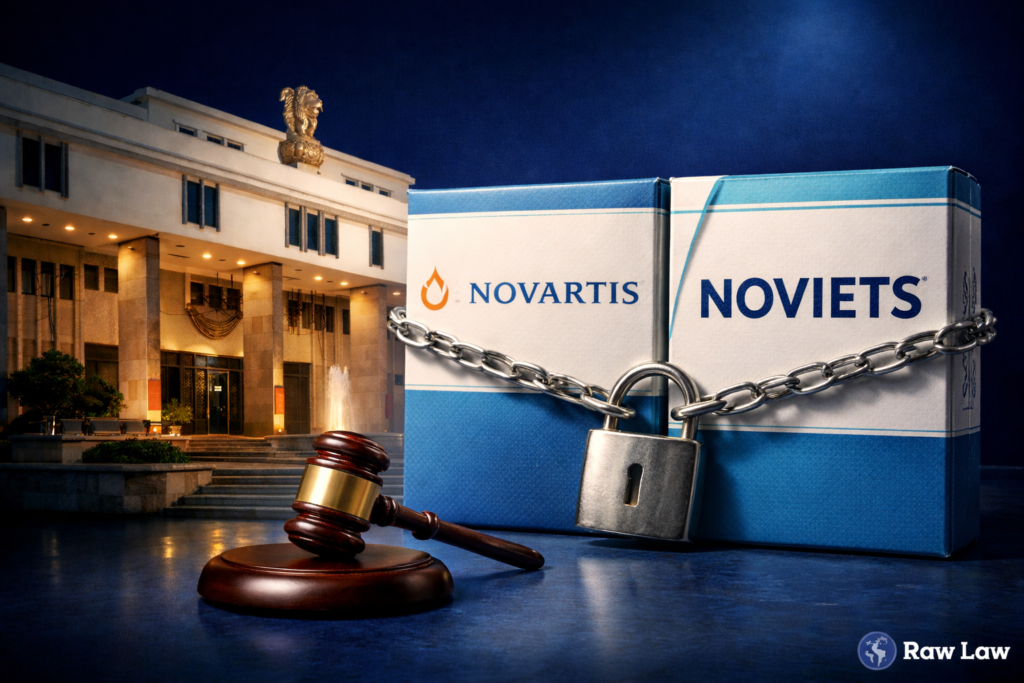
The Delhi High Court granted a sweeping interim injunction in favour of Novartis AG and its group entities, restraining Noviets Pharma and allied entities from using the marks “NOVIETS” and its device mark for pharmaceutical and veterinary products.
Justice Tejas Karia held that the impugned marks are visually, structurally and phonetically deceptively similar to the well-known mark “NOVARTIS”. The Court found a clear case of infringement, passing off and dishonest adoption, observing that this was a case of “triple identity” — identical marks, identical goods, and identical trade channels. The defendants were restrained from using the impugned marks as trade mark or trade name .
Facts
The plaintiffs form part of the global Novartis Group, present in India since 1947. The house mark “NOVARTIS” was adopted in 1996 and registered in India in Class 05 the same year. The registration details, as reproduced on page 3 of the judgment, confirm long-standing statutory protection.
The annual turnover figures placed on record (page 4) show consistent and substantial sales in India, including ₹3,672 million for FY 2022–23, evidencing formidable goodwill.
In January 2024, the plaintiffs discovered pharmaceutical products marketed under the mark “NOVIETS” on the IndiaMart platform. Earlier, in 2020, the defendants had filed a trademark application for “NOVIETS” in Class 05, which was later abandoned. Despite cease-and-desist notices, the defendants continued use.
Issues
The Court considered:
- Whether Delhi courts had territorial jurisdiction based on the defendants’ IndiaMart listing.
- Whether “NOVIETS” is deceptively similar to “NOVARTIS”.
- Whether use as a trade name constitutes infringement.
- Whether the prefix “NOV” is generic or common to trade.
- Whether interim injunction was warranted under settled principles of trademark law.
Plaintiffs’ arguments
The plaintiffs argued that “NOVARTIS” is a globally reputed pharmaceutical house mark with extensive registrations and decades of use. They contended that “NOVIETS” is a calculated imitation, achieved by replacing “AR” with “IE” and removing the final “I”.
It was submitted that the goods are identical — pharmaceutical and veterinary products — and confusion in this sector must be assessed with stricter scrutiny, relying on the Supreme Court’s ruling in Cadila Healthcare.
The plaintiffs further argued that trademark registration of the defendant’s device mark does not defeat infringement claims, particularly under Section 124(5) of the Trade Marks Act. They also invoked the doctrine of initial interest confusion.
Defendants’ arguments
The defendants contended that they are small-scale enterprises operating offline in Bihar and that no cause of action arose in Delhi. They described their IndiaMart listing as passive and non-interactive.
On merits, they argued that “NOV” is common in the pharmaceutical industry and derived from “nova” or “new.” They claimed bona fide adoption and asserted that “NOVIETS” was used merely as a trade name and not as a product brand.
They also alleged forum shopping and undervaluation of the suit to invoke Delhi’s jurisdiction.
Analysis of the law
On jurisdiction, the Court applied the demurrer principle, holding that at the preliminary stage, pleaded facts must be assumed true. The IndiaMart listing displaying Delhi as a place of business and providing a “Contact Us” interface prima facie conferred territorial jurisdiction.
On deceptive similarity, the Court applied the settled tests in Amritdhara, Corn Products, and Ruston & Hornsby. It emphasized that in pharmaceutical disputes, the threshold for confusion is lower given public health implications.
The Court rejected the “common to trade” defence, noting that the defendants themselves had sought registration of “NOVIETS” and could not approbate and reprobate.
Precedent analysis
The Court relied on landmark precedents including:
• Cadila Healthcare Ltd. v. Cadila Pharmaceuticals Ltd. – Stricter approach in pharmaceutical trademark disputes.
• Midas Hygiene Industries Pvt. Ltd. v. Sudhir Bhatia – Injunction must ordinarily follow in infringement cases.
• Lakshmikant Patel v. Chetanbhai Shah – Passing off protects goodwill against misrepresentation.
• Indian Performing Right Society Ltd. v. Sanjay Dalia – Forum shopping principles (distinguished at interim stage).
The Court also applied the dominant feature test and initial interest confusion doctrine.
Court’s reasoning
The Bench found that “NOVIETS” and “NOVARTIS” are phonetically close, especially in a multilingual country where slurring is common. Minor alphabetic substitutions do not eliminate deceptive similarity.
The dominant feature “NOV” was held to be identical in both marks, and the defendants’ explanation of independent adoption was found unconvincing.
The Court noted that the defendants operate in identical goods, identical trade channels and target identical consumers. This constituted “triple identity.”
Use as a trade name was also held actionable, as infringement may occur even where the mark is used as part of a business name in relation to identical goods.
Conclusion
The Delhi High Court granted interim injunction restraining the defendants, their associates and agents from using “NOVIETS” or any deceptively similar mark in relation to pharmaceutical and veterinary products.
The application under Order XXXIX Rules 1 and 2 CPC was allowed, and the defendants were restrained nationwide from infringing or passing off the plaintiffs’ marks .
Implications
This ruling reinforces key trademark principles:
• Pharmaceutical marks receive heightened protection.
• Trade name use can amount to infringement.
• Minor spelling changes do not negate deceptive similarity.
• Online listings can confer territorial jurisdiction.
• “Common to trade” defence fails without proof of widespread use.
The judgment underscores India’s strong judicial stance against brand dilution and imitation in the healthcare sector.
Case law references
- Cadila Healthcare Ltd. v. Cadila Pharmaceuticals Ltd. (2001) – Mandated stricter scrutiny in medicinal trademark disputes.
- Midas Hygiene Industries Pvt. Ltd. v. Sudhir Bhatia (2004) – Injunction must follow in cases of clear infringement.
- Lakshmikant Patel v. Chetanbhai Shah (2002) – Defined elements of passing off.
- Indian Performing Right Society Ltd. v. Sanjay Dalia (2015) – Limited misuse of additional forum provisions.
- Amritdhara Pharmacy v. Satya Deo Gupta (1963) – Laid down test for deceptive similarity.
FAQs
1. Can a company be restrained from using a mark as a trade name?
Yes. If the trade name is deceptively similar to a registered trademark and used for identical goods, courts can restrain such use.
2. Is minor spelling difference enough to avoid trademark infringement?
No. Courts assess overall phonetic, visual and structural similarity. Minor changes do not prevent confusion.
3. Do online listings create territorial jurisdiction?
Yes. If a defendant purposefully avails the forum through interactive online listings, courts may assume jurisdiction at the interim stage.


