

1. Court’s decision
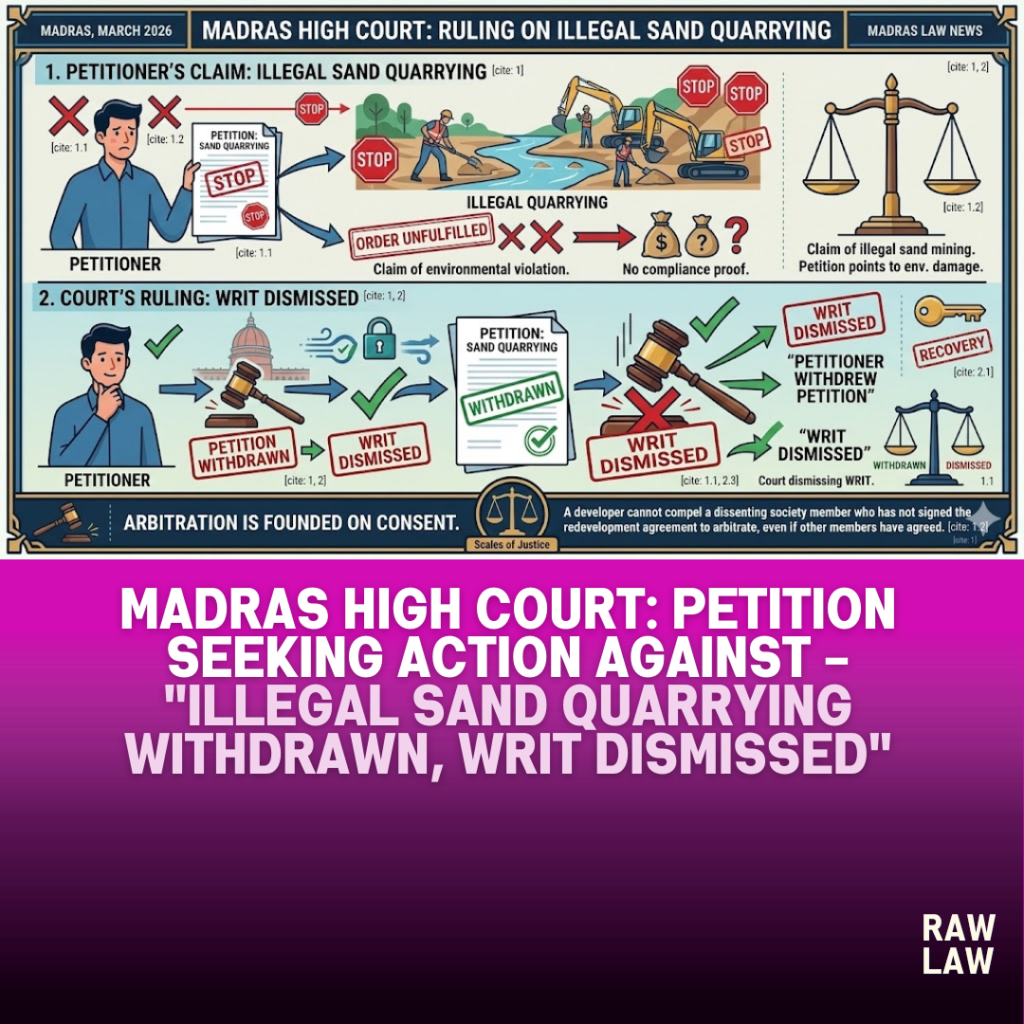
A Division Bench of the Madras High Court dismissed a writ petition concerning alleged illegal sand quarrying in a lake in Thiruvallur district after the petitioner sought permission to withdraw the case.
The Court recorded the submission made by counsel for the petitioner seeking leave to withdraw the petition. Accepting the request, the Bench dismissed the petition as withdrawn and declined to pass any further orders.
The Court also clarified that there would be no order as to costs.
2. Facts
The petitioner, a resident of Vidaiyur Village in Thiruvallur district, approached the High Court alleging that illegal sand quarrying was taking place in a lake located in Survey No.243 of the village.
According to the petitioner, the quarrying activity was unlawful and required immediate intervention by the district authorities.
Prior to filing the writ petition, the petitioner had submitted a representation dated 2 February 2026 to local administrative authorities seeking action against the alleged quarrying operations.
Since the authorities allegedly failed to respond to the representation, the petitioner approached the High Court seeking a direction to restrain the illegal activity.
3. Issues
The primary issue raised before the Court was whether directions should be issued to district authorities to restrain alleged illegal sand quarrying in the lake area.
Another issue was whether the authorities had failed to act upon the representation submitted by the petitioner requesting administrative intervention.
However, the Court did not adjudicate these issues because the petitioner later sought withdrawal of the petition during the hearing.
4. Petitioner’s arguments
The petitioner initially argued that sand quarrying activities were being carried out illegally in the lake area and that such activities were causing environmental harm and violating statutory regulations governing mineral extraction.
It was contended that despite submitting a formal representation to the district administration requesting intervention, no effective steps had been taken to prevent the quarrying activities.
The petitioner therefore sought a writ directing the authorities to restrain illegal sand mining in the lake and enforce relevant laws governing mineral extraction and environmental protection.
5. Respondent’s arguments
The State authorities were represented by the Additional Government Pleader.
However, the Court did not record detailed arguments from the respondents because the counsel appearing for the petitioner sought permission to withdraw the writ petition at the outset of the hearing.
As a result, the matter did not proceed to substantive adjudication of the allegations or the response of the authorities.
6. Analysis of the law
The Court briefly addressed the procedural aspect of withdrawal of writ petitions under Article 226 of the Constitution of India.
When a petitioner voluntarily seeks withdrawal of a petition, courts generally permit such withdrawal unless there are overriding public interest concerns requiring adjudication.
In this case, since the petitioner’s counsel expressly sought leave to withdraw the case and no request was made for further directions, the Court exercised its discretion to dismiss the petition as withdrawn.
7. Precedent analysis
Indian constitutional courts routinely permit withdrawal of writ petitions when the petitioner decides not to pursue the matter further.
Such withdrawal does not amount to adjudication on merits and does not determine the legality or illegality of the allegations raised in the petition.
Consequently, the dismissal of the present petition does not create any binding determination regarding the alleged quarrying activities.
8. Court’s reasoning
The Court noted the submission made by the petitioner’s counsel requesting permission to withdraw the writ petition.
Since the petitioner no longer wished to pursue the matter, the Court considered it appropriate to allow withdrawal rather than examine the merits of the dispute.
The Court therefore dismissed the petition as withdrawn without issuing any directions to the authorities or examining the factual allegations regarding sand quarrying.
9. Conclusion
The High Court permitted the petitioner to withdraw the writ petition and dismissed the case accordingly.
The Court did not pass any directions regarding the alleged illegal sand quarrying and clarified that there would be no order as to costs.
10. Implications
The judgment illustrates a common procedural outcome in writ litigation where petitioners withdraw their cases before substantive adjudication.
Since the case was dismissed as withdrawn, the Court did not determine the legality of the alleged sand quarrying activities.
The ruling therefore leaves the issue open for future administrative action or fresh litigation if similar allegations are raised again before competent authorities or courts.
Case Law References
- Withdrawal of writ petitions under Article 226: Courts exercising jurisdiction under Article 226 of the Constitution may permit petitioners to withdraw their petitions without deciding the merits of the dispute.
FAQs
1. Can a writ petition be withdrawn after filing in the High Court?
Yes. Petitioners may seek permission to withdraw a writ petition, and courts generally allow such withdrawal if there are no overriding public interest concerns.
2. Does dismissal of a writ petition as withdrawn mean the court decided the case?
No. When a petition is dismissed as withdrawn, the court does not examine or decide the merits of the allegations.
3. Can the issue be raised again after a petition is withdrawn?
In many cases, yes. Since the merits are not adjudicated, the issue may be raised again through fresh legal proceedings or administrative complaints.


