

Court’s Decision
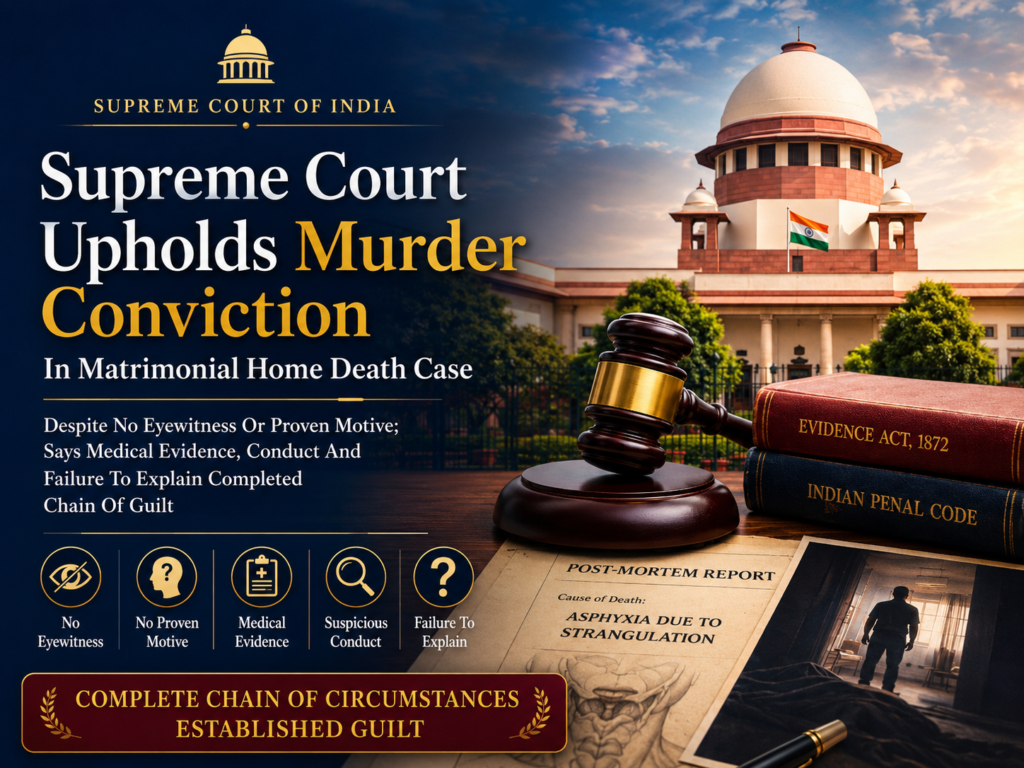
The Supreme Court dismissed the criminal appeal and upheld the conviction and sentence imposed upon the appellant-husband under Sections 302 and 201 of the Indian Penal Code, as affirmed by the Bombay High Court. The Court held that the prosecution had successfully established a complete chain of circumstances pointing towards guilt and found no perversity, illegality, or miscarriage of justice in the concurrent findings of the Trial Court and High Court.
The Court observed:
“The prosecution has successfully established a complete and unbroken chain of circumstances which unerringly points towards the guilt of the appellant and is wholly inconsistent with any hypothesis of innocence.”
The Court, however, granted liberty to the appellant to submit an application for premature release as per the applicable State policy.
Facts
The deceased-wife was living in her matrimonial home with her husband and in-laws. She had earlier suffered an intrauterine foetal death and later gave birth to a male child, who was around six months old at the time of the incident.
On the date of the incident, the deceased’s father was informed that she had died. Initially, information was given that she had allegedly attempted suicide by hanging. The deceased was first taken to one private clinic, where the doctor found her dead and advised that she be taken to a civil hospital. Despite this, she was taken to another private hospital before being taken to the rural hospital.
When the deceased’s family saw the body, they noticed a fresh injury mark on her cheek and a ligature mark on her neck. They also noticed that certain ornaments normally worn by her, including an earring, anklet and toe rings, were missing. The prosecution relied heavily on these circumstances to argue that it was not a case of suicide but homicidal strangulation.
The Trial Court convicted the appellant and one co-accused under Section 302 read with Section 34 IPC, while acquitting all accused of charges under Sections 498-A and 304-B IPC. In appeal, the High Court acquitted the co-accused of murder but upheld the conviction of the appellant-husband, finding that the death was homicidal and not suicidal.
Issues
The principal issue before the Supreme Court was whether the Trial Court and High Court were right in convicting the appellant under Section 302 IPC on the basis of circumstantial evidence.
The Court also considered whether the alleged suicide note, absence of eyewitnesses, absence of proved motive, and alleged inconsistency in medical evidence were sufficient to create reasonable doubt in favour of the appellant.
Appellant’s Arguments
The appellant argued that there was no eyewitness to the incident and that the prosecution had failed to establish motive, intention, or common intention to commit murder. It was further contended that the medical evidence was inconsistent, as one view suggested hanging while another suggested strangulation.
The appellant also relied upon an alleged suicide note, which according to him was confirmed by the handwriting expert to be in the handwriting of the deceased. On this basis, it was argued that the deceased had taken responsibility for her own death and that the appellant was entitled to benefit of doubt.
Respondent’s Arguments
The State argued that both the Trial Court and High Court had carefully appreciated the evidence and had concurrently found the appellant guilty. It was submitted that such concurrent findings should not be interfered with in an appeal under Article 136 of the Constitution.
The State further argued that the post-mortem findings, including fracture of the hyoid bone/trachea and asphyxia, supported death by strangulation and not suicide. The State also relied on the fact that the death occurred inside the matrimonial home, thereby placing a burden on the appellant to explain the circumstances under Section 106 of the Evidence Act.
Analysis of Law
The Supreme Court reiterated that in an appeal under Article 136, it does not normally re-appreciate evidence where there are concurrent findings of fact by the Trial Court and the High Court. Interference is warranted only in rare cases involving manifest illegality, serious miscarriage of justice, or misreading/ignoring of material evidence.
On circumstantial evidence, the Court relied upon the settled principles in Sharad Birdhichand Sarda v. State of Maharashtra, where the Court laid down the “five golden principles” or “panchsheel” for sustaining conviction on circumstantial evidence. The Court reiterated that the chain must be complete, conclusive, consistent only with guilt, and must exclude every reasonable hypothesis of innocence.
The Court also relied on Section 106 of the Evidence Act, holding that when facts are especially within the knowledge of the accused, and the prosecution has established foundational circumstances, failure to offer a reasonable explanation may become an additional link in the chain of circumstances.
Precedent Analysis
1. Mekala Sivaiah v. State of Andhra Pradesh
The Court relied on this judgment to explain the limited scope of interference under Article 136. The Court noted that re-appreciation of evidence is not normally undertaken unless there is grave miscarriage of justice, misreading of evidence, or ignoring of material evidence.
2. Sharad Birdhichand Sarda v. State of Maharashtra
This judgment was relied upon for the principles governing circumstantial evidence. The Supreme Court applied the five golden principles and held that the circumstances in the present case formed a complete chain pointing only towards the guilt of the appellant.
3. Nagendra Sah v. State of Bihar
The Court relied on this decision to explain Section 106 of the Evidence Act. It observed that where certain facts are within the special knowledge of the accused and the accused fails to explain them, such failure may provide an additional link in the chain of circumstances.
4. Mulakh Raj v. Satish Kumar
The Court relied on this judgment to hold that failure to prove motive is not fatal when the facts and circumstances otherwise clearly connect the accused with the crime. The Court quoted the principle that “proof of motive is never an indispensable for conviction.”
Court’s Reasoning
The Supreme Court found that the deceased had died an unnatural death inside the matrimonial home. The prosecution’s case was that death was caused by strangulation. The Court noted that both the Trial Court and High Court had relied on the medical evidence and surrounding circumstances to conclude that the death was homicidal.
The Court found the missing ornaments to be an important circumstance. It noted that in a case of hanging, the chance of missing such articles was remote, whereas their absence supported the prosecution case of strangulation. The fresh injury on the cheek, along with the ligature mark, further supported the prosecution case.
The medical evidence recorded fracture of the hyoid bone and trachea, congestion of lungs, and the probable cause of death as:
“asphyxia due to strangulation”
The Court also found the conduct of the appellant suspicious. Even after the deceased was declared dead at the first clinic and the doctor advised that the body be taken to the civil hospital, the body was taken to another private hospital. The appellant failed to provide any satisfactory explanation for this conduct or for the injuries found on the deceased’s body.
On the alleged suicide note, the Court noted that the Trial Court had considered the handwriting expert’s opinion and found that the so-called chit had been forcibly written before the strangulation. Therefore, the suicide theory was rejected.
The Court held that the suspicious death occurred inside the matrimonial home, and the relevant facts were within the special knowledge of the appellant-husband. Since he failed to give a plausible explanation, the burden under Section 106 of the Evidence Act was not discharged.
Conclusion
The Supreme Court held that the prosecution had proved a complete and unbroken chain of circumstances against the appellant. The medical evidence, the deceased’s death inside the matrimonial home, the appellant’s conduct after the incident, the false defence based on the alleged suicide note, and failure to explain the circumstances under Section 106 of the Evidence Act cumulatively established guilt.
The appeal was dismissed, and the conviction and sentence under Sections 302 and 201 IPC were upheld.
The Court concluded:
“We find no perversity, illegality, or miscarriage of justice in the appreciation of evidence by the learned Trial Court, as affirmed by the High Court, warranting interference by this Court in exercise of jurisdiction under Article 136 of the Constitution of India.”
Key Takeaway
The Supreme Court reaffirmed that even in the absence of eyewitnesses or proved motive, conviction can be sustained on circumstantial evidence when the chain is complete, medical evidence supports homicide, and the accused fails to explain facts specially within his knowledge under Section 106 of the Evidence Act.

