

HEADNOTE
Nisha Khan v. Delhi Police & Anr.
Court: High Court of Delhi
Bench: Justice Navin Chawla and Justice Madhu Jain
Date of Judgment: 12 December 2025
Citation: W.P.(C) 12698/2023
Laws / Sections Involved: Articles 14, 16, 226 Constitution of India; Administrative Tribunals Act, 1985
Keywords: Delhi Police recruitment, clerical error application form, height relaxation, police ward quota, judicial review recruitment
Summary:
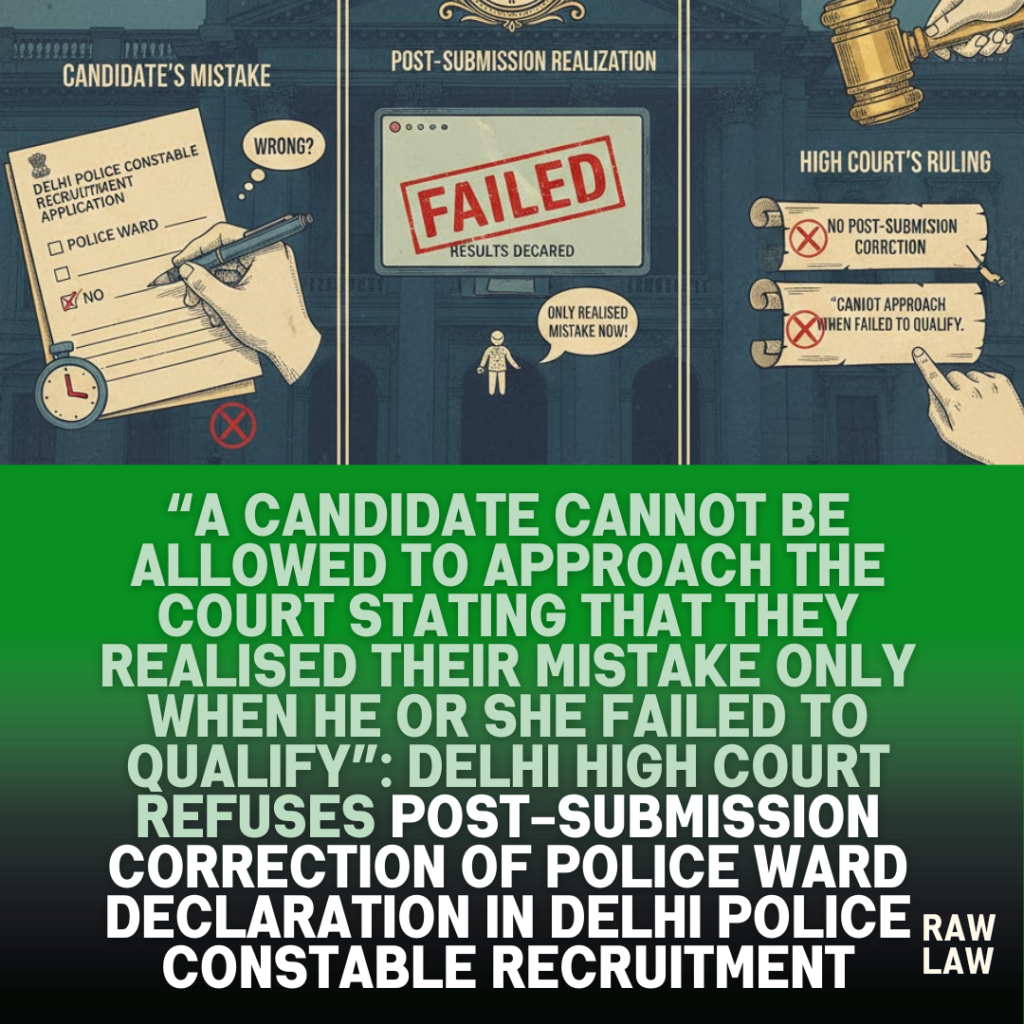
The Delhi High Court dismissed a writ petition filed by a woman candidate challenging her disqualification from the Delhi Police Constable (Executive) recruitment process due to incorrect entries in her online application form. The petitioner sought correction of entries relating to her status as a ward of a police personnel to avail height relaxation. Upholding the Central Administrative Tribunal’s decision, the Court held that eligibility-related declarations in recruitment forms cannot be corrected after submission, even if the error is claimed to be bona fide. Emphasising that courts cannot rewrite recruitment conditions or permit post-selection corrections that affect eligibility, the Court ruled that allowing such relief would disturb equality among candidates and undermine the sanctity of recruitment processes.
Court’s decision
The Delhi High Court dismissed the writ petition and upheld the order passed by the Central Administrative Tribunal rejecting the petitioner’s claim for correction of entries in her online application form. The Court held that the petitioner was not entitled to seek post-submission correction of her declaration regarding police ward status, as the recruitment rules and examination notice clearly prohibited any modification after submission. The Court concluded that permitting such corrections would amount to judicial interference in recruitment policy and would be unfair to other candidates who were similarly bound by the application conditions.
Facts
The Staff Selection Commission invited applications in August 2020 for recruitment to the post of Constable (Executive) Male/Female in Delhi Police. The petitioner submitted her online application on 6 September 2020. While filling the form at a cyber café, she mistakenly marked herself as a departmental candidate and simultaneously marked ‘No’ in the column indicating whether she was the daughter of a serving police personnel. In reality, her father was serving as an Assistant Sub Inspector in Delhi Police. After qualifying the written examination and the Physical Endurance and Measurement Test, she was initially granted height relaxation based on documents produced, but was later disqualified once the discrepancy in her online application was noticed.
Issues
The core issue before the Court was whether a candidate could be permitted to correct eligibility-related declarations in an online recruitment application after submission, on the ground that the error was bona fide and clerical. The Court also examined whether such correction could be allowed after the candidate had participated in subsequent stages of the recruitment process and failed to meet the physical standards without the claimed relaxation.
Petitioner’s arguments
The petitioner argued that the incorrect entries were minor clerical mistakes caused by network issues and reliance on cyber café assistance. She submitted that she had produced all supporting documents during the physical test, including her father’s service certificate, and was initially declared qualified. Relying on Supreme Court and Delhi High Court precedents, she contended that trivial errors should not result in denial of appointment, especially when no fraud or misrepresentation was involved and her eligibility as a police ward was otherwise undisputed.
Respondent’s arguments
The respondents contended that the recruitment notice explicitly barred any correction or modification after submission of the online application. They emphasised that the onus was entirely on the candidate to verify all details before final submission. It was argued that allowing post-submission corrections would open floodgates of similar claims, disrupt recruitment processes, and violate equality among candidates. The respondents relied on Supreme Court precedent holding that courts cannot reinterpret recruitment conditions or grant equitable relief contrary to clear rules.
Analysis of the law
The Court analysed the scope of judicial review in recruitment matters and reiterated that courts cannot dilute or rewrite eligibility conditions prescribed in recruitment notifications. It emphasised that online application systems function on self-declaration, and any deviation from declared particulars after submission would compromise transparency and fairness. The Court distinguished between trivial typographical errors and errors that go to the root of eligibility, holding that declarations affecting relaxation or qualification standards fall in the latter category.
Precedent analysis
The Court relied on the Supreme Court’s decisions in Maharashtra Public Service Commission v. Sandeep Shriram Warade and Mohit Kumar v. State of Uttar Pradesh, which held that recruitment authorities are the best judges of their requirements and that courts should not interfere where rules are clear. It distinguished cases like Vashist Narayan Kumar and Ajay Kumar Mishra, noting that those involved inconsequential errors unrelated to eligibility, unlike the present case where the incorrect declaration directly impacted the petitioner’s qualification.
Court’s reasoning
The Bench observed that the petitioner sought correction only after being disqualified, which amounted to taking a calculated chance in the recruitment process. The Court held that permitting correction at such a stage would prejudice other candidates who may have been excluded for similar mistakes. It further observed that the recruitment authority could not be faulted for strictly enforcing the application conditions, and judicial sympathy could not override explicit prohibitions in the recruitment notice.
Conclusion
The Delhi High Court concluded that the petitioner’s claim lacked merit and dismissed the writ petition. The Court upheld the Tribunal’s order and affirmed that no correction of eligibility-related declarations could be allowed after submission of the online application. No costs were imposed.
Implications
This judgment reinforces strict compliance with recruitment notifications and underscores that candidates bear full responsibility for accuracy in online applications. It sends a clear signal that courts will not grant equitable relief for post-submission corrections affecting eligibility, thereby preserving certainty, equality, and administrative efficiency in large-scale recruitment processes.
CASE LAW REFERENCES
• Maharashtra Public Service Commission v. Sandeep Shriram Warade – Courts cannot rewrite recruitment conditions
• Mohit Kumar v. State of Uttar Pradesh – Recruiting authority’s interpretation prevails
• Pooja Devi v. SSC – No post-submission correction for police ward height relaxation
• Vashist Narayan Kumar v. State of Bihar – Trivial errors distinguished from eligibility defects
FAQs
Q1. Can errors in online recruitment forms be corrected later?
No, if the recruitment notice bars post-submission corrections, especially for eligibility-related declarations.
Q2. Is height relaxation for police wards automatic?
No, it must be claimed correctly in the application form; documents alone are insufficient.
Q3. Will courts grant relief for bona fide clerical mistakes?
Only for trivial errors not affecting eligibility; fundamental eligibility defects are not condonable.


