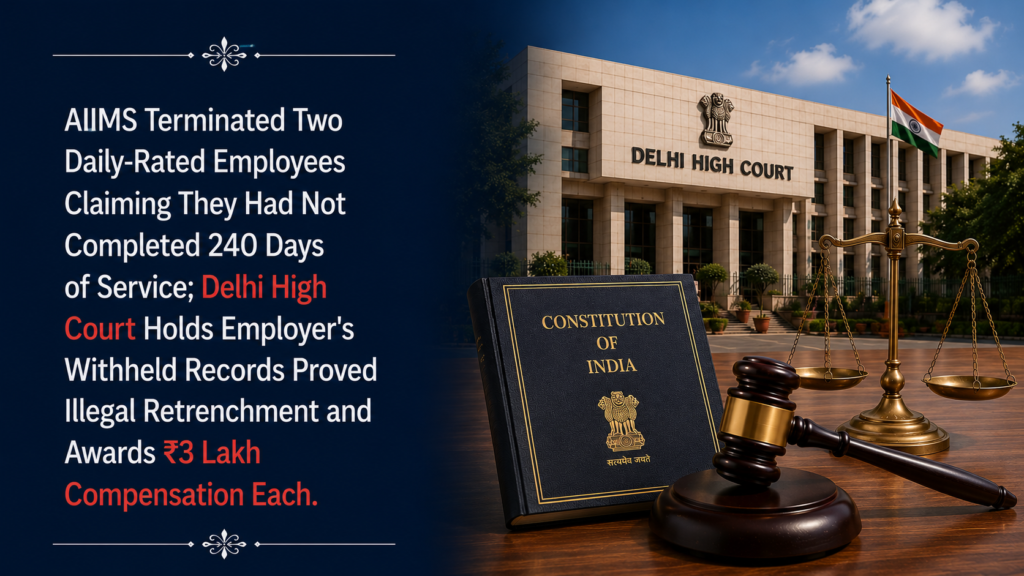
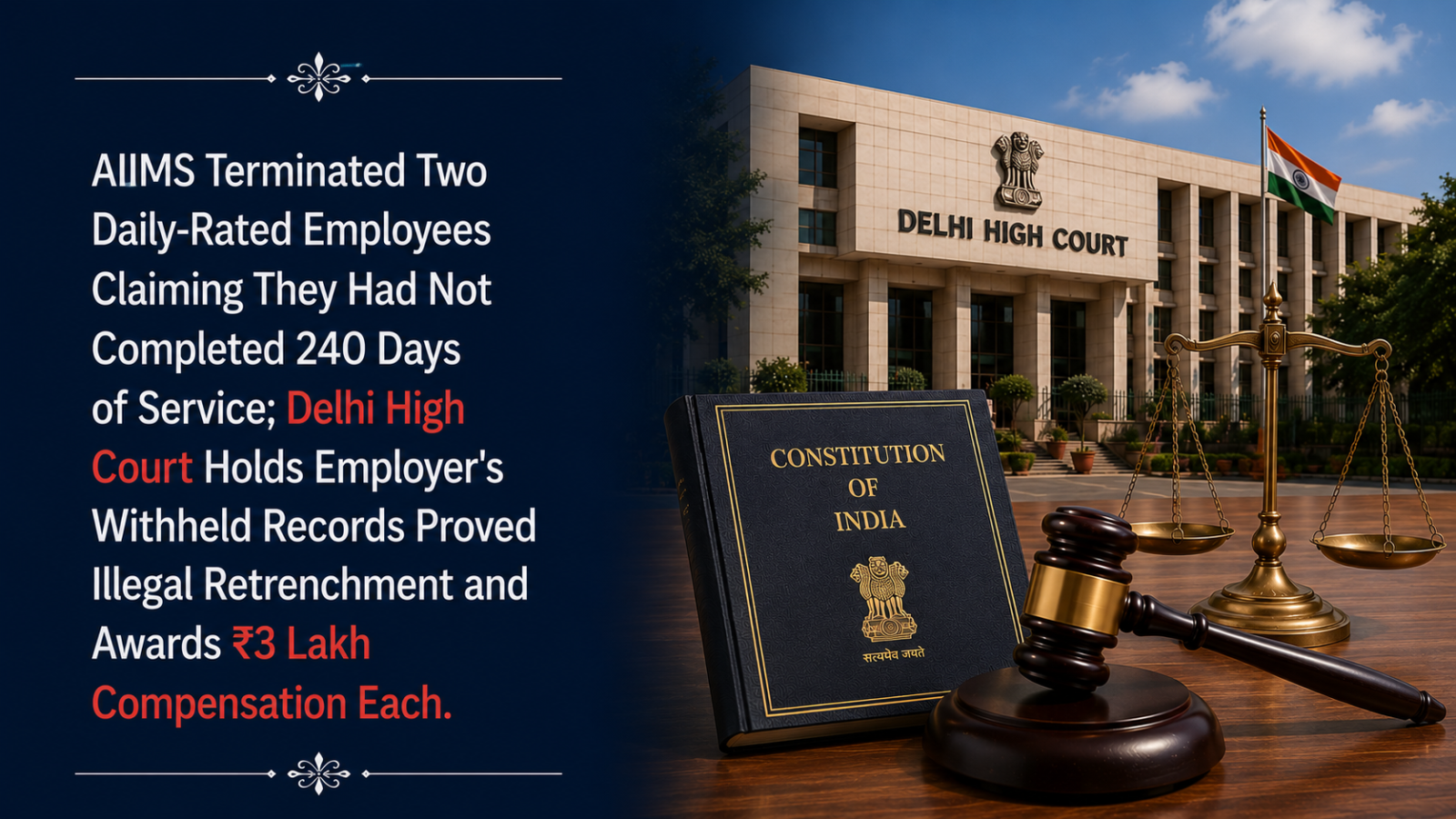
AIIMS Terminated Two Daily-Rated Employees Claiming They Had Not Completed 240 Days of Service; Delhi High Court Holds Employer’s Withheld Records Proved Illegal Retrenchment and Awards ₹3 Lakh Compensation Each.

Workers Issued Notices Seeking Attendance and Wage Records Before Termination Dispute; Delhi High Court Holds AIIMS Failed to Rebut Continuous Service and Awards Compensation.
Facts
These connected writ petitions arose from separate awards passed by the Labour Court rejecting the claims of Amarjit Singh and Ved Prakash, both daily-rated employees engaged by the All India Institute of Medical Sciences (AIIMS). Amarjit Singh worked as a Tractor Driver from November 1993 until his services were orally terminated on June 21, 1995, while Ved Prakash worked as a daily-rated Lift Operator from July 1, 1992 until July 23, 1995. Both alleged that they had worked continuously for more than 240 days during the twelve months preceding their termination but were removed without notice, retrenchment compensation or compliance with Section 25F of the Industrial Disputes Act, 1947.
After conciliation proceedings failed, the disputes were referred to the Labour Court. The workmen sought reinstatement with continuity of service and full back wages, contending that their retrenchment violated Sections 25F and 25G of the Industrial Disputes Act. AIIMS contested the claims, asserting that the petitioners were casual daily-rated employees engaged only when work was available and had failed to establish completion of 240 days of continuous service. The Labour Court accepted AIIMS’ defence and rejected both claims, leading to the present writ petitions.
Issues
The Delhi High Court considered the following principal issues:
- Whether the Labour Court had correctly held that the petitioners failed to establish completion of 240 days of continuous service under Section 25B of the Industrial Disputes Act.
- Whether AIIMS’ failure to produce attendance registers, muster rolls and wage records justified drawing an adverse inference against it.
- Whether the termination of the petitioners violated Section 25F of the Industrial Disputes Act.
- If the retrenchment was illegal, whether reinstatement or monetary compensation was the appropriate relief.
Petitioners’ Arguments
The petitioners argued that although the initial burden of proving 240 days of service rested on them, AIIMS admittedly maintained computerized attendance and wage records and had exclusive custody of those documents. After they entered the witness box, gave evidence on oath and specifically called upon AIIMS to produce the employment records through notices, the evidentiary burden shifted to the employer.
They contended that AIIMS neither produced the records nor replied to their notices and that the Labour Court wrongly assumed that the records had been destroyed despite there being no pleading or evidence to support such a conclusion. They further argued that no meaningful challenge was made to their testimony during cross-examination regarding continuous service and that an adverse inference ought to have been drawn against AIIMS for withholding the best available evidence.
The petitioners relied heavily on R.M. Yellatti v. Assistant Executive Engineer and argued that the Labour Court had ignored the settled law governing proof of continuous service and non-production of employment records. They accordingly sought reinstatement with continuity of service, full back wages and consequential benefits.
Respondents’ Arguments
AIIMS argued that the Labour Court’s awards were well reasoned and did not warrant interference under Articles 226 and 227 of the Constitution.
It submitted that both petitioners were merely casual daily-wage workers engaged depending upon work requirements and not against sanctioned posts. According to AIIMS, the workmen failed to produce documentary evidence proving completion of 240 days of continuous service and could not rely solely upon self-serving affidavits.
The respondent further contended that no adverse inference could be drawn merely because employment records were not produced, especially when the petitioners had not obtained any specific order compelling production. AIIMS also claimed that the records had been destroyed in the ordinary course. It additionally argued that AIIMS was not an “industry” under the Industrial Disputes Act and that, in any event, reinstatement and back wages could not be granted.
Analysis of the Law
The Court first reiterated the limited scope of judicial review over Labour Court awards. While exercising jurisdiction under Articles 226 and 227, the High Court does not act as an appellate court but interferes only where findings suffer from perversity, patent illegality, jurisdictional error, or disregard of material evidence.
The Court then undertook an extensive examination of the distinction between the legal burden of proof and the evidentiary burden. It held that although the legal burden of proving completion of 240 days always remains upon the workman, the evidentiary burden shifts once the workman lays a credible factual foundation and specifically calls upon the employer to produce employment records that remain exclusively in its possession.
The Court observed that in disputes involving daily-rated employees, attendance registers, muster rolls and wage registers ordinarily remain under the employer’s exclusive control. Consequently, once the workman has discharged the initial burden by giving cogent evidence and seeking production of those records, the employer must rebut the claim by producing the best available evidence.
The Court further explained that an adverse inference under Section 114(g) of the Evidence Act becomes relevant where the employer withholds such evidence without justification. However, the adverse inference operates only after the workman has first established the foundational facts through credible evidence.
Precedent Analysis
The Court conducted an extensive survey of Supreme Court jurisprudence.
It relied principally upon R.M. Yellatti v. Assistant Executive Engineer, which harmonised earlier authorities and clarified that while the workman bears the legal burden, the employer’s failure to produce records after being called upon to do so assumes considerable evidentiary significance.
The Court distinguished Range Forest Officer v. S.T. Hadimani, Manager, RBI v. S. Mani, and Municipal Corporation, Faridabad v. Siri Niwas, observing that those decisions merely held that self-serving affidavits alone are insufficient and did not require documentary evidence in every case.
The Court also relied upon Director, Fisheries Terminal Division v. Bhikubhai Meghajibhai Chavda, reaffirming that once the workman establishes the foundational facts, the employer’s failure to produce records may justify drawing an adverse inference.
On the issue of AIIMS being an “industry”, the Court followed Bangalore Water Supply & Sewerage Board v. A. Rajappa and the Delhi High Court decision in AIIMS v. Raj Singh, holding that AIIMS continues to fall within the definition of an “industry” until the Supreme Court overrules the binding precedent.
For relief, the Court relied upon Jagbir Singh v. Haryana State Agriculture Marketing Board, Assistant Engineer, Rajasthan Development Corporation v. Gitam Singh, and BSNL v. Bhurumal, holding that reinstatement is no longer the automatic consequence of every illegal retrenchment and that compensation may be more appropriate in long-delayed cases.
Court’s Reasoning
The High Court found that the petitioners had not merely relied upon pleadings. They entered the witness box, deposed on oath regarding continuous service, withstood cross-examination, identified the relevant attendance and wage records maintained by AIIMS and formally called upon AIIMS to produce those documents through notices.
AIIMS admittedly maintained those records but neither produced them nor furnished any convincing explanation for their absence. The Court found it particularly significant that AIIMS’ own witnesses admitted preparing their affidavits on the basis of employment records which they simultaneously failed to produce before the Labour Court. The witnesses were also unable to explain the factual basis for alleging that the petitioners had not completed 240 days of service.
The Court observed that the Labour Court committed a serious legal error by attaching decisive importance to the absence of documentary evidence from the workmen while ignoring AIIMS’ unexplained failure to produce records exclusively within its custody. It further held that the Labour Court’s finding that the records had been destroyed had no foundation either in the pleadings or in the evidence.
Considering the admissions of AIIMS, the oral evidence of the petitioners, the notices demanding production of records, AIIMS’ failure to produce those records and the inability of its witnesses to substantiate the alleged breaks in service, the Court concluded that the petitioners had successfully established completion of 240 days of continuous service.
Since AIIMS neither complied with Section 25F nor established any statutory exception, the retrenchment was declared illegal. However, considering that the termination had occurred in 1995 and more than thirty years had elapsed, the Court held that reinstatement had become impracticable. Following recent Supreme Court jurisprudence, it awarded each petitioner lump-sum compensation of ₹3,00,000 in lieu of reinstatement, continuity of service and back wages. The Court also rejected the prayer for regularization because no industrial dispute regarding regularization had ever been referred to the Labour Court.
Conclusion
The Delhi High Court allowed both writ petitions and set aside the Labour Court awards. It held that the Labour Court had misapplied the law governing proof of 240 days of continuous service by ignoring AIIMS’ failure to produce employment records exclusively within its possession. The Court concluded that the petitioners had successfully established continuous service and that their retrenchment violated Section 25F of the Industrial Disputes Act.
Instead of directing reinstatement after more than three decades, the Court awarded each petitioner ₹3,00,000 as full and final compensation, payable within eight weeks, with interest at 9% per annum in case of default. The prayer for regularization was rejected as being beyond the scope of the industrial reference.
Case Details
Case: Amarjit Singh v. AIIMS & Anr. (along with Ved Prakash v. AIIMS & Anr.)
Court: Delhi High Court
Case Number: W.P.(C) 18004/2004 and W.P.(C) 18551/2004
Judge: Hon’ble Ms. Justice Shail Jain
Date: July 29, 2026
Result: Writ petitions allowed. Labour Court awards set aside. Retrenchment held illegal. AIIMS directed to pay ₹3,00,000 compensation to each petitioner within eight weeks with 9% interest on default. Prayer for reinstatement and regularization declined.