Allahabad High Court: Refund Cannot Be Denied Merely Because TDS Is Not Reflected in Form 26AS — ‘Assessee Cannot Be Left at the Mercy of Deductors’

Court’s Decision
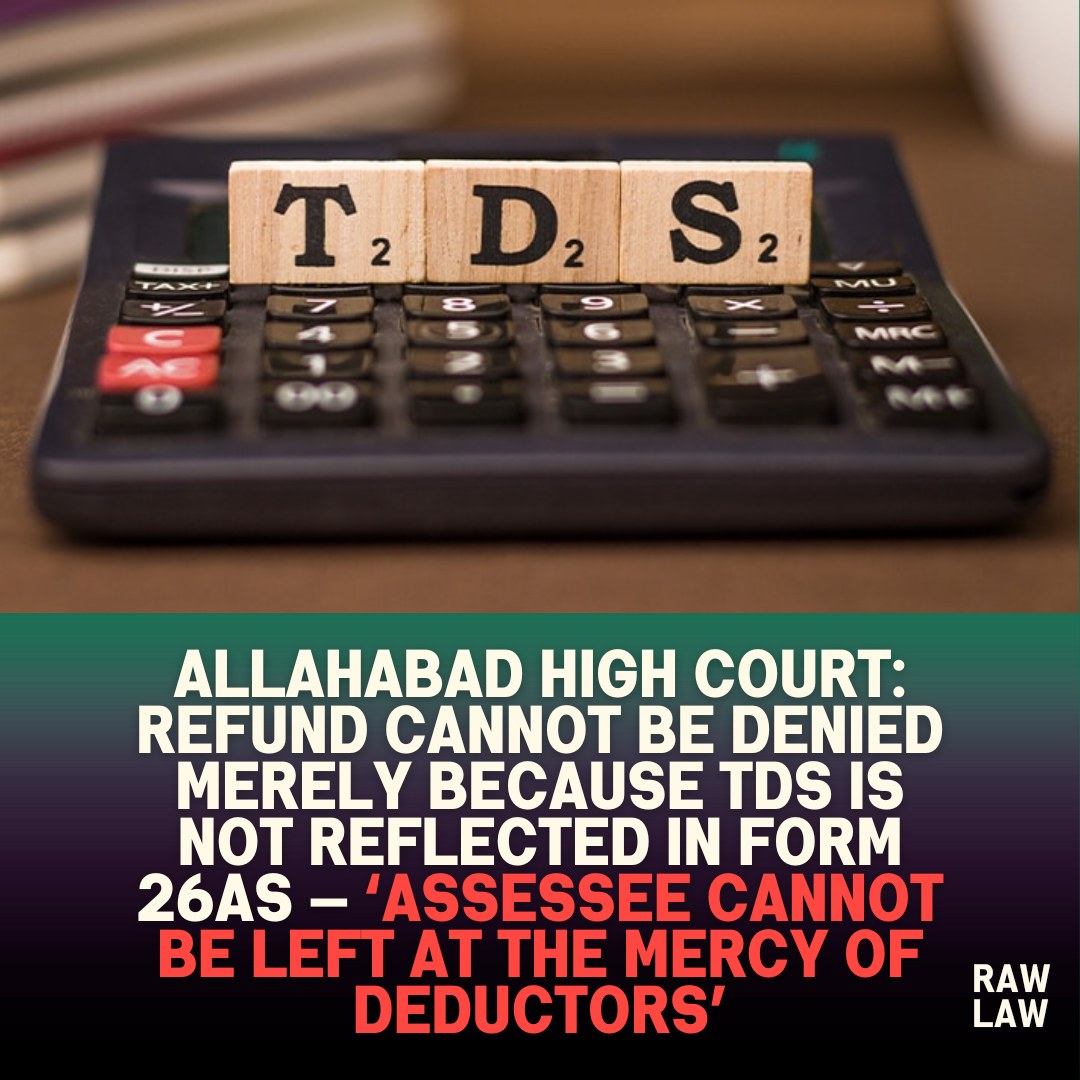
The Allahabad High Court (Lucknow Bench), comprising Justice Shekhar B. Saraf and Justice Prashant Kumar, held that an assessee’s genuine tax refund cannot be withheld merely because the Tax Deducted at Source (TDS) amount is not reflected in Form 26AS, provided the assessee produces TDS certificates (Form 16A) to substantiate the deduction.
The Bench observed that the Income Tax Department must verify the correctness of such certificates and, upon confirmation that the tax has indeed been deposited by the deductor, grant the refund without delay.
In a strongly worded remark, the Court stated:
“A taxpayer should not be left at the mercy of an Assessing Officer who chooses to delay the payment of genuine refunds. As long as the assessee is able to provide documents proving that tax has been deducted at source, the same has to be accepted.”
Accordingly, the Court directed the Assessing Officer to verify the petitioner’s Form 16A certificates and process the refund within four weeks of submission.
Facts
The petitioner, a co-operative society registered under the U.P. Co-operative Societies Act, sought refund of TDS amounts deducted from interest income for Assessment Years 2009–10 to 2012–13 and 2015–16.
The society claimed exemption under Section 80P of the Income Tax Act, 1961, which exempts income of co-operative societies engaged in specific activities. It submitted multiple refund applications along with Form 16A certificates evidencing TDS deductions.
However, the Income Tax Department refused to issue refunds, stating that the deducted amounts were not reflected in Form 26AS, which is generated electronically through data uploaded by the deductor. The Assessing Officer further invoked Section 226(3) of the Income Tax Act to attach the society’s bank account and recover ₹1.5 crore towards alleged tax arrears.
The society challenged the order, arguing that the non-reflection in Form 26AS was not its fault but that of the deductor, who failed to upload details properly.
Issues
- Whether an assessee can be denied TDS credit or refund merely because the amount is not reflected in Form 26AS.
- Whether the Department can recover tax through garnishee proceedings under Section 226(3) despite the assessee having produced valid Form 16A certificates.
- Whether the Assessing Officer has a statutory duty to verify the correctness of TDS claims through available departmental mechanisms.
Petitioner’s Arguments
Senior Advocate D.D. Chopra, appearing for the petitioner, argued that the TDS deductions were made and evidenced by Form 16A certificates, which were duly furnished to the Income Tax Department. The petitioner contended that the failure of deductors to upload TDS details in the centralized system should not prejudice the assessee, who has already borne the tax.
It was submitted that the petitioner, being a co-operative society eligible for exemption under Section 80P, was entitled to a refund of the entire TDS amount. The Department’s insistence on the Form 26AS match, despite submission of original certificates, was arbitrary and contrary to settled law.
Reliance was placed on the Delhi High Court’s judgment in Court on Its Motion v. Commissioner of Income Tax (2013), and on the Allahabad High Court’s earlier decision in Rakesh Kumar Gupta v. Union of India (2014), where it was held that the Assessing Officer is duty-bound to verify the deductor’s payments and grant credit even in case of mismatch.
Respondent’s Arguments
The Revenue defended its position, stating that Form 26AS is the official record for granting TDS credit and refunds. It contended that the system does not permit processing refunds where entries are not reflected in the centralized database. The Department argued that it could not be expected to manually verify each TDS certificate, as such responsibility lay with the deductor to correctly upload data.
The respondents further justified the attachment of the petitioner’s bank account under Section 226(3), claiming that it was a statutory recovery mechanism in response to outstanding demands reflected in the system.
Analysis of the Law
The Court conducted a detailed examination of Sections 199 and 205 of the Income Tax Act, which govern credit for TDS and the prohibition on double taxation.
It relied on the Delhi High Court’s decision in Court on Its Motion (2013), which held that the Assessing Officer must verify TDS claims when the assessee furnishes valid certificates, and that a mismatch in Form 26AS cannot justify denial of credit. The Delhi High Court had observed that the statutory powers of the Assessing Officer are “sufficient and should be resorted to,” and that an assessee “cannot be left to the mercy or sweet will of deductors.”
The Bench also referred to its own precedent in Rakesh Kumar Gupta v. Union of India (2014), where the Allahabad High Court directed refund of mismatched TDS amounts, holding that the fault of the deductor cannot be visited upon the assessee. The Court in that case also awarded interest on delayed refund due to departmental delay.
Additionally, the Bench noted that the Central Board of Direct Taxes (CBDT) had issued Instruction No. 05/2013 dated 8 July 2013, which expressly mandates Assessing Officers to verify TDS certificates manually and grant credit if the deductor has deposited tax in the government account, irrespective of mismatch in Form 26AS.
The circular, in compliance with the Delhi High Court’s ruling, clarifies that the Assessing Officer can obtain confirmation from the TDS Circle or issue notice to the deductor to ensure accuracy.
Precedent Analysis
- Court on Its Motion v. Commissioner of Income Tax (Delhi High Court, 2013) — The Court directed that in cases of TDS mismatch, the Assessing Officer must verify from the deductor and grant credit if tax is deposited, as “the assessee cannot be punished for the fault of the deductor.”
- Rakesh Kumar Gupta v. Union of India (Allahabad High Court, 2014) — Held that delay or denial of refund due to TDS mismatch is illegal when the mismatch is not attributable to the assessee; refund must be granted with interest.
- CBDT Instruction No. 05/2013 (8 July 2013) — Directed Assessing Officers to manually verify TDS claims with the deductor or AO(TDS) and grant refund upon confirmation of payment into the government account.
Court’s Reasoning
The Division Bench held that the Revenue’s refusal to issue refund solely on the ground of Form 26AS mismatch was unjustified. It emphasized that the Income Tax Department possesses the machinery and authority to verify TDS payments and cannot shirk this responsibility by blaming technical system limitations.
The Court observed:
“As long as the assessee provides proof through Form 16A that tax has been deducted at source, the Assessing Officer cannot insist on a match with Form 26AS. It is his duty to verify the same and ensure that genuine refunds are not delayed.”
The Bench further remarked that the CBDT’s own instructions reinforce this position, leaving no room for discretionary refusal by tax authorities.
Accordingly, the Court directed the petitioner to appear before the Assessing Officer on 28 October 2025 at 11:00 AM with relevant documents, and ordered that the officer pass necessary orders within four weeks thereafter.
Conclusion
The High Court disposed of the petition with the following key directions:
- The petitioner shall appear before the Assessing Officer with all relevant Form 16A certificates.
- The Assessing Officer must verify the documents and process the refund within four weeks.
- The petitioner may rely on the judgments of the Delhi and Allahabad High Courts and the CBDT circular before the authority.
In closing, the Bench reiterated:
“The taxpayer cannot be left helpless merely due to technical deficiencies in Form 26AS. The Assessing Officer must act to ensure justice and fairness in taxation.”
Implications
This judgment is a landmark reinforcement of taxpayer rights, clarifying that TDS credit and refund cannot be denied due to mismatched entries in Form 26AS.
It strengthens judicial and administrative accountability by reaffirming:
- The Assessing Officer’s duty to manually verify genuine TDS claims.
- The CBDT’s obligation to ensure uniform implementation of its own circulars.
- The principle that no taxpayer should suffer for the negligence or default of the deductor.
The decision sets a binding precedent for future refund disputes involving TDS mismatches, promoting fairness and transparency in the income tax system.