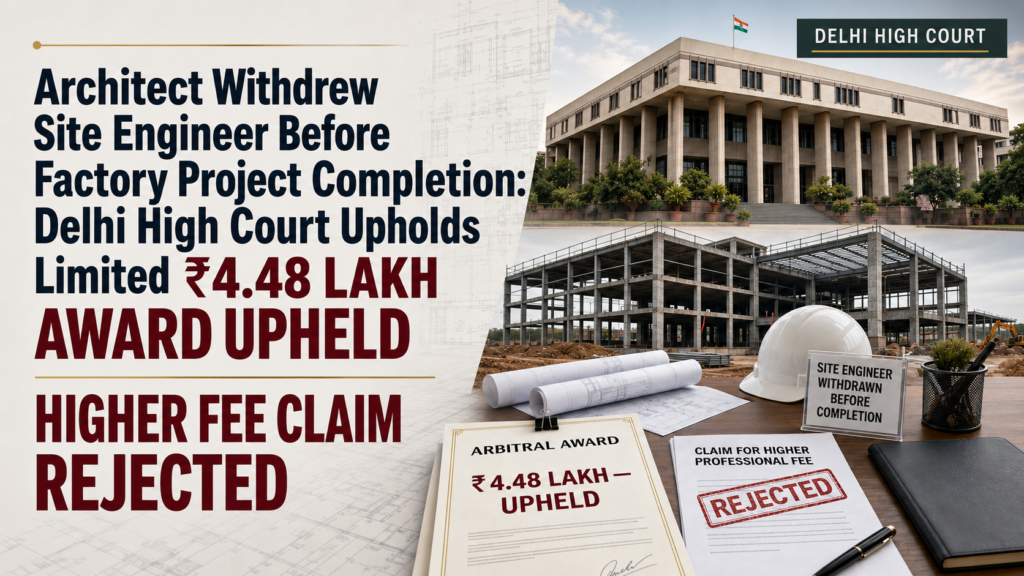
Architect Withdrew Site Engineer Before Factory Project Completion: Delhi High Court Upholds Limited ₹4.48 Lakh Arbitral Award and Rejects Higher Fee Claim

Consultant Claimed Full Fees Despite Incomplete Noida Factory Project: Delhi High Court Refuses to Set Aside ₹4.48 Lakh Arbitration Award
Facts
SMC Pneumatics (India) Private Limited engaged SDB Consultants Private Limited to provide architectural, engineering, project-management and consultancy services for the construction of a factory and office at Sector 84, Noida.
The parties executed an agreement dated 23 August 2012. The total consultancy fee was fixed at ₹31 lakh and was payable in stages linked to the progress and completion of the project. Under Clause 10, SDB Consultants’ duties were to continue until 12 months after completion of the project, as evidenced by a completion certificate issued by the competent authority.
SMC Pneumatics subsequently appointed Rohan Builders (India) Private Limited as the construction contractor. Its construction agreement contemplated completion by 31 August 2013. During construction, several drawings and designs were changed, including relocation of a proposed guest room. SDB Consultants prepared revised drawings in response to these changes.
The contractor delayed the construction, and SMC Pneumatics reportedly imposed approximately ₹55 lakh as liquidated damages upon it. The project was still incomplete when SDB Consultants withdrew its site engineer around 7 June 2014.
Before withdrawing from the site, SDB Consultants raised an invoice dated 4 April 2014 for ₹17,41,580, asserting that its entire work had been completed and that 100% of the ₹31 lakh contractual fee had become payable. However, another bill dated 11 April 2014 claimed fees only for the first four stages under the agreement.
SDB Consultants also raised a supplementary invoice dated 1 June 2014 for ₹60,67,440. This included charges for redesigning the scheme, providing multiple alternatives, revising drawings and supervising and managing the project beyond the alleged agreed completion date.
After its invoices remained unpaid, SDB Consultants invoked arbitration on 20 June 2014. It claimed ₹84,91,827 with interest, while SMC Pneumatics raised counterclaims totalling ₹6,23,67,500.
The sole arbitrator dismissed all the counterclaims of SMC Pneumatics and partly allowed SDB Consultants’ claims. The consultant was awarded ₹4,48,316, comprising ₹3,48,316 for the completed contractual stages and ₹1 lakh for additional work caused by design deviations, together with interest at 18% per annum.
SDB Consultants challenged the limited award before the Delhi High Court under Section 34 of the Arbitration and Conciliation Act, 1996, seeking recognition of its larger claims.
Issues
- Whether the consultancy agreement prescribed a six-month period for completion of the project.
- Whether SDB Consultants had completed the project in accordance with Clause 10 of the agreement.
- Whether SDB Consultants was entitled to the full balance claimed under its invoice dated 4 April 2014.
- Whether it was entitled to ₹60,67,440 under the supplementary invoice for revised designs and prolonged supervision and project management.
- Whether the arbitrator ignored material evidence, including the deduction and deposit of Tax Deducted at Source by SMC Pneumatics.
- Whether the award was contrary to Indian public policy or suffered from patent illegality under Sections 34(2) and 34(2A) of the Arbitration and Conciliation Act.
- Whether the High Court could reassess the contractual interpretation and evidence examined by the arbitrator.
Petitioner’s Arguments
SDB Consultants contended that the project was contractually expected to be completed within six months, following which the 12-month defect-liability or post-completion period under Clause 10 would begin.
It argued that the project was substantially delayed because of the contractor and because SMC Pneumatics repeatedly altered the project’s scope, drawings and designs. These changes allegedly required additional professional work beyond the original scope of the agreement.
The petitioner maintained that the arbitrator failed to give proper weight to the prolonged delays, admitted changes in scope and evidence relating to the work performed by it.
It further submitted that SMC Pneumatics had accepted the invoice dated 4 April 2014 and deposited Tax Deducted at Source against it. According to SDB Consultants, this supported its case that the amount claimed in the invoice had been acknowledged.
The petitioner claimed that the arbitrator wrongly relied upon the subsequent stage-wise invoice instead of accepting the comprehensive invoice claiming the entire contractual fee.
It argued that the contract had been interpreted in a manner inconsistent with commercial reasonableness and business common sense. According to it, the rejection of the substantial portion of its claims despite the work performed amounted to patent illegality and violated the public policy of India.
SDB Consultants relied principally upon Delhi Metro Rail Corporation Ltd. v. Delhi Airport Metro Express Private Limited and Jindal Rail Infrastructure Limited v. Union of India.
Respondent’s Arguments
The High Court did not issue notice to SMC Pneumatics because it found that the petitioner had raised only a limited challenge which could be decided after hearing the petitioner. Therefore, no separate oral submissions were advanced by the respondent before the High Court.
The respondent’s position before the arbitral tribunal, as reflected in the judgment, was that SDB Consultants had not completed the entire project and was consequently not entitled to the full contractual fee.
The project had not received a completion certificate, and SDB Consultants itself admitted that the building was far from complete when it withdrew its site engineer in June 2014. Its subsequent invoice also sought payment only up to the fourth contractual stage.
SMC Pneumatics relied upon Clause 6 of the agreement to argue that changes and deviations in drawings were to be implemented by SDB Consultants without additional charges.
It also raised substantial counterclaims alleging losses caused by project delay, expenditure incurred in relaying the production floor and loss of profits. All these counterclaims were ultimately dismissed by the arbitrator.
Analysis of the Law
Section 34 of the Arbitration and Conciliation Act provides limited grounds for setting aside an arbitral award. Proceedings under this provision are supervisory and cannot be treated as a regular appeal against the arbitrator’s findings.
A court cannot reassess the evidence merely because another interpretation is possible. It also cannot substitute its own construction of the contract where the arbitrator’s interpretation is plausible and supported by the record.
After the 2015 amendment, a domestic arbitral award may be set aside for patent illegality appearing on its face. However, the illegality must go to the root of the award. An erroneous application of law, a minor error or a request to reappreciate evidence is insufficient.
An award may be vulnerable where it directly contradicts substantive Indian law, the Arbitration and Conciliation Act or the express terms of the parties’ contract. But a reasonable contractual interpretation reached after considering evidence does not become patently illegal merely because one party prefers a different interpretation.
The Court also approved the arbitrator’s reliance on Sections 91 and 92 of the Indian Evidence Act, 1872. Where the written agreement did not prescribe a six-month completion period, the petitioner could not establish such a term merely by asserting an unproved oral understanding between the parties.
Precedent Analysis
MMTC Ltd. v. Vedanta Ltd.
The Supreme Court held that courts do not sit in appeal over arbitral awards. Interference is permitted only on the statutory grounds under Section 34, such as conflict with public policy or a serious illegality going to the root of the award.
An award cannot be disturbed if the arbitrator has adopted a possible view based on the facts. Findings must ordinarily be shown to be arbitrary, perverse, capricious or such as would shock the Court’s conscience before interference is justified.
OPG Power Generation Private Limited v. Enexio Power Cooling Solutions (India) Private Limited
This decision explained the restricted meaning of “patent illegality” under Section 34(2A). The illegality must be apparent on the face of the award and must materially affect the adjudication. Reassessment of evidence is expressly prohibited.
ONGC Ltd. v. Saw Pipes Ltd.
The Supreme Court held that an award patently violating statutory provisions may be set aside, but the illegality must be fundamental rather than trivial.
Associate Builders v. Delhi Development Authority
The Court identified awards contrary to substantive law, the Arbitration Act or the terms of the contract as possible instances of patent illegality. At the same time, judicial interference remains unavailable when the arbitrator has taken a possible and reasonable view.
Ssangyong Engineering & Construction Co. Ltd. v. National Highways Authority of India
The Supreme Court clarified that patent illegality cannot be used as a backdoor for reconsidering the merits or reappreciating evidence. A mere erroneous application of law is not enough.
Authorities relied upon by SDB Consultants
The petitioner relied on Delhi Metro Rail Corporation Ltd. v. Delhi Airport Metro Express Private Limited and Jindal Rail Infrastructure Limited v. Union of India. The High Court nevertheless found no comparable patent illegality because the arbitrator had considered the contractual provisions, documentary evidence, correspondence and witness testimony before reaching a plausible conclusion.
Court’s Reasoning
The Court first rejected the contention that the consultancy agreement fixed a six-month completion period. Clause 10 only stated that SDB Consultants’ obligations would continue for 12 months after completion, as recorded in the completion certificate. It did not state when the project itself had to be completed.
Although the separate construction agreement with Rohan Builders contemplated completion within six months, the consultancy agreement with SDB Consultants was never amended to incorporate that deadline. Witness testimony also supported the finding that the agreement contained no express six-month period.
The Court held that SDB Consultants had not completed the project. It withdrew its site engineer on or around 7 June 2014 while construction remained unfinished and before any completion certificate had been issued.
SDB Consultants’ own correspondence and statement of claim admitted that the building was far from complete. Its invoice dated 11 April 2014 also claimed payment only for the first four contractual stages. These materials contradicted its separate assertion that 100% of the work had been completed.
The arbitrator nevertheless found that the first four stages had been completed. Since SMC Pneumatics had not denied completion of those stages, the arbitrator calculated ₹20,89,896 as payable and, after adjusting the payments already made, awarded a balance of ₹3,48,316.
The Court found this calculation reasonable and refused to reconsider the evidence merely because SDB Consultants sought the full amount under its earlier invoice.
Regarding the supplementary invoice, the arbitrator found that the agreement itself did not fix the alleged completion date on which the prolonged-supervision charges were based. However, the evidence established that SMC Pneumatics had sought several changes to the drawings while the contract was being performed.
Clause 6 required certain deviations communicated before the invitation of bids to be carried out without extra cost. The deviations in question were made during the performance of the contract and not before bids were invited. The arbitrator therefore granted SDB Consultants ₹1 lakh for the additional design work.
The High Court held that it could not decide whether ₹1 lakh was adequate. Doing so would require it to reassess the evidence and quantify the claim afresh, which is beyond the permissible scope of Section 34.
The award demonstrated consideration of the pleadings, documents, correspondence, contractual clauses and witness testimony. Its conclusions were plausible, structured and supported by the record. No violation of public policy or patent illegality was established.
Conclusion
The Delhi High Court dismissed SDB Consultants’ petition and upheld the arbitral award.
The Court affirmed that SDB Consultants could not claim the entire contractual fee because the project remained incomplete when it withdrew its site engineer. It was entitled only to the unpaid amount for the first four completed stages and ₹1 lakh for additional design work.
The award of ₹4,48,316, together with interest at 18% per annum until realisation, therefore remained undisturbed. The Court also left intact the arbitrator’s dismissal of all counterclaims raised by SMC Pneumatics.
Case Details
Case: M/s SDB Consultants Pvt. Ltd. v. SMC Pneumatics (I) Pvt. Ltd.
Court: High Court of Delhi at New Delhi
Case Number: O.M.P. (COMM) 70/2026 and I.A. 3245/2026
Judge: Hon’ble Mr Justice Subramonium Prasad
Date: 16 July 2026
Result: Section 34 petition dismissed; arbitral award granting SDB Consultants ₹4,48,316 with 18% annual interest upheld.