Article 226(1) Jurisdiction Cannot Be Defeated Mechanically By Forum Non Conveniens: Supreme Court Revives Dismissed BSF Personnel’s Writ Before Delhi High Court

Court’s Decision
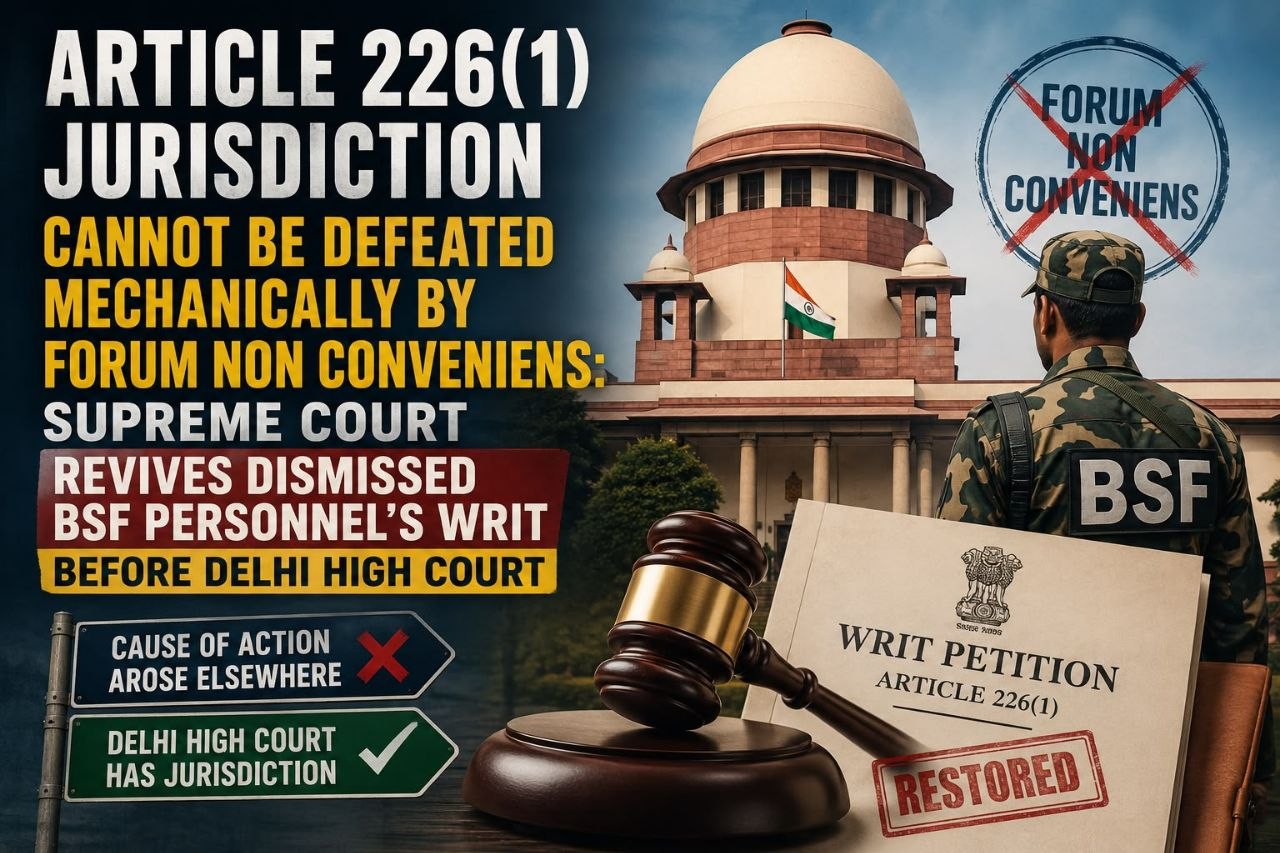
The Supreme Court allowed the appeal filed by a dismissed Border Security Force personnel and set aside the Delhi High Court’s order which had refused to entertain his writ petition on the ground of forum non conveniens.
The Court held that the Delhi High Court did have territorial jurisdiction under Article 226(1) of the Constitution, since the Union of India and the Director General, BSF, whose offices are in New Delhi, were necessary parties to the writ petition.
The Supreme Court clarified that where a constitutional remedy under Article 226(1) is invoked, especially in a writ of certiorari, the doctrine of forum non conveniens may rarely apply. The Court therefore restored the appellant’s writ petition before the Delhi High Court for decision on merits.
However, the Supreme Court did not decide whether the appellant’s dismissal from service was valid or invalid. That issue was left open for the Delhi High Court to decide. The appeal against dismissal of the review petition was dismissed as not maintainable.
Facts
The appellant was enrolled as a member of the Border Security Force on 31 December 2010 and was posted in the 44th Battalion at Narayanpur, Malda, West Bengal.
On 24 April 2022, a missing person report concerning a lady was received by the Company Commander. The appellant and another constable were suspected to be involved in the alleged abduction of the lady. Around the same time, the appellant’s wife also lodged a complaint alleging that the appellant had contracted a second marriage with the lady against her wishes and had subjected her to criminal force.
The BSF ordered a Staff Court of Inquiry. The inquiry found that the appellant had contracted a second marriage with the lady on 6 May 2022, during the subsistence of his first marriage. The lady herself was also married. The marriage was later registered on 23 May 2022 under the Uttar Pradesh Marriage Registration Rules, 2017, at Kushinagar, Uttar Pradesh. The appellant had not obtained divorce from his first wife and had also not obtained prior permission from the competent authority.
However, the Staff Court of Inquiry exonerated the appellant from the allegation relating to the lady’s abduction.
On 19 September 2022, the appellant was served with a show cause notice under Rules 22 and 177 of the BSF Rules, 1969, alleging violation of Rule 7 of the BSF Rules and Rule 21 of the Central Civil Services (Conduct) Rules, 1964. The allegation was that he had entered into a second marriage during the subsistence of his own marriage and that of the lady, without permission.
The appellant did not submit his reply within the stipulated period of fifteen days. Consequently, by order dated 27 October 2022, the Commandant, 44th Battalion, dismissed him from service without pensionary benefits.
The appellant then filed a statutory petition under Rule 28A of the BSF Rules seeking reinstatement. Though the petition was addressed to the Director General, BSF, it was placed before the Inspector General, Frontier Headquarters, BSF, Jammu, as the appellant was an enrolled member. The delay in filing the petition was condoned, but the petition was rejected on merits on 22 December 2023.
The appellant challenged both the dismissal order and the rejection of his statutory petition before the Delhi High Court under Article 226 of the Constitution.
The Delhi High Court dismissed the writ petition, holding that no part of the cause of action had arisen within its territorial jurisdiction and that Delhi was not the convenient forum merely because the offices of the Director General, BSF and the Ministry of Home Affairs were situated in Delhi. The High Court reserved liberty to the appellant to approach the court having jurisdiction.
Issues
The principal issue before the Supreme Court was whether the Delhi High Court was right in refusing to entertain the appellant’s writ petition by applying the doctrine of forum non conveniens.
The connected question was whether the Delhi High Court could exercise jurisdiction under Article 226(1) merely because the Union of India and the Director General, BSF, were situated in Delhi, even though the dismissal order was issued in West Bengal and the statutory petition was rejected in Jammu.
Appellant’s Arguments
The appellant argued that the Delhi High Court had territorial jurisdiction under Article 226(1) of the Constitution because the authorities against whom relief was sought were located within Delhi.
It was submitted that Article 226(1) confers jurisdiction on a High Court where the authority or person against whom the writ is sought is located, while Article 226(2) separately deals with jurisdiction based on cause of action.
The appellant contended that the Central Government exercises overall superintendence over the BSF and that command and administration vest in the Director General, BSF. Since both authorities were located in Delhi, the Delhi High Court was competent to adjudicate the writ petition.
The appellant relied heavily on the Supreme Court’s decision in Abrar Ali v. CISF, where the Court had held that the Delhi High Court had jurisdiction because the headquarters of CISF were located in Delhi. He also relied upon Delhi High Court decisions which had followed Abrar Ali.
It was further submitted that Delhi was also a convenient forum because of the proximity of the BSF Headquarters to the Delhi High Court.
Respondents’ Arguments
The Union of India opposed the appeal and supported the Delhi High Court’s decision.
It was argued that no part of the cause of action had arisen in Delhi. The relevant events had taken place in West Bengal, where the appellant was posted and where the dismissal order was issued, and in Jammu, where the statutory petition was rejected.
The respondents submitted that the Delhi High Court could not become the forum conveniens merely because the offices of the Union of India or the Director General, BSF were located in Delhi.
According to the respondents, the High Court at Calcutta was the most appropriate forum because the integral and essential part of the cause of action had arisen within its territorial jurisdiction.
Reliance was placed on Arif Azim Co. Ltd. v. Micromax Informatics FZE, where the Supreme Court had discussed the doctrine of forum non conveniens and the power of a court to decline jurisdiction where another forum is more appropriate.
Analysis
The Supreme Court noted that the limited question was not whether the dismissal was justified, but whether the Delhi High Court was correct in refusing to entertain the writ petition on the ground of forum non conveniens.
The Court considered the earlier decision in Abrar Ali v. CISF, where the Supreme Court had held that the Delhi High Court’s jurisdiction was referable to Article 226(1) because the headquarters of CISF were located in Delhi. Although the Court observed that Abrar Ali may have overlooked certain aspects of the Delhi High Court’s reasoning in that case, it nevertheless agreed with the final conclusion in Abrar Ali.
The Court then referred to Shri Ranjeet Mal v. General Manager, Northern Railway, where it was held that in cases involving quashing of dismissal or removal from service, the Union of India would be liable for enforcement of the order, not merely the officer who passed the order.
Applying that reasoning to the BSF framework, the Supreme Court held that the Union of India and the Director General, BSF, having their offices in New Delhi, were necessary parties to the writ petition. The Court also relied on Sections 4 and 5 of the BSF Act and Rule 22(4) of the BSF Rules, which requires all dismissal or removal orders under Rule 22 to be reported to the Director General.
On this cumulative basis, the Supreme Court held that the Delhi High Court had competence to entertain and try the writ petition.
The Court also examined other precedents, including Eastern Coalfields Ltd. v. Kalyan Banerjee and Dinesh Chandra Gahtori v. Chief of Army Staff, and noted certain differences and tensions in the case law. To reconcile the position, the Supreme Court held that where a member of the Central Armed Police Forces, including the BSF, is aggrieved by an administrative order of termination of service, the Delhi High Court would have territorial jurisdiction under Article 226(1) if the Union of India and the Director General or equivalent supervising authority are situated in Delhi, even if the cause of action arose outside Delhi.
The Court further explained that the appellant could also have approached other High Courts under Article 226(2): the Calcutta High Court because the show cause notice and dismissal order were issued in West Bengal; the High Court of Jammu & Kashmir and Ladakh because the statutory petition was rejected there; and the Allahabad High Court because the marriage which formed the basis of the misconduct charge was registered in Uttar Pradesh.
However, the Supreme Court held that the existence of these other forums did not mean that the Delhi High Court could refuse to entertain the petition in the facts of the case.
The Court clarified that the doctrine of forum non conveniens applies where multiple forums are available and the court examines whether another forum is more appropriate. But the Court emphasized that in writ jurisdiction under Article 226, particularly where jurisdiction is traceable to Article 226(1), the doctrine may rarely apply.
The Court further observed that in a writ of certiorari, the records of the case are required to be placed before the Court to examine whether the order under challenge deserves to be quashed. Such records would generally be available with the respondents, and if not, they can be called from the custodian. Therefore, where the litigant has chosen a forum convenient to the respondents themselves, applying forum non conveniens may become self-defeating and may deny access to justice rather than advance it.
Precedent
The Supreme Court considered the following important precedents:
- Abrar Ali v. CISF
The Court relied on this decision to support the proposition that the Delhi High Court can exercise jurisdiction under Article 226(1) where the headquarters of the concerned force is located in Delhi. - Shri Ranjeet Mal v. General Manager, Northern Railway
The Court relied on this decision to explain that the Union of India would be liable for enforcement of an order quashing dismissal or removal from service. - Eastern Coalfields Ltd. v. Kalyan Banerjee
The Court noted that this decision had taken a different view in the context of head office jurisdiction, but also noted that it had not considered certain earlier authority. - Dinesh Chandra Gahtori v. Chief of Army Staff
The Court discussed this case but observed that its relevance has to be understood in light of later developments, including the Armed Forces Tribunal Act, 2007. - Arif Azim Co. Ltd. v. Micromax Informatics FZE
The Court referred to this case for the doctrine of forum non conveniens, but noted that it did not arise from writ proceedings. - Kusum Ingots & Alloys Ltd. v. Union of India
The Court noted that this decision dealt with situations where parts of the cause of action arise within different High Courts, and not with jurisdiction based on the situs of the respondent authority’s office under Article 226(1).
Reasoning
The Supreme Court’s reasoning rested on three main points.
First, Article 226 contains two separate bases of jurisdiction. Article 226(1) allows a High Court to issue writs to authorities located within its territorial limits. Article 226(2) separately deals with jurisdiction based on cause of action. Therefore, the absence of cause of action in Delhi was not by itself decisive when the respondent authorities were situated in Delhi.
Second, in BSF service dismissal matters, the Union of India and the Director General, BSF are not merely formal parties. The BSF Act and Rules show that they have a legally relevant role, especially because dismissal and removal orders under Rule 22 must be reported to the Director General.
Third, the Delhi High Court misapplied the doctrine of forum non conveniens. The Supreme Court held that when a constitutional remedy is invoked under Article 226(1), especially in a writ of certiorari, a High Court should be slow to decline jurisdiction merely because other High Courts may also have jurisdiction under Article 226(2).
Conclusion
The Supreme Court set aside the Delhi High Court’s order dismissing the writ petition on the ground of forum non conveniens.
The appellant’s writ petition was restored to the file of the Delhi High Court and directed to be considered on merits and in accordance with law.
The respondents were granted two months to file their counter affidavit, and the appellant was granted one month thereafter to file a rejoinder, if any.
The appeal against the dismissal of the review petition was dismissed as not maintainable.
Importantly, the Supreme Court did not decide the legality of the appellant’s dismissal from BSF service. That question remains open before the Delhi High Court.
Implications
This judgment is significant for members of the BSF and other Central Armed Police Forces.
The Supreme Court has clarified that in service termination matters involving CAPF personnel, the Delhi High Court can exercise jurisdiction under Article 226(1) where the Union of India and the Director General or equivalent command authority are situated in Delhi, even if the dismissal order or the events leading to dismissal occurred elsewhere.
The judgment also limits the mechanical use of forum non conveniens in writ proceedings. It makes clear that where jurisdiction is founded on Article 226(1), especially in constitutional remedies involving certiorari, courts should be careful before refusing to hear the case on the ground that some other High Court may be more convenient.
The ruling therefore strengthens access to constitutional remedies for CAPF personnel, while leaving the merits of individual service disputes to be decided by the appropriate High Court.