BEST Challenged Compensation in 2012; Widow and Children Sought Enhancement Only in 2026—Bombay High Court Dismisses Cross-Objection as 14 Years Late

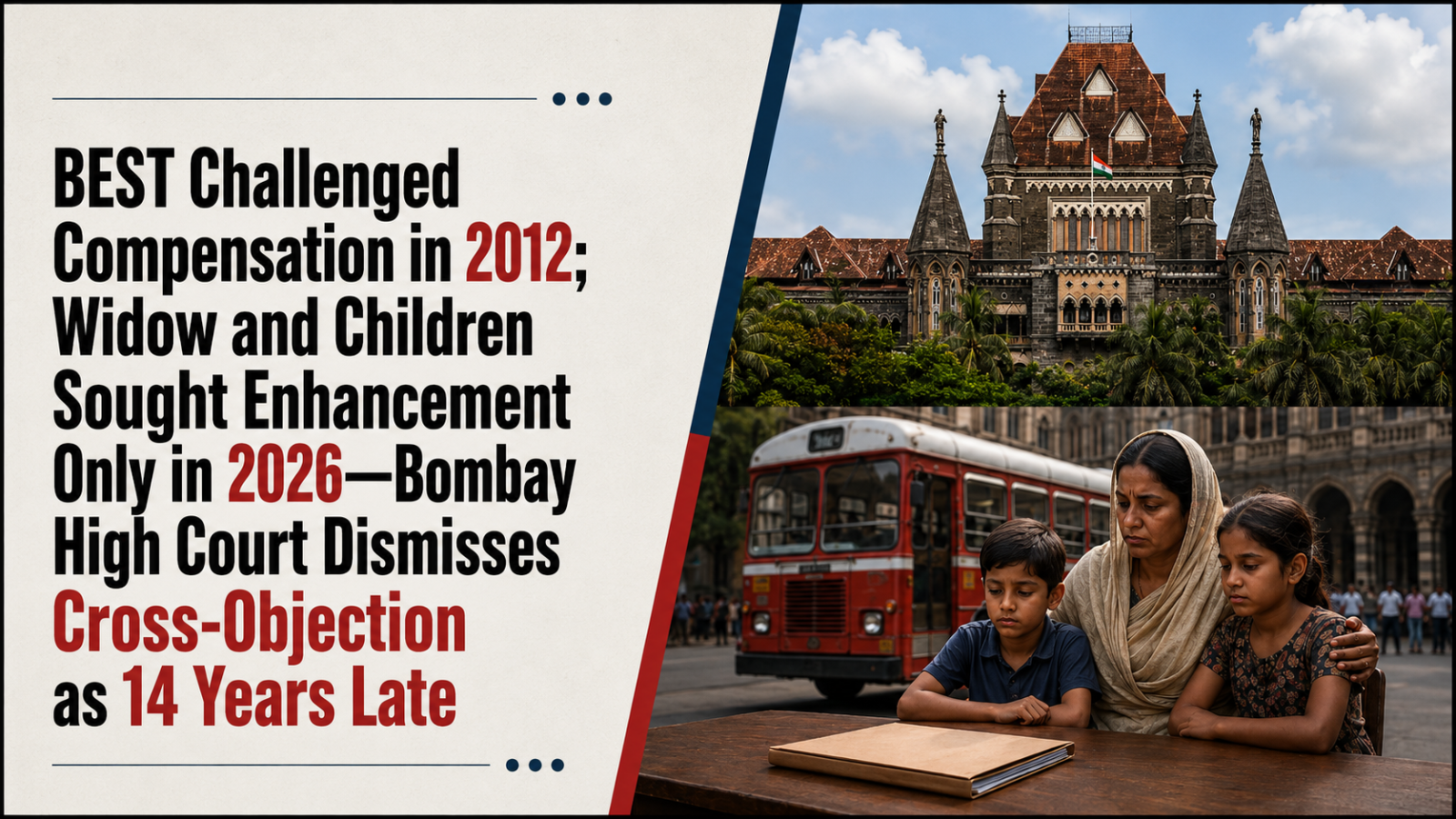
Claimants Knew About BEST’s Appeal When It Was Admitted in 2012 but Sought Higher Compensation in 2026; Bombay High Court Rejects Delayed Claim
Facts
- The General Manager of the Bombay Electric Supply and Transport Undertaking (“BEST”) filed First Appeal No. 343 of 2012 on 20 January 2012 against a compensation award passed in favour of the deceased’s widow and children.
- On 9 February 2012, the delay in filing BEST’s appeal was condoned and the Tribunal’s order was stayed subject to deposit of the compensation amount.
- The claimants entered appearance through their advocate by filing a Vakalatnama on 22 February 2012.
- On 18 April 2012, the High Court admitted BEST’s appeal in the presence of the claimants’ advocate.
- The matter subsequently appeared before the Lok Adalat on 12 November 2022, 11 February 2023 and 9 September 2023. Advocates for both sides were present on these dates.
- On 9 June 2026, when the appeal came up for final hearing, BEST sought time to decide whether it wished to pursue or withdraw the appeal. The matter was adjourned to 23 June 2026.
- On 12 June 2026, the claimants filed a cross-objection seeking enhancement of compensation.
- The claimants asserted that:
- BEST’s appeal had been admitted on 31 March 2023; and
- It had been notified for final hearing for the first time on 23 June 2026.
- The High Court found both statements factually incorrect. The appeal had been admitted on 18 April 2012 in the presence of the claimants’ advocate and had come up for hearing on several occasions thereafter.
- BEST agreed to withdraw its appeal, provided the claimants’ cross-objection was dismissed as time-barred.
Issues
- Whether the limitation period for filing a cross-objection under Order XLI Rule 22 of the Code of Civil Procedure commenced when the claimants appeared at the admission of the appeal in 2012.
- Whether limitation commenced only when the claimants received notice of the appeal’s final hearing in June 2026.
- Whether a respondent who participated through an advocate at the admission stage was entitled to a fresh notice before limitation for filing a cross-objection could begin.
- Whether the cross-objection filed after more than 14 years could be entertained without an application for extension of time or condonation of delay.
- Whether BEST could be permitted to withdraw its original appeal after dismissal of the cross-objection.
Appellant’s Arguments
- BEST submitted that the cross-objection was filed far beyond the limitation period prescribed under Order XLI Rule 22 CPC.
- The claimants’ advocate had filed a Vakalatnama before the appeal was admitted and had participated in the admission hearing on 18 April 2012.
- The claimants therefore had complete knowledge of the appeal and its admission from 2012 itself.
- The limitation period could not be postponed merely because an exact date for final hearing was not communicated at that time.
- The cross-objection should have been filed within the prescribed period after the admission of the appeal.
- The claimants had neither filed an application seeking an extension of time nor an application for condonation of the delay of more than 14 years.
- BEST expressed its willingness to withdraw its appeal if the delayed cross-objection was dismissed.
Respondents’ Arguments
- The claimants contended that their cross-objection was filed within limitation because the appeal was notified for final hearing in June 2026.
- According to them, the limitation period under Order XLI Rule 22 began only upon notice of the date fixed for final hearing.
- Since the cross-objection was filed on 12 June 2026, before the stated final-hearing date of 23 June 2026, it was argued to be within time.
- The claimants relied on paragraphs 59 and 60 of the Supreme Court’s decision in Mahadev Govind Gharge v. Special Land Acquisition Officer.
- They maintained that their earlier appearance at the admission stage did not remove the requirement of a later notice specifying the date of final hearing.
Analysis of the Law
- Order XLI Rule 22 CPC permits a respondent to file a cross-objection within one month from service of notice of the date fixed for hearing of the appeal, or within such further time as the appellate court may allow.
- The purpose of serving notice is to inform the respondent about the existence and pendency of the appeal.
- Once the respondent appears through an advocate and participates when the appeal is admitted, that purpose stands fulfilled.
- Civil procedure does not require fresh notices to be issued to a party at every subsequent stage of the same appeal.
- An advocate’s appearance at admission gives the respondent knowledge that:
- The appeal has been admitted;
- It remains pending; and
- It will eventually be taken up for final hearing.
- The fact that the Court does not immediately specify an exact final-hearing date does not indefinitely postpone the limitation period.
- Where a respondent was present at admission, the admission proceedings constitute sufficient notice for computing the limitation period for a cross-objection.
- The appellate court has the power to extend time, but the party seeking such indulgence must make an appropriate request and explain the delay.
- In the present case, the claimants did not file any written application for extension or condonation of delay. They did not even make an oral request for such relief during the hearing.
Precedent Analysis
- Mahadev Govind Gharge v. Special Land Acquisition Officer, Upper Krishna Project, Jamkhandi, Karnataka, (2011) 6 SCC 321
- The claimants relied on paragraphs 59 and 60 to argue that limitation began when notice of final hearing was served.
- However, the High Court referred to paragraph 36 of the same judgment, which directly dealt with a respondent who had participated at the admission stage.
- The Supreme Court held that such a respondent cannot wait until the appeal is taken up for final hearing and then claim that limitation begins only upon service of a fresh notice.
- Allowing such a course would delay disposal of old appeals and undermine the administration of justice.
- The precedent therefore operated against the claimants rather than supporting them.
- Vasant Builders (Developers, Builders and Contractors), Akot v. Mohan Narayan Patwardhan, 2021 (1) Mah LJ 585
- A Larger Bench of the Bombay High Court considered whether limitation for a cross-objection commenced only after intimation regarding filing of the paper book, even where the respondent had appeared at admission.
- The Larger Bench held that once a respondent enters appearance, no additional notice is required for every subsequent stage of the appeal.
- Appearance may arise from service of notice, filing of a caveat or voluntary participation.
- Where the respondent appears at admission, the one-month period for filing a cross-objection becomes applicable from that stage.
- This Larger Bench ruling directly governed the present case.
- East India Hotels Ltd. v. Smt. Mahendra Kumari, AIR 2008 Rajasthan 131
- The respondent in that case had appeared as a caveator and participated when the appeal was admitted.
- It was held that formal written notice after admission was unnecessary because the respondent already knew about the appeal.
- Limitation for filing a cross-objection could therefore be computed from the date of admission and not from a later formal notice.
- This principle supported BEST’s objection on limitation.
- Mutyam Agaiah v. Special Deputy Collector, (NTPC) Land Acquisition Unit, 2002 (2) ALT 715
- The decision recognised that the purpose of notice is to give the opposite party knowledge of the proceedings.
- Notice need not always be in a prescribed written form if actual knowledge of the appeal is established.
- Engagement of an advocate and participation in the proceedings can constitute sufficient knowledge.
- The claimants’ participation through their advocate therefore prevented them from claiming that limitation had not begun.
- Smt. Krishnabai Rajaram Lonkar v. Prop. Shri Sanjay Sakharam Kamble, 2018 SCC OnLine Bom 3915
- The Bombay High Court held that limitation for filing a cross-objection begins from the date of admission where the respondent had appeared pursuant to an earlier notice.
- A party already aware of the appeal cannot insist upon another notice for final hearing to postpone limitation.
- This decision supported the conclusion that limitation began on 18 April 2012.
- Oil and Natural Gas Corporation v. Punjsons Pvt. Ltd.
- The decision explained the normal appellate practice where the respondent’s advocate waives service when the appeal is admitted.
- Such waiver is treated as sufficient notice for final hearing, and no fresh notice is ordinarily issued.
- Once service is waived at admission, the appeal may later be placed directly for final hearing.
- The claimants’ participation in the admission proceedings therefore constituted sufficient notice.
Court’s Reasoning
- The Court records conclusively showed that the claimants’ advocate filed a Vakalatnama on 22 February 2012 and appeared when the appeal was admitted on 18 April 2012.
- The claimants were therefore aware of the appeal and its admission for more than 14 years before filing their cross-objection.
- Their statement that the appeal was admitted on 31 March 2023 was factually incorrect.
- Their statement that the appeal was first listed for hearing on 23 June 2026 was also incorrect. The matter had appeared before the Lok Adalat on several occasions and came up for final hearing on 9 June 2026.
- Once the appeal was admitted in the presence of the claimants, the next procedural stage was final hearing. The non-fixation of an exact hearing date in 2012 did not prevent limitation from commencing.
- Accepting the claimants’ interpretation would allow a respondent who had participated throughout the appeal to wait indefinitely and file a cross-objection only when the matter eventually reached final hearing.
- Such an interpretation would revive stale claims and obstruct the disposal of old appeals.
- The Court held that limitation commenced on 18 April 2012, when the appeal was admitted in the presence of the claimants’ advocate.
- Since the cross-objection was filed on 12 June 2026, it was delayed by more than 14 years.
- No application for extension of time or condonation of delay was filed. No oral request seeking such relief was made.
- The Court therefore held that it had no option but to dismiss the cross-objection as barred by limitation.
Conclusion
The Bombay High Court held that where respondents appear through an advocate and participate when an appeal is admitted, they have sufficient notice of the appeal. Limitation for filing a cross-objection under Order XLI Rule 22 CPC begins from that stage and cannot be postponed until a fresh notice specifying the final-hearing date is received.
The claimants’ cross-objection seeking enhancement of compensation, filed more than 14 years after admission of the appeal, was dismissed as time-barred. The absence of any application for extension of time or condonation of delay was fatal.
BEST was permitted to withdraw its original appeal. The pending interim or civil application was disposed of as not surviving.
Case Details
Case: The General Manager, Bombay Electric Supply and Transport Undertaking v. Usha Indrajeet Yadav and Others
Court: High Court of Judicature at Bombay, Civil Appellate Jurisdiction
Case Number: First Appeal No. 343 of 2012, with Cross-Objection (St.) No. 16313 of 2026 and Civil Application No. 354 of 2012
CNR: HCBM010278122026
Judge: Justice Jitendra Jain
Date: 22 July 2026
Result: Cross-objection dismissed as barred by limitation; BEST’s appeal permitted to be withdrawn; interim/civil application disposed of as not surviving.