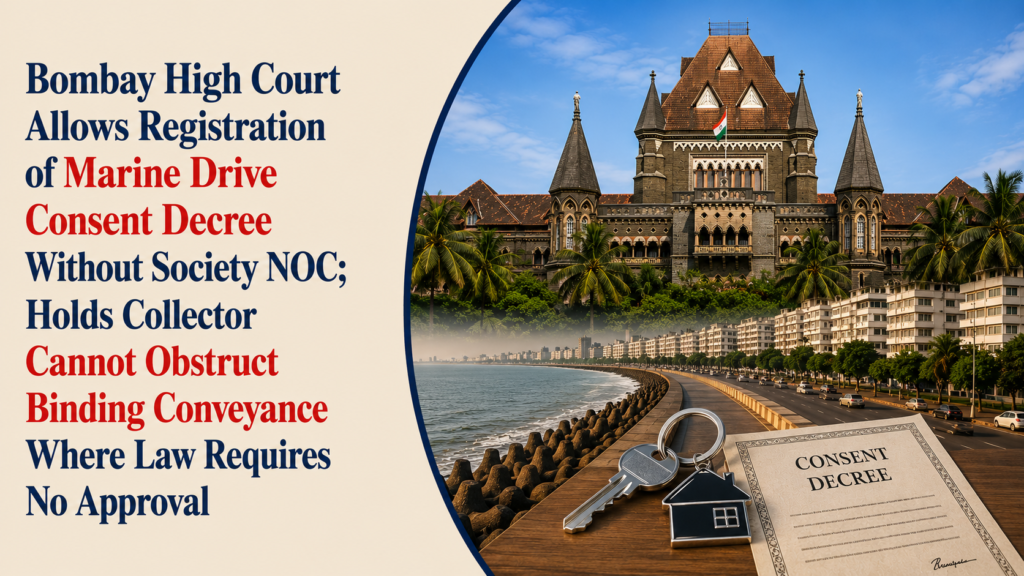
Bombay High Court Allows Registration of Marine Drive Consent Decree Without Society NOC; Holds Collector Cannot Obstruct Binding Conveyance Where Law Requires No Approval

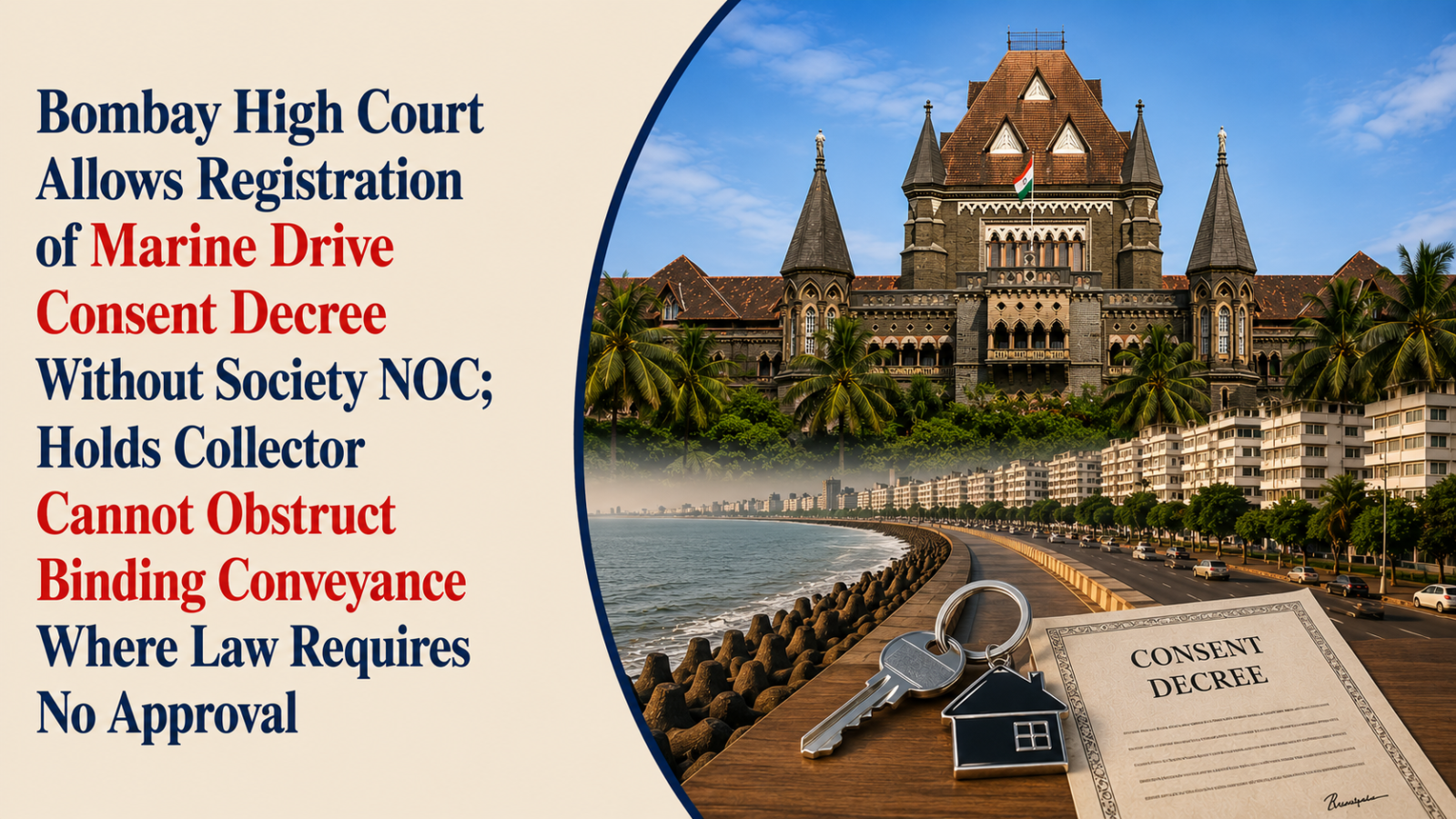
Bombay High Court Rejects Collector’s Demand for Society NOC Before Property Transfer; Holds No Statutory Provision Requires Such Consent for Decree Registration
Facts
The petition concerned premises in Soona Mahal Co-operative Housing Society Ltd., 143 Marine Drive, Mumbai, comprising a 186 sq. ft. shop known as “Pushp Milan” and an adjoining restaurant premises of approximately 2,530 sq. ft. carpet area. Khorshed Tehemton Udwadia and Dr. Adi Nazir claimed ownership of the premises and were members of the Society.
In January 2018, Khorshed Udwadia entered into an agreement to sell the shop premises to Mars Enterprises & Hospitality Pvt. Ltd., a company promoted by the petitioners, Sanjay Narang and Rachna Narang. Subsequently, disputes arose and Udwadia and Dr. Nazir instituted Suit No. 621 of 2019 before the Bombay High Court. The Society was impleaded only as a formal party and no relief was sought against it.
The parties entered into Consent Terms dated 13 December 2022, and the suit was decreed in those terms on 16 December 2022. The Consent Terms expressly provided that they would operate as a conveyance of the suit premises in favour of the petitioners.
The Consent Decree was sent for stamp adjudication, and stamp duty of ₹91,58,300 was determined and paid by the petitioners on 24 May 2024. The decree was thereafter sealed and forwarded for registration.
The Sub-Registrar, however, informed the petitioners that because the premises stood on land belonging to the Collector, a No-Objection from the Collector was required. The petitioners therefore approached the Collector and expressed willingness to pay the applicable transfer fee.
The Collector in turn demanded, among other documents, a No-Objection Certificate from the Society. The Society refused to grant the NOC and wrote to the Collector objecting to the transfer.
The petitioners therefore approached the Bombay High Court under Article 226 seeking a direction that their application be decided without insisting upon an NOC from the Society.
Issues
The central issue before the Court was:
Whether the Collector possessed any legal authority to insist upon a No-Objection Certificate from the co-operative housing society as a precondition to registration of a Consent Decree which itself operated as a conveyance of the property.
The Court also considered:
- Whether the Consent Decree had attained finality and was binding on the respondents.
- Whether Section 37A of the Maharashtra Land Revenue Code authorised the Collector’s insistence on a Society NOC.
- Whether the decree had been presented within the period prescribed by Section 23 of the Registration Act.
- Whether Section 17 of the Registration Act required registration of the Consent Decree.
- Whether the Collector could instead process the transfer upon payment of the prescribed transfer fee and premium.
Petitioners’ Arguments
The petitioners argued that the Collector’s insistence upon an NOC from the Society was arbitrary, unreasonable and illegal, because no statutory provision made such consent a condition precedent to registration.
They emphasised that the suit had already been decreed in accordance with the Consent Terms and that neither the Consent Terms nor the decree had ever been challenged.
The petitioners relied especially upon clauses 11 and 12 of the Consent Terms, under which the decree was expressly to operate as a conveyance conferring title upon them. They had already discharged the substantial stamp duty liability and undertook to pay any lawful transfer fee or premium.
Reliance was placed on Aspi Chinoy v. State of Maharashtra, subsequently affirmed by the Supreme Court, to argue that the Collector could not insist upon prior approval for transfer of premises merely because the building stood on Collector’s land.
The petitioners also invoked Section 17 of the Registration Act, which mandates registration of documents affecting immovable property, and the Government Resolution dated 7 July 2017 permitting transfer transactions to be regularised upon payment of the prescribed charges.
Respondents’ Arguments
The State relied upon Section 37A of the Maharashtra Land Revenue Code, arguing that Government and nazul land are subject to statutory restrictions on sale, transfer, redevelopment and change of use, which the Collector was required to enforce.
It also contended that the Consent Decree had not been presented for registration within the four-month period prescribed under Section 23 of the Registration Act.
The Society opposed the petition on the ground that there was an alleged serious encroachment concerning the suit premises. It also raised objections relating to ownership interests and the fact that the Collector was not a party to the earlier suit.
The Society’s Chairman clarified, however, that the Society’s concern was also that it should not be made responsible or liable by the Collector for refusing to issue an NOC.
Analysis of the Law
The Court first examined the operative Consent Terms.
Clause 11 specifically provided that the Consent Terms would operate as a conveyance in favour of the petitioners, who were to remain in possession as owners from the date of execution. Clause 12 placed upon the petitioners the liability to pay stamp duty, registration charges, transfer fees and Collector’s charges, if any.
The Court held that the record left no dispute that the Consent Terms operated as a deed of conveyance transferring title to the petitioners.
Crucially, neither the Consent Terms, the order dated 16 December 2022 nor the resulting Consent Decree had been challenged by any respondent. They had therefore attained finality.
The Court held that revenue authorities were obliged to act in furtherance of the binding decree rather than create hurdles in its implementation.
Precedent Analysis
The principal precedent relied upon was Aspi Chinoy & Anr. v. State of Maharashtra & Ors.
In that case, the Bombay High Court had rejected the Collector’s position that parties transferring flats in buildings situated on Collector’s land had first to approach the Collector and obtain prior approval.
The Supreme Court thereafter dismissed the State’s appeal. It observed that where the land had originally been leased to a builder, flats had subsequently been conveyed to private purchasers and a society of flat owners had thereafter been formed, prior permission from the Collector was not required.
The Division Bench held that the reasoning in Aspi Chinoy directly supported the petitioners.
The Court also considered the Government Resolution dated 7 July 2017, under which certain transfers could be regularised through ex post facto approval upon payment of prescribed transfer charges.
Court’s Reasoning
The Court found the Collector’s approach legally unsustainable.
First, the Consent Decree was final and binding. Revenue authorities were therefore expected to facilitate its implementation, not undermine it by introducing conditions unsupported by law.
The Court stated that the Collector should simply have notified the applicable transfer fee to enable registration rather than insist upon an NOC from the Society.
Second, despite extensive submissions, the respondents were unable to point to any statute, rule, regulation, notification or other legal provision authorising the Collector to insist upon a Society NOC as a prerequisite to registration.
The Court characterised such conduct as an “obstructionist approach” to implementation of a legally binding decree.
Third, Section 37A of the Maharashtra Land Revenue Code did not assist the State because that provision concerns restrictions applicable to Government land; it did not create the specific NOC requirement asserted by the Collector.
Fourth, the Court rejected the State’s limitation objection under Section 23 of the Registration Act. The final decree had been drawn and sealed on 12 June 2024 and forwarded for registration on 3 July 2024. The four-month requirement had therefore been complied with.
Fifth, Section 17 of the Registration Act applied because the Consent Decree operated as a conveyance of title in immovable property, and the respondents had demonstrated no legal basis for excluding registration.
Finally, because the petitioners were willing to pay the prescribed transfer fee and premium, the Court found no justification for the Collector refusing to process the transaction.
Conclusion
The Bombay High Court allowed the writ petition.
It directed the Collector to decide the petitioners’ application dated 22 August 2024:
- without insisting upon a No-Objection Certificate from Soona Mahal Co-operative Housing Society;
- in accordance with law;
- upon payment of the applicable transfer fee and premium; and
- in a manner enabling the Sub-Registrar to register the Consent Decree dated 16 December 2022.
The Court further clarified that the Society would not be held responsible or liable by the Collector for not issuing the NOC. Questions relating to the alleged encroachment were expressly left open to be decided in appropriate proceedings.
Case Details
Case: Sanjay Narang & Anr. v. Joint Sub-Registrar City No.1 of Assurance Mumbai & Ors.
Court: Bombay High Court, Ordinary Original Civil Jurisdiction
Case Number: Writ Petition No. 5225 of 2024
Judge: Justice Suman Shyam and Justice Advait M. Sethna
Date: 17 August 2026
Result: Petition allowed; Collector directed to decide the transfer application without insisting upon Society NOC and upon payment of applicable transfer fee/premium to facilitate registration of the Consent Decree.