Bombay High Court directs issuance of Scheduled Tribe validity to student relying on family certificates—“Scrutiny committee cannot sit in appeal over earlier validities”; caste claim restored

Court’s decision
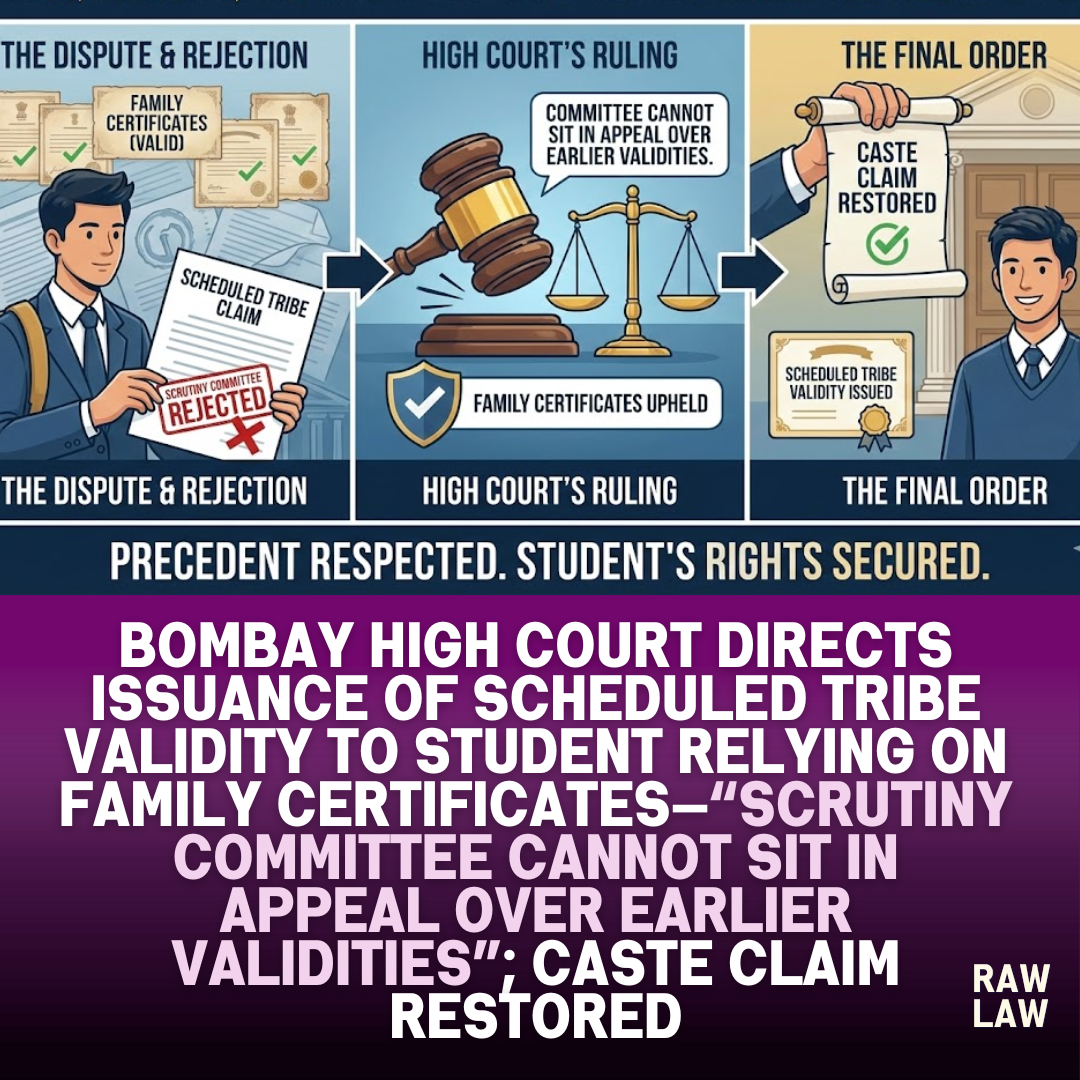
The Bombay High Court set aside an order of the Scheduled Tribe Certificate Scrutiny Committee, Nashik, which had invalidated the caste claim of a student belonging to the “Mahadev Koli, Scheduled Tribe”. The Court held that where close blood relatives already possess valid caste validity certificates issued after due consideration, the Scrutiny Committee cannot discard such certificates merely because a Vigilance Cell enquiry was not conducted in those cases. Observing that the Committee had effectively sat in appeal over earlier validity certificates without initiating cancellation proceedings, the Court directed issuance of a validity certificate to the petitioner within six weeks.
Facts
The petitioner, a 22-year-old student, claimed belonging to “Mahadev Koli, Scheduled Tribe” and applied for caste validity. His claim was rejected by the Scheduled Tribe Certificate Scrutiny Committee by an order dated 19 June 2023. This rejection came despite the undisputed fact that the petitioner’s father and real brother already held caste validity certificates recognising them as belonging to the same Scheduled Tribe.
The Scrutiny Committee invalidated the petitioner’s claim primarily on the ground that in his own case, a Vigilance Cell enquiry revealed alleged interpolations and discrepancies in certain documents relied upon by him. The Committee further observed that the validity certificates issued earlier to the petitioner’s father and brother were granted without conducting Vigilance Cell enquiries and, therefore, could not be relied upon.
Aggrieved by this decision, the petitioner approached the High Court under its writ jurisdiction, contending that the Scrutiny Committee had acted contrary to settled law governing caste validity claims based on close blood relatives.
Issues
The core issues before the High Court were whether a Scrutiny Committee can disregard caste validity certificates granted to close blood relatives solely on the ground that those certificates were issued without a Vigilance Cell enquiry, whether the Committee could effectively question or discard earlier validity certificates without initiating proceedings for their cancellation, and whether the petitioner was entitled to a validity certificate based on existing family validities under settled legal principles.
Petitioner’s arguments
The petitioner argued that his caste claim stood on a strong legal footing as both his father and real brother had already been granted caste validity certificates recognising them as belonging to “Mahadev Koli, Scheduled Tribe”. Relying on binding Supreme Court and Bombay High Court precedent, it was contended that once the relationship by blood is established and the earlier validity certificates are genuine, the Scrutiny Committee is bound to extend the benefit to the claimant unless it is shown that those certificates were obtained by fraud.
It was further argued that the Committee could not unilaterally discard the father’s and brother’s validity certificates without issuing them show cause notices or initiating proceedings for cancellation under the governing statute. The petitioner submitted that the Committee’s approach defeated the principle of consistency and resulted in unnecessary harassment and duplication of scrutiny.
Respondents’ arguments
The State defended the impugned order by submitting that the Vigilance Cell enquiry conducted in the petitioner’s case revealed serious discrepancies and document interpolations, which justified rejection of his claim. It was argued that the earlier validity certificates issued to the petitioner’s father and brother were granted casually and without adherence to the expected procedure, particularly the absence of Vigilance Cell enquiries.
The State contended that the Scrutiny Committee was entitled to examine whether earlier validity certificates were issued after proper enquiry and that merely because close relatives held such certificates, the petitioner could not claim automatic entitlement to a validity certificate.
Analysis of the law
The High Court examined the scheme of the Maharashtra Scheduled Castes, Scheduled Tribes, De-notified Tribes (Vimukta Jatis), Nomadic Tribes, Other Backward Classes and Special Backward Category (Regulation of Issuance and Verification of) Caste Certificate Act, 2000 and the Rules framed thereunder. It emphasised that Rule 12 contemplates a Vigilance Cell enquiry only when the Scrutiny Committee is not satisfied with the documentary evidence produced by the applicant.
The Court reiterated that a Vigilance Cell enquiry is not mandatory in every case and that the Scrutiny Committee has discretion to dispense with such enquiry where the documentary material is found sufficient and reliable. Importantly, the Court noted that earlier validity certificates issued to close blood relatives cannot be ignored unless they are shown to be fraudulent or are cancelled in accordance with law.
Precedent analysis
The Court placed heavy reliance on the Supreme Court’s decision in Maharashtra Adiwasi Thakur Jamat Swarakshan Samiti v. State of Maharashtra, which laid down three prerequisites for granting validity based on a relative’s certificate: establishing blood relationship, verifying that the earlier certificate was issued after due enquiry, and ascertaining its genuineness. The Court also relied on the Bombay High Court’s ruling in Apoorva d/o Vinay Nichale v. Divisional Caste Certificate Scrutiny Committee, which cautioned against repetitive scrutiny where a close relative’s caste claim has already been validated, unless fraud is demonstrated.
Applying these precedents, the Court held that the Scrutiny Committee had overstepped its jurisdiction by effectively re-evaluating and discarding earlier validities without following the procedure for cancellation.
Court’s reasoning
The High Court found that the validity certificate issued to the petitioner’s brother explicitly recorded that the Scrutiny Committee had examined documentary evidence, affinity, and social status, and had consciously decided that no Vigilance Cell enquiry was required. In such circumstances, the present Committee could not retrospectively fault that decision.
The Court further noted that no show cause notices had been issued to the petitioner’s father or brother for cancellation of their validity certificates. Discarding those certificates in the petitioner’s proceedings amounted to sitting in appeal over decisions of a coordinate authority, which was impermissible. The Court clarified that while it was open to the authorities to initiate lawful proceedings for cancellation of earlier certificates, until such action was taken, the certificates remained valid and binding.
Conclusion
The Bombay High Court quashed the impugned order of the Scrutiny Committee and directed issuance of a caste validity certificate to the petitioner as belonging to “Mahadev Koli, Scheduled Tribe” within six weeks. The Court clarified that the validity granted to the petitioner would be subject to the outcome of any lawful proceedings that may be initiated against the earlier family certificates in accordance with law.
Implications
This judgment reinforces the principle of consistency and fairness in caste validity adjudication. It provides significant relief to students and candidates whose claims are supported by existing family validities, protecting them from repetitive and inconsistent scrutiny. The ruling also places clear limits on the powers of Scrutiny Committees, emphasising that earlier validity certificates cannot be brushed aside casually and must be dealt with only through proper cancellation proceedings. The decision is likely to have wide ramifications for caste verification processes across Maharashtra.
Case law references
- Maharashtra Adiwasi Thakur Jamat Swarakshan Samiti v. State of Maharashtra: Laid down prerequisites for granting caste validity based on close blood relatives and clarified the limited role of Vigilance Cell enquiries.
- Apoorva d/o Vinay Nichale v. Divisional Caste Certificate Scrutiny Committee: Held that once a close relative’s caste claim is validated, repetitive scrutiny is unwarranted unless fraud is shown.
- Madhuri Patil v. Commissioner, Tribal Development: Recognised the high probative value of pre-Constitution documents in caste verification.
FAQs
1. Can a student get caste validity based on a parent’s or sibling’s certificate?
Yes. If close blood relatives hold valid caste validity certificates issued after due enquiry, the claimant is ordinarily entitled to the same benefit unless fraud is established.
2. Is Vigilance Cell enquiry mandatory in every caste validity case?
No. A Vigilance Cell enquiry is required only when the Scrutiny Committee is not satisfied with the documentary evidence produced.
3. Can a Scrutiny Committee ignore earlier validity certificates?
No. Earlier validity certificates cannot be discarded unless they are cancelled through proper legal proceedings after issuing notice to the holders.