Bombay High Court dismisses Bombay Rayon Fashion Ltd appeal in work injury case — “No substantial question of law under Section 30; 50% functional disability and interest from date of accident upheld”, compensation release directed

Court’s decision
The Bombay High Court dismissed a First Appeal filed under Section 30 of the Employees’ Compensation Act, 1923, challenging the order of the Commissioner for Workmen Compensation dated 21 November 2017.
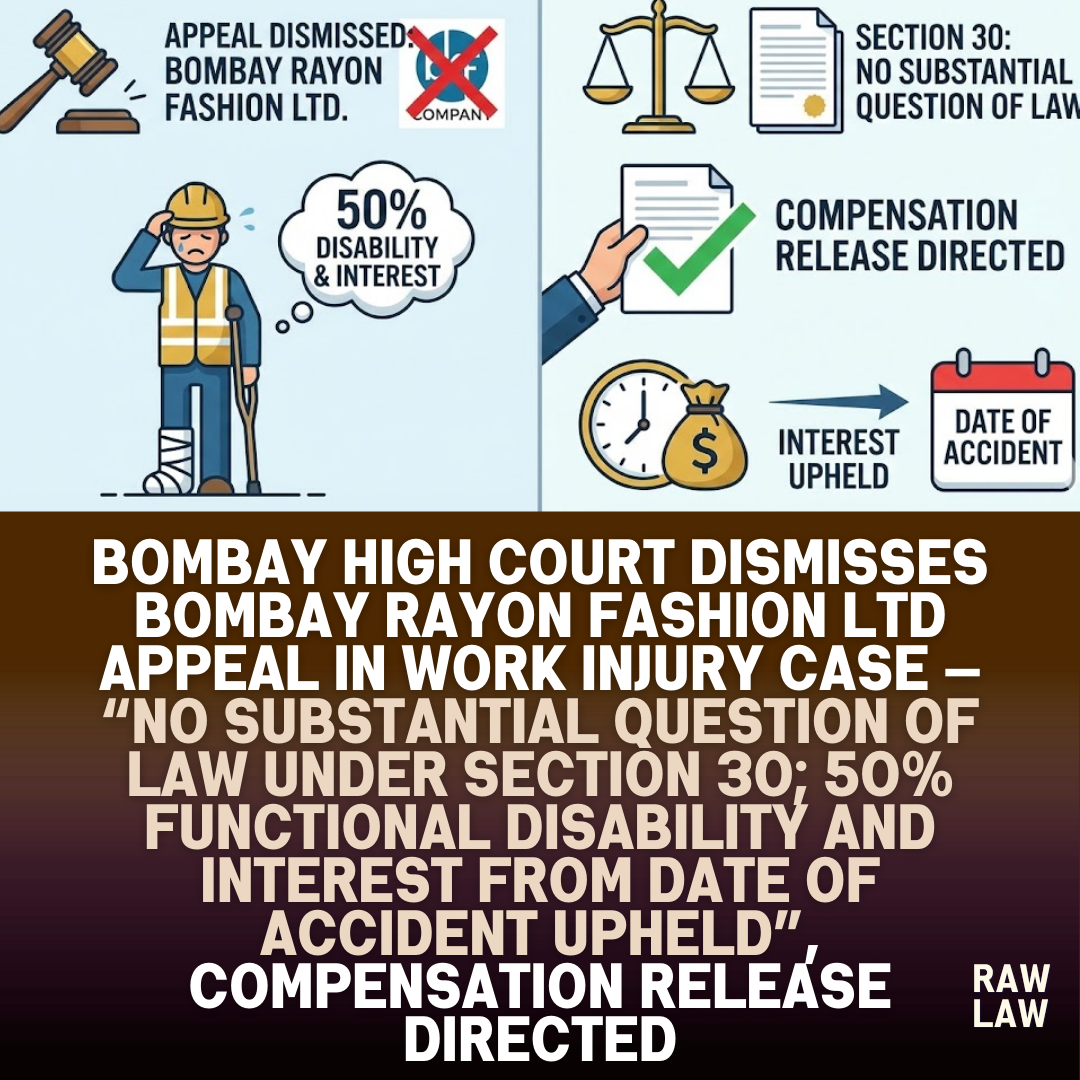
Justice Jitendra Jain held that no substantial question of law arose in the appeal, as mandated by the first proviso to Section 30(1) of the Employees’ Compensation Act. The Court upheld the Commissioner’s findings on employment nexus, functional disability assessed at 50%, and grant of interest from the date of accident. The deposited compensation was directed to be released to the injured employee within eight weeks.
Facts
The respondent, a 27-year-old employee, sustained injuries in an accident on 17 February 2015 while working with Bombay Rayon Fashion Ltd at its Tarapur unit. The claim was filed before the Commissioner for Workmen Compensation under the Employees’ Compensation Act, 1923.
The Commissioner recorded that the employer admitted that the accident occurred during the course of employment. Medical evidence showed head injury with bleeding and chest blunt trauma resulting in fractures of the 2nd, 3rd, 4th, 5th and 7th ribs on the right side.
The employee claimed 100% functional disability. However, after evaluating evidence, the Commissioner assessed functional disability at 50% and awarded compensation with interest from the date of accident.
Issues
The appeal raised four substantial questions of law:
- Whether the injuries arose out of and in the course of employment.
- Whether the Commissioner erred in awarding 50% disability despite a medical certificate indicating 38% permanent partial disability.
- Whether interest should have been granted from the date of accident or only after one month.
- Whether the Commissioner misappreciated evidence regarding disability.
The High Court’s task was to determine whether these issues constituted substantial questions of law under Section 30 of the Act.
Appellants’ arguments
The employer contended that the employee rejoined duty in April 2015, within three months of the accident, which allegedly contradicted the finding of 50% functional disability.
It was argued that the medical certificate reflected only 38% permanent partial disability and that the Commissioner erred in enhancing it to 50%.
On interest, the employer submitted that under Section 4A(3) of the Employees’ Compensation Act, interest should commence only after expiry of one month from the date compensation fell due, not from the date of accident.
Respondent’s position
Though unrepresented at the hearing, the record reflected that the employee had led medical evidence establishing serious injuries and ongoing physical limitations, including severe bone pain and inability to perform work effectively.
The Commissioner had considered both parties’ medical evidence and recorded reasons for assessing functional disability at 50%, instead of the claimed 100%.
Analysis of the law
The Court reiterated that Section 30 of the Employees’ Compensation Act bars appeals unless a substantial question of law is involved. The first proviso to Section 30(1) is couched in negative terms, restricting appellate interference in factual determinations.
On employment nexus, the Court noted that the employer had admitted that the accident occurred during the course of employment. This finding was factual and not open to reconsideration in appeal.
Regarding disability percentage, the Court observed that functional disability assessment depends on evidence. The Commissioner had exhaustively evaluated medical testimony and injuries before arriving at 50%. Such evaluation did not give rise to a substantial question of law.
Precedent analysis
While the judgment did not elaborate on multiple precedents, it implicitly applied settled principles that appellate courts under Section 30 of the Employees’ Compensation Act cannot reappreciate evidence or interfere with factual findings unless a substantial question of law arises.
The Court emphasized that determination of functional disability is primarily evidentiary and falls within the domain of the Commissioner.
Court’s reasoning
The High Court rejected the argument regarding disability percentage, holding that the Commissioner had considered medical evidence, the nature of injuries, and cross-examination. The fact that the employee resumed work did not negate functional disability.
On interest, the Court interpreted Section 4A(3) to mean that the one-month period empowers the Commissioner to impose interest if payment is delayed, but does not postpone commencement of interest calculation. The statute does not mandate that interest starts only after one month.
Thus, none of the grounds raised involved a substantial question of law.
Conclusion
The Bombay High Court dismissed the appeal and upheld the Commissioner’s award. The amount deposited by the employer was directed to be released to the injured employee within eight weeks.
The ruling reaffirms the limited scope of appellate interference under Section 30 of the Employees’ Compensation Act.
Implications
This judgment strengthens the finality of factual findings by the Commissioner for Workmen Compensation. Employers cannot convert evidentiary disputes into substantial questions of law to prolong litigation.
The ruling also clarifies that interest under Section 4A(3) can validly run from the date of accident where compensation is not promptly paid.
For workplace injury litigation, the decision underscores that functional disability assessment is a fact-based exercise grounded in medical evidence and practical impact on earning capacity.
Case Law References
- Interpretation of Section 30, Employees’ Compensation Act, 1923 – Appeal maintainable only if substantial question of law arises.
- Interpretation of Section 4A(3), Employees’ Compensation Act, 1923 – Interest payable upon default; one-month period empowers levy but does not defer accrual.
FAQs
1. Can an employer appeal a compensation order under the Employees’ Compensation Act on factual grounds?
No. An appeal under Section 30 lies only if a substantial question of law arises. Pure factual disputes are not sufficient.
2. Can functional disability exceed the percentage mentioned in a medical certificate?
Yes. The Commissioner may assess functional disability based on overall evidence, not merely the medical percentage.
3. From when is interest payable under Section 4A(3) of the Act?
Interest may be awarded from the date of accident if compensation is not paid, as the one-month period relates to default, not accrual.