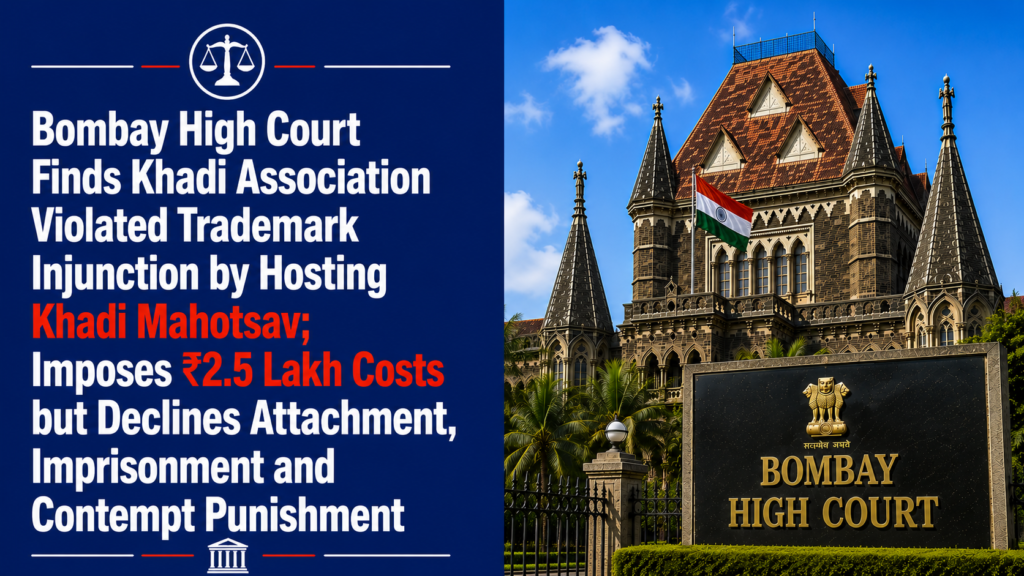
Bombay High Court Finds Khadi Association Violated Trademark Injunction by Hosting Khadi Mahotsav; Imposes ₹2.5 Lakh Costs but Declines Attachment, Imprisonment and Contempt Punishment

Bombay High Court Finds Mumbai Khadi Association Breached Injunction by Hosting Khadi Mahotsav; Imposes ₹2.5 Lakh Costs but Declines Imprisonment
Facts
The dispute arose between the Khadi & Village Industries Commission (KVIC) and the Mumbai Khadi & Village Industries Association (MKVIA). KVIC filed Interim Application No. 5867 of 2025 under Order XXXIX Rule 2A CPC, alleging circumvention of an injunction dated 14 December 2022. It also instituted Contempt Petition No. 13 of 2026 against certain trustees alleging further violations. Both proceedings were heard and disposed of by a common judgment.
The 2022 injunction restrained MKVIA and persons acting on its behalf from directly or indirectly manufacturing, selling, advertising or providing goods and services using “KHADI”, KVIC’s registered trademarks, the Charkha logo, deceptively similar marks, and the impugned trade/business names in connection with the prohibited activities.
The parties had a substantial litigation history. KVIC had earlier instituted Suit No. 213 of 2021 alleging infringement and passing off after MKVIA’s Khadi certification was withdrawn. That suit was withdrawn after MKVIA undertook that it would not sell products called, labelled or described as Khadi without KVIC certification. The subsequent injunction arose after the Court found that garments continued to be sold as Khadi despite that undertaking.
The present proceedings principally concerned three alleged violations.
First, within approximately five months of the injunction, a three-day event titled “Khadi Mahotsav 2.0” was held at MKVIA’s own premises. Promotional material represented Atharva School of Fashion and Arts and MKVIA as joint organisers.
Second, MKVIA entered into an Agreement for Sale dated 30 March 2025 with Rishabraj Estate Developers Pvt. Ltd. for sale of immovable property. The agreement identified the seller by its existing name, “Mumbai Khadi & Village Industries Association.” KVIC alleged that even this amounted to contempt.
Third, MKVIA’s original name continued to appear on certain third-party business-directory listings, which KVIC contended amounted to continuing marketing of the association as a Khadi garment business.
Issues
The principal issues before the Court were:
- Whether holding Khadi Mahotsav 2.0 at MKVIA’s premises amounted to violation of the injunction under Order XXXIX Rule 2A CPC.
- Whether proceedings under Order XXXIX Rule 2A require proof beyond reasonable doubt, as in contempt proceedings, or whether a civil standard applies.
- Whether Order XXXIX Rule 2A is essentially punitive or remedial/coercive in nature.
- Whether attachment of property or civil imprisonment must necessarily follow once violation of an injunction is established.
- Whether MKVIA’s trustees could individually be subjected to civil imprisonment merely because they were trustees or office-bearers.
- Whether using MKVIA’s existing institutional name in the Agreement for Sale of immovable property constituted contempt of the trademark injunction.
- Whether residual listings of MKVIA on third-party online platforms justified exercise of contempt jurisdiction.
KVIC’s Arguments
KVIC argued that the injunction imposed a clear and unambiguous prohibition against MKVIA directly or indirectly promoting goods or services under the Khadi name and Charkha symbol.
Despite this, Khadi Mahotsav 2.0 was conducted only months later at MKVIA’s own premises and promotional material expressly portrayed MKVIA as a joint organiser.
KVIC therefore contended that MKVIA could not plausibly deny knowledge or participation in a three-day Khadi promotional event conducted from its own premises.
KVIC further sought consequences against the trustees under Order XXXIX Rule 2A and relied upon the continued use of MKVIA’s institutional name in the Agreement for Sale and third-party listings as additional violations.
It relied, inter alia, upon Samee Khan v. Bindu Khan to emphasise the coercive powers available under Order XXXIX Rule 2A for securing compliance with injunctions.
MKVIA’s Arguments
MKVIA denied that KVIC had established its involvement in organising Khadi Mahotsav 2.0 and sought application of the criminal-law standard of proof beyond reasonable doubt.
It argued that proceedings under Order XXXIX Rule 2A were punitive and akin to civil contempt and therefore required stringent proof of wilful disobedience.
MKVIA relied upon Food Corporation of India v. Sukh Deo Prasad, U.C. Surendranath v. Mambally’s Bakery, Anil Ratan Sarkar v. Hirak Ghosh, Rama Narang v. Ramesh Narang, and other contempt authorities.
It also disputed personal liability of all trustees merely because of their institutional positions and relied upon Dr. U.N. Bora v. Assam Roller Flour Mills Association concerning vicarious liability in contempt proceedings. The Court, however, noted that U.N. Bora concerned contempt under the Contempt of Courts Act rather than proceedings under Order XXXIX Rule 2A.
Regarding the Agreement for Sale, MKVIA’s case effectively required the Court to distinguish between use of its institutional name for an ordinary property transaction and prohibited use of the Khadi mark for selling or promoting Khadi products.
Analysis of the Law
Order XXXIX Rule 2A Is Not Identical to Contempt Jurisdiction
A major aspect of the judgment is the Court’s distinction between Order XXXIX Rule 2A CPC and contempt jurisdiction under the Contempt of Courts Act, 1971.
The Court held that although the Supreme Court has described Rule 2A jurisdiction as “akin” to civil contempt, this does not mean that every characteristic of contempt jurisdiction automatically applies to Rule 2A proceedings.
Order XXXIX Rule 2A is available to every civil court and is intended to create a strong disincentive against breach of interim injunctions and provide mechanisms for enforcing compliance. Contempt jurisdiction, by contrast, is constitutionally vested in Courts of Record and has its own statutory framework.
Four-Part Test Under Order XXXIX Rule 2A
The Court formulated the following test:
- Is there an interim order in existence?
- Does that order contain a discernible obligation to do or refrain from doing something?
- Has that obligation been violated?
- If violated, is attachment of property or civil imprisonment necessary to secure compliance?
The Court emphasised that attachment and imprisonment are not automatic consequences merely because violation is established.
Standard of Proof
The Court made an important pronouncement on the applicable standard of proof.
For determining whether an obligation under an interim injunction has been violated under Order XXXIX Rule 2A, the applicable standard is:
preponderance of probability, but of a high degree commensurate with the stigma attached to violating a Court order.
Thus, the Court rejected the proposition that proof beyond reasonable doubt must invariably be applied merely because Rule 2A has been described as akin to contempt.
At the same time, conjecture, suspicion or surmise cannot substitute proof even under the civil standard.
Remedial Rather Than Purely Punitive Jurisdiction
The Court held that the fundamental objective of Order XXXIX Rule 2A is securing obedience to an interim injunction.
Attachment of property and civil imprisonment are coercive mechanisms available to procure compliance. They are not ends in themselves.
Consequently, once compliance has been achieved, the Court may use its inherent powers under Section 151 CPC to impose appropriate remedial measures instead of mechanically ordering attachment or imprisonment.
Precedent Analysis
Food Corporation of India v. Sukh Deo Prasad, (2009) 5 SCC 665
FCI described Order XXXIX Rule 2A as punitive and akin to civil contempt and held that a court cannot create an obligation by surmise, suspicion or inference where the injunction itself does not contain such an obligation.
The Bombay High Court interpreted FCI contextually. It held that FCI’s insistence on absence of doubt related principally to the existence and clarity of the obligation allegedly breached, rather than laying down a universal criminal standard of proof for every Rule 2A proceeding.
Samee Khan v. Bindu Khan, (1998) 7 SCC 59
The Supreme Court explained that attachment under Rule 2A facilitates coercive enforcement and eventual compensation if disobedience continues. Civil imprisonment constitutes an additional coercive mechanism.
The High Court relied on this decision to reinforce its conclusion that Rule 2A is primarily directed toward securing compliance rather than punishment for its own sake.
U.C. Surendranath v. Mambally’s Bakery, (2019) 20 SCC 666
Surendranath had stated that wilful disobedience under Rule 2A must be established before civil imprisonment could be imposed.
The High Court interpreted that decision in its factual context: the Supreme Court was considering whether civil imprisonment should be sustained after efforts had already been made to comply with the injunction. It was not treated as laying down a universal criminal standard for maintainability of every Rule 2A application.
Amazon.com NV Investment Holdings LLC v. Future Retail Ltd., (2022) 1 SCC 209
The Court placed considerable reliance on Amazon. There, the Supreme Court expressly noticed that unlike Section 2(b) of the Contempt of Courts Act, Order XXXIX Rule 2A does not contain the word “wilful.”
The Supreme Court distinguished enforcement of injunctions from contempt punishment and observed that Rule 2A is primarily intended to enforce orders passed under Rules 1 and 2.
Dr. U.N. Bora v. Assam Roller Flour Mills Association, (2022) 1 SCC 101
MKVIA relied on U.N. Bora regarding vicarious liability of directors or office-bearers.
The High Court distinguished the judgment because it concerned liability of directors under the Contempt of Courts Act, whereas the present Interim Application was under Order XXXIX Rule 2A CPC.
Union of India v. Major Bahadur Singh, (2006) 1 SCC 368
The Court relied upon this judgment for the fundamental proposition that judgments are not to be read as statutes. Judicial observations must be understood in the factual and legal context in which they were made.
Ravi Ranjan Developers Pvt. Ltd. v. Aditya Kumar Chatterjee, 2022 SCC OnLine SC 568
The Supreme Court reiterated that a judgment is a precedent for the issue of law actually raised and decided, and individual words or sentences cannot be divorced from their factual context.
The Court applied this principle while rejecting an overbroad reading of FCI and Surendranath.
Anil Ratan Sarkar and Rama Narang
The Court acknowledged Anil Ratan Sarkar v. Hirak Ghosh and Rama Narang v. Ramesh Narang as authorities applying proof beyond reasonable doubt in contempt jurisdiction. However, it declined to mechanically transplant that standard into every proceeding under Order XXXIX Rule 2A.
Court’s Reasoning
On the evidence, the Court found the violation concerning Khadi Mahotsav 2.0 clearly established.
The event took place over three days at MKVIA’s own premises only months after the injunction. Promotional material expressly showed MKVIA as being associated with the event, and the event itself prominently used the word “Khadi” and the Charkha symbol.
MKVIA’s assertion that it was unaware of such an event taking place at its own premises was characterised as a “mere bald assertion” that did not inspire confidence.
The Court held that the evidence established MKVIA’s breach by a very high degree of preponderance of probability — and, according to the Court, even beyond reasonable doubt on the facts. The conduct demonstrated “utter disregard” for the injunction.
However, the Court noted that after the Rule 2A application was filed, no further editions of the Mahotsav were held. The objective of securing compliance had therefore been achieved.
For that reason, attachment of MKVIA’s property or sending its trustees to civil prison would serve no further enforcement purpose.
Agreement for Sale
The Court rejected KVIC’s contention that MKVIA committed contempt merely by using its institutional name in the registered Agreement for Sale with Rishabraj.
The injunction prohibited use of the MKVIA/Khadi name in connection with the promotion and sale of Khadi products. The Agreement for Sale concerned immovable property and had no nexus with selling Khadi goods.
Therefore, its execution was outside the activity restrained by the injunction.
The Court observed that accepting KVIC’s argument would produce untenable consequences: historical land records, Charity Commissioner records and even court filings continuing to bear MKVIA’s existing name could themselves become acts of contempt. The injunction could not be interpreted so expansively.
Conclusion
The Bombay High Court found that MKVIA had violated the injunction by permitting/associating itself with Khadi Mahotsav 2.0, but declined to order attachment of property or civil imprisonment because subsequent compliance had been achieved.
Instead, the Court:
- directed MKVIA’s Board of Trustees not to host any event relating to Khadi or its promotion, whether at MKVIA’s premises or elsewhere;
- directed MKVIA to pay ₹2,50,000 as litigation costs to KVIC within four weeks;
- warned every trustee against future “sharp practice” conflicting with the injunction;
- declined to punish the trustees for contempt merely because of the Agreement for Sale or residual third-party listings;
- directed the trustees to file an affidavit containing full facts and audited financial information concerning Khadi Mahotsav, institutional measures adopted to prevent recurrence, and efforts made to remove third-party listings.
The Court crystallised the broader legal principle that Order XXXIX Rule 2A is primarily an enforcement mechanism. A breach is to be assessed on a high degree of preponderance of probability, while attachment and civil imprisonment should be deployed only when necessary to secure compliance rather than as punishment for its own sake.
Case Details
Case: Khadi & Village Industries Commission v. Shri Jaishukh N. Bhuta & Ors.
Court: High Court of Judicature at Bombay, Ordinary Original Civil Jurisdiction, Commercial Division
Case Number: Interim Application No. 5867 of 2025 in Commercial IP Suit No. 580 of 2022, with Contempt Petition No. 13 of 2026
Judge: Justice Somasekhar Sundaresan
Date: 7 August 2026
Result: Injunction violation concerning Khadi Mahotsav established; ₹2.5 lakh costs imposed and remedial directions issued; attachment and civil imprisonment declined; contempt punishment concerning the Agreement for Sale and third-party listings declined. Both proceedings disposed of.