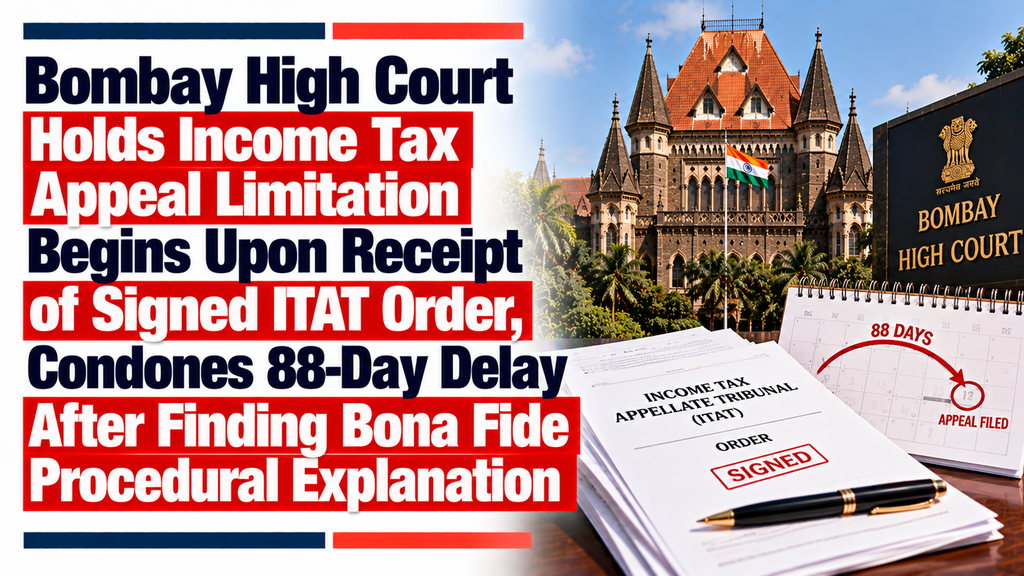
Bombay High Court Holds Income Tax Appeal Limitation Begins Upon Receipt of Signed ITAT Order, Condones 88-Day Delay After Finding Bona Fide Procedural Explanation

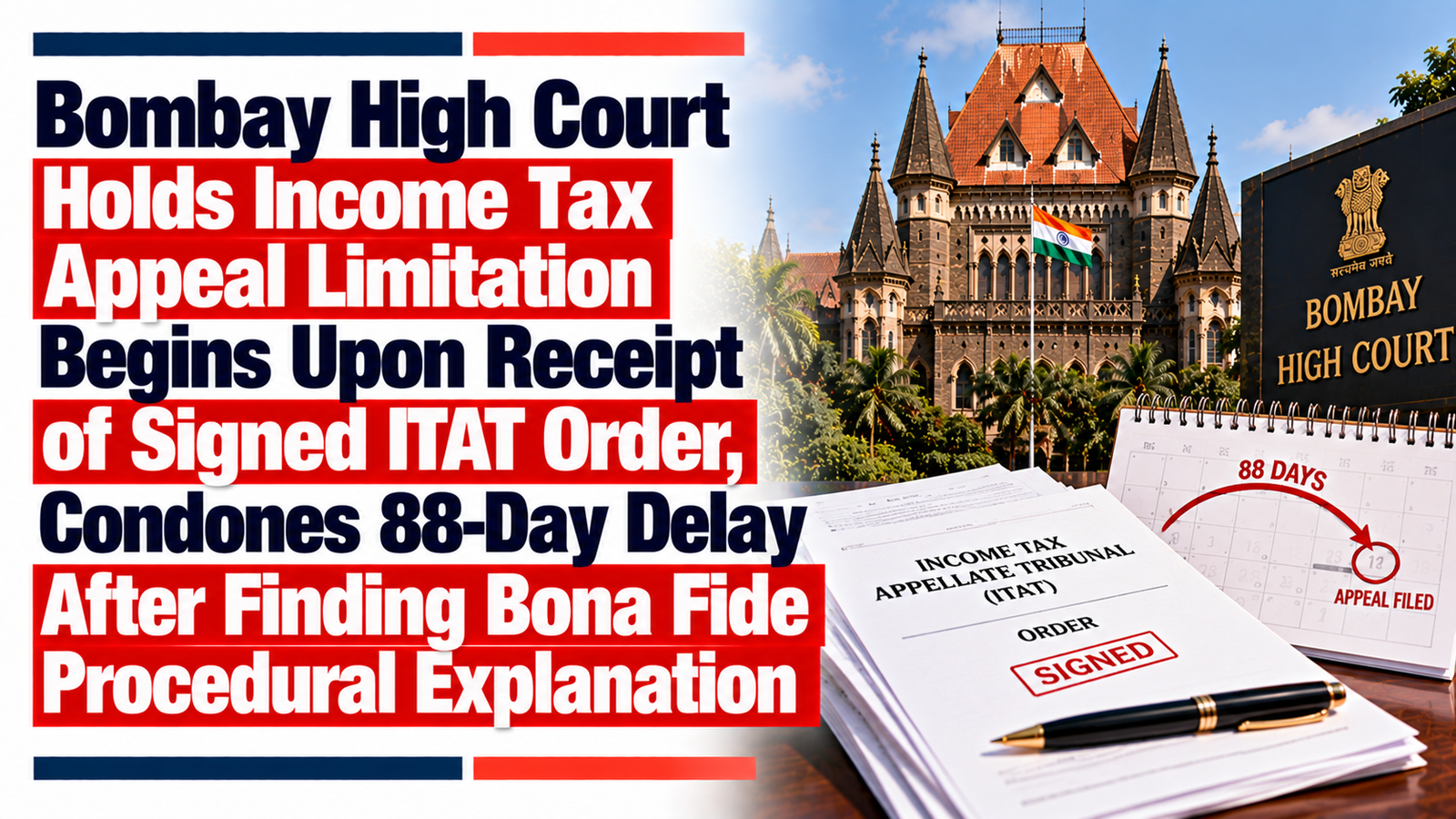
Bombay High Court Rejects Mere Pronouncement as Trigger for Income Tax Appeal Limitation, Permits Delayed Challenge to ITAT Remand After Finding Credible and Sufficient Cause
Facts
GS Strategic Investments Limited sought condonation of an 88-day delay in filing its High Court appeal against the Income Tax Appellate Tribunal’s order dated 22 October 2024 (ITA No. 4401/MUM/2023; assessment year 2021–22). The ITAT had remanded the company’s claim that its long-term capital gains were exempt, since the claim had not been examined during assessment and the necessary facts were absent. The signed ITAT order was dispatched on 25 February 2025 and received on 27 February 2025. The company filed its appeal on 23 September 2025, after the calculated deadline of 27 June 2025.
Issues
Whether limitation for an appeal against an ITAT order commences on pronouncement or knowledge of its result, or upon receipt of the order communicated to the aggrieved party; and whether the company’s 88-day delay, attributed to consideration of an alternative rectification application and ensuing legal preparations, was supported by sufficient cause.
Petitioner’s Arguments
The applicant maintained that the statutory period began only on receiving the signed order on 27 February 2025, not on oral pronouncement. It initially explored a miscellaneous application under Section 254(2) of the Income-tax Act; its chartered accountant prepared a draft forwarded on 4 June 2025. After consultations, it elected to appeal instead, forwarding papers to counsel on 28 July 2025 and essential documents by 14 August 2025. The 23 September filing reflected procedural and professional deliberations, not deliberate inaction or bad faith.
Respondent’s Arguments
The Revenue opposed condonation, contending that the applicant knew of the ITAT’s decision upon pronouncement on 22 October 2024. On that premise, the company had failed to account for the longer interval from pronouncement. The Revenue further asserted that the explanation did not constitute sufficient cause, and urged dismissal of the interim application.
Analysis of the Law
Section 254(3) of the Income-tax Act requires the ITAT to send its order to the assessee and Commissioner. Rule 35 of the Income-tax (Appellate Tribunal) Rules, 1963 requires communication of the signed order; Rule 49 deals with copying fees and additional copies. The Court distinguished knowing an outcome from receiving the reasoned decision necessary to formulate appellate grounds. It held that limitation commences on receipt of the communicated ITAT order. Condonation under Section 5 of the Limitation Act additionally requires an adequate, bona fide explanation assessed on the facts; it is not automatic.
Precedent Analysis
The Court applied Maniben Devraj Shah v. Municipal Corporation of Brihan Mumbai (Supreme Court, 9 April 2012). That decision requires a distinction between inordinate delay and relatively shorter delay, while examining negligence, bona fides, prejudice to the successful party and the quality of the explanation. A justice-oriented approach does not excuse concocted explanations or gross indifference. Here, no irreversible prejudice to the Revenue was demonstrated, and the applicant furnished a chronological explanation covering the delay.
Court’s Reasoning
The envelope established dispatch of the signed order on 25 February 2025 and receipt on 27 February 2025. Pronouncement alone communicated only the result, whereas an appeal required examination of the ITAT’s findings and reasons. Accordingly, the Court accepted 27 February as the relevant starting date and treated the delay as 88 days, not as a period beginning in October 2024. The company’s sequential steps—considering Section 254(2) relief, obtaining advice, assembling documents and filing an appeal—sufficiently explained the lapse. The Court found condonation appropriate without deciding the long-term capital-gains exemption.
Conclusion
The Division Bench allowed Interim Application (L) No. 30896 of 2026 and condoned the 88-day delay in Income Tax Appeal (L) No. 30455 of 2025. Office objections must be removed within eight weeks; the appeal is to be listed for admission thereafter. No costs were awarded. The underlying tax dispute remains open: the judgment concerns computation of appellate limitation and sufficient cause, not the merits of the company’s capital-gains exemption or the correctness of the ITAT remand.
Case: GS Strategic Investments Limited v. Assistant Commissioner of Income Tax
Court: High Court of Judicature at Bombay, Ordinary Original Civil Jurisdiction
Case Number: Interim Application (L) No. 30896 of 2026 in Income Tax Appeal (L) No. 30455 of 2025; 2026:BHC-OS:23226-DB
Judge: Hon’ble Mr. Justice G. S. Kulkarni and Hon’ble Dr. Justice Neela Gokhale
Date: 27 October 2026 (reserved 9 October 2026)
Result: 88-day delay condoned; defects to be cured within eight weeks; income tax appeal to be listed for admission; merits not decided; no costs