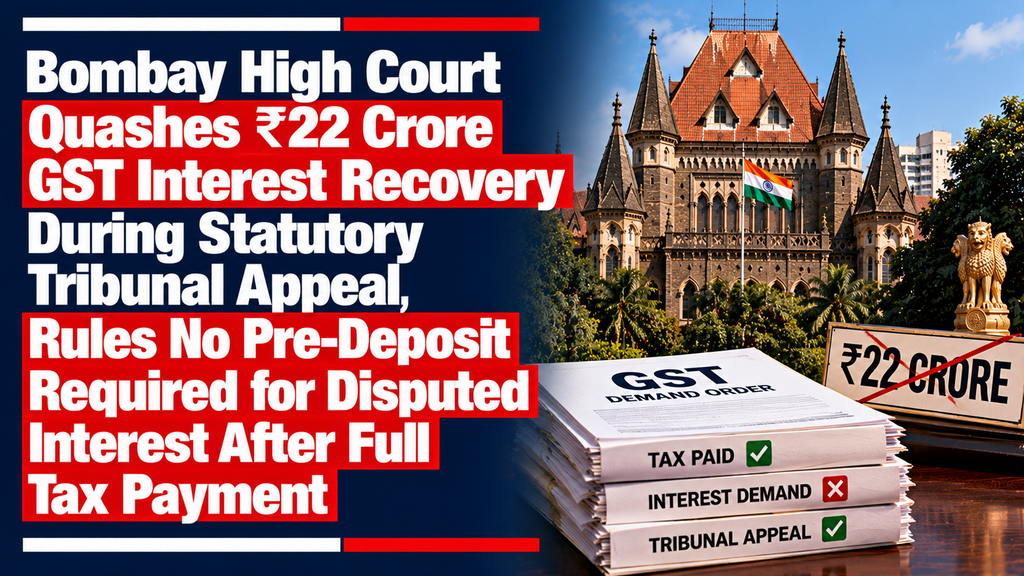
Bombay High Court Quashes ₹22 Crore GST Interest Recovery During Statutory Tribunal Appeal, Rules No Pre-Deposit Required for Disputed Interest After Full Tax Payment

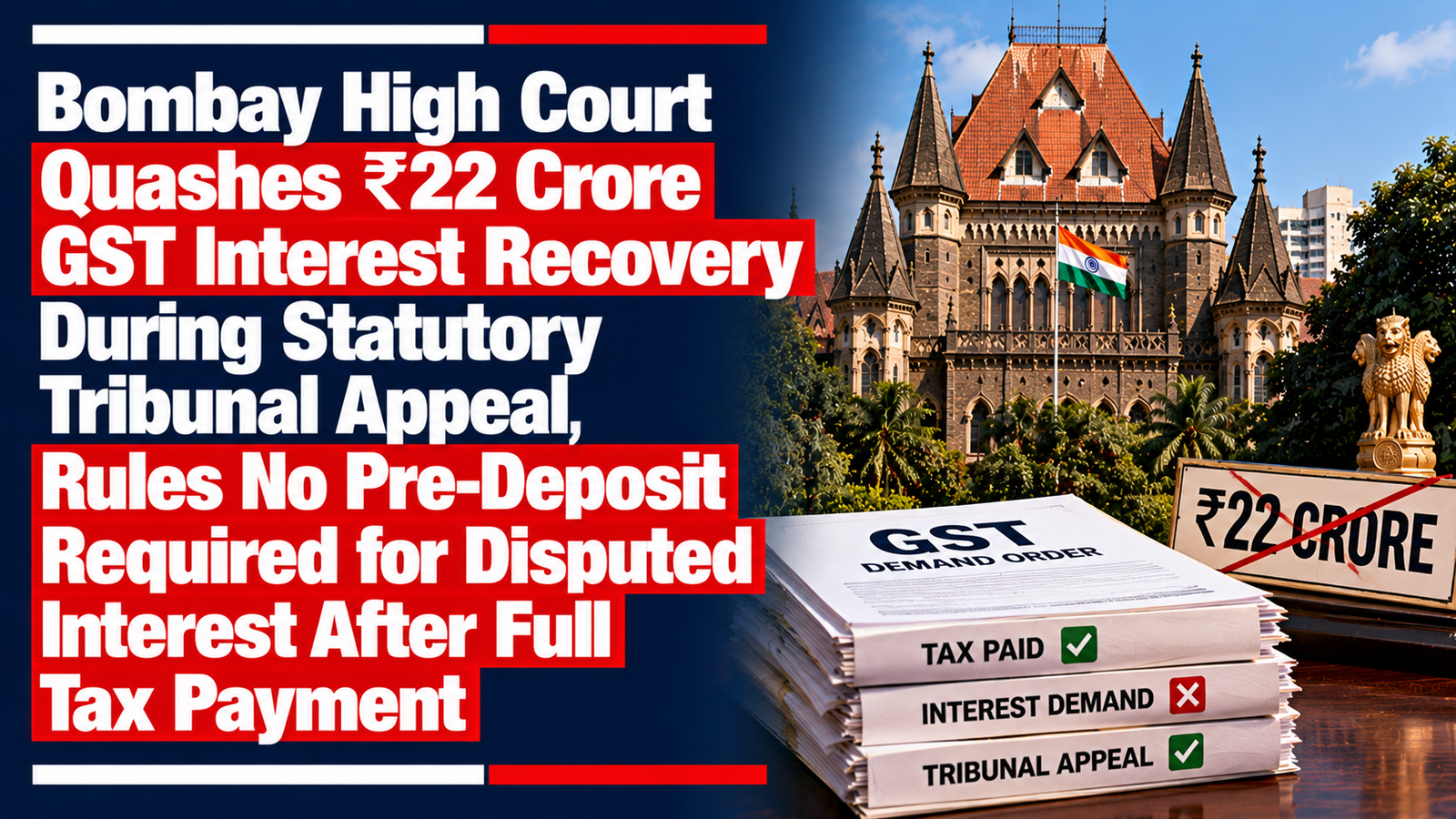
Bombay High Court Orders Banks to Lift Debit Freezes, Holds Pending GST Tribunal Appeal Automatically Stays ₹22 Crore Interest Recovery Without Any Separate Interest Pre-Deposit
Facts
Roadway Solutions India Infra Ltd., a road-construction and maintenance contractor, challenged recovery communications dated 4 and 23 September 2026 and five garnishee notices served on banks on 29 September 2026 under Section 79(1)(c), CGST/MGST Act, 2017. The notices sought ₹22,12,15,180 in interest relating to FY 2023–24, 2024–25 and 2025–26. Tax authorities alleged delayed discharge of outward-supply liabilities under Section 50. An adjudication order of 16 April 2026 was affirmed in appeal on 13 July 2026, and the taxpayer pursued appeals before the GST Appellate Tribunal. The principal tax had been paid; the interest was disputed.
Issues
Whether the percentage-based appellate pre-deposit under Sections 107(6) and 112(8) applies where the tax has been discharged and only interest is contested; whether recovery of the disputed interest is deemed stayed under Sections 107(7) and 112(9) pending statutory appeal; and whether the State could continue Section 79(1)(c) recovery notices to banks and resultant debit restrictions. The validity and calculation of the interest itself was not for final determination in these writ petitions.
Petitioner’s Arguments
The company submitted that it had paid the entire underlying tax and lodged an acknowledged appeal before the Tribunal against the interest liability. Sections 107(6) and 112(8) require full payment of admitted sums and a prescribed percentage of disputed tax, but prescribe no percentage deposit for disputed interest alone. Accordingly, the balance demand stood automatically stayed under Sections 107(7) and 112(9). It also relied on Section 78, challenged recovery before expiry of the statutory period, and asserted that contractual disputes and payments made under protest warranted reconsideration of tax/interest liability. Bank restrictions, it said, had impaired business operations.
Respondent’s Arguments
The State contended that interest under Section 50 is compensatory and follows automatically when self-assessed tax is paid after the statutory due date. GSTR-1 reporting and GSTR-3B payment operate differently; delayed invoice disclosure cannot shift the time of supply. Sections 75(9) and 75(12) permit recovery of interest on unpaid or belatedly paid self-assessed liabilities without a fresh tax determination, and Section 79 authorises bank garnishee notices. The authorities maintained that payment of the underlying tax demonstrated liability and opposed the taxpayer’s claim to an appeal-related recovery stay.
Analysis of the Law
Sections 107(6)(a) and 112(8)(a) require deposit of the admitted component of tax, interest, fine, fee and penalty. The percentage-based deposit under Sections 107(6)(b) and 112(8)(b) applies to the remaining “tax in dispute”; it does not refer to contested interest alone. Once the applicable deposit conditions are satisfied, Sections 107(7) and 112(9) deem recovery of the balance stayed, with Section 112(9) operating until Tribunal disposal. Although Section 50 creates interest liability and Section 75(12) permits recovery of self-assessed dues, those provisions must operate subject to the statutory appellate stay. The merits of disputed interest remain for the Tribunal.
Precedent Analysis
The petitioner cited Evergreen Construction Pvt. Ltd. v. Commissioner of Commercial Taxes (Calcutta High Court), Tejas Arecanut Traders v. Joint Commissioner of Commercial Taxes (Appeals) (Karnataka High Court), Magnum Estates Pvt. Ltd. v. Additional Commissioner, GST (Appeals) (Orissa High Court), and Hongkong and Shanghai Banking Corporation Ltd. v. State of Maharashtra (Bombay High Court). The Bench recorded these authorities but resolved the controversy principally through the text of Sections 107(6)–(7) and 112(8)–(9); the judgment does not separately analyse or formulate a ratio from each cited decision.
Court’s Reasoning
The Court found that the entire tax had already been deposited and the surviving appellate challenge related to interest. The first appeal and the Tribunal appeals were entertained without an interest pre-deposit. A statutory percentage deposit tied to disputed “tax” could not be extended by interpretation to disputed “interest”. Consequently, the appeals attracted the deemed stay in Section 112(9), making continued collection of the identified interest amounts through bank notices contrary to law. The Court expressly refrained from adjudicating the interest computation, the taxpayer’s assertion of protest, and its proposed refund claim of approximately ₹80 crore.
Conclusion
All three writ petitions were allowed on 27 October 2026. The Court quashed the recovery communications dated 4 and 23 September 2026 and five bank notices dated 29 September 2026 insofar as they sought the interest demands covered by pending Tribunal appeals. It declared that recovery stands stayed on compliance with Section 112(8) until the appeals are decided and directed the State Tax authority to withdraw the bank notices, inform the banks forthwith and remove debit restrictions arising solely from those notices. The Tribunal retains jurisdiction over the substantive interest disputes. No order as to costs.
Case: Roadway Solutions India Infra Ltd. v. State of Maharashtra & Ors.
Court: High Court of Judicature at Bombay, Civil Appellate Jurisdiction
Case Number: Writ Petition Nos. 14038, 14039 & 14040 of 2026; 2026:BHC-AS:43662-DB
Judge: Hon’ble Mr. Justice M. S. Karnik and Hon’ble Mr. Justice Sandesh D. Patil
Date: 27 October 2026
Result: Three writ petitions allowed; ₹22.12 crore interest recovery notices quashed; bank debit restrictions directed to be lifted; merits reserved for GSTAT