Supreme Court Rules Creditors Cannot Withdraw Approved Insolvency Resolution Plan Before NCLT Confirmation Merely Because Corporate Debtor’s Financial Position Improves During Prolonged Insolvency Proceedings

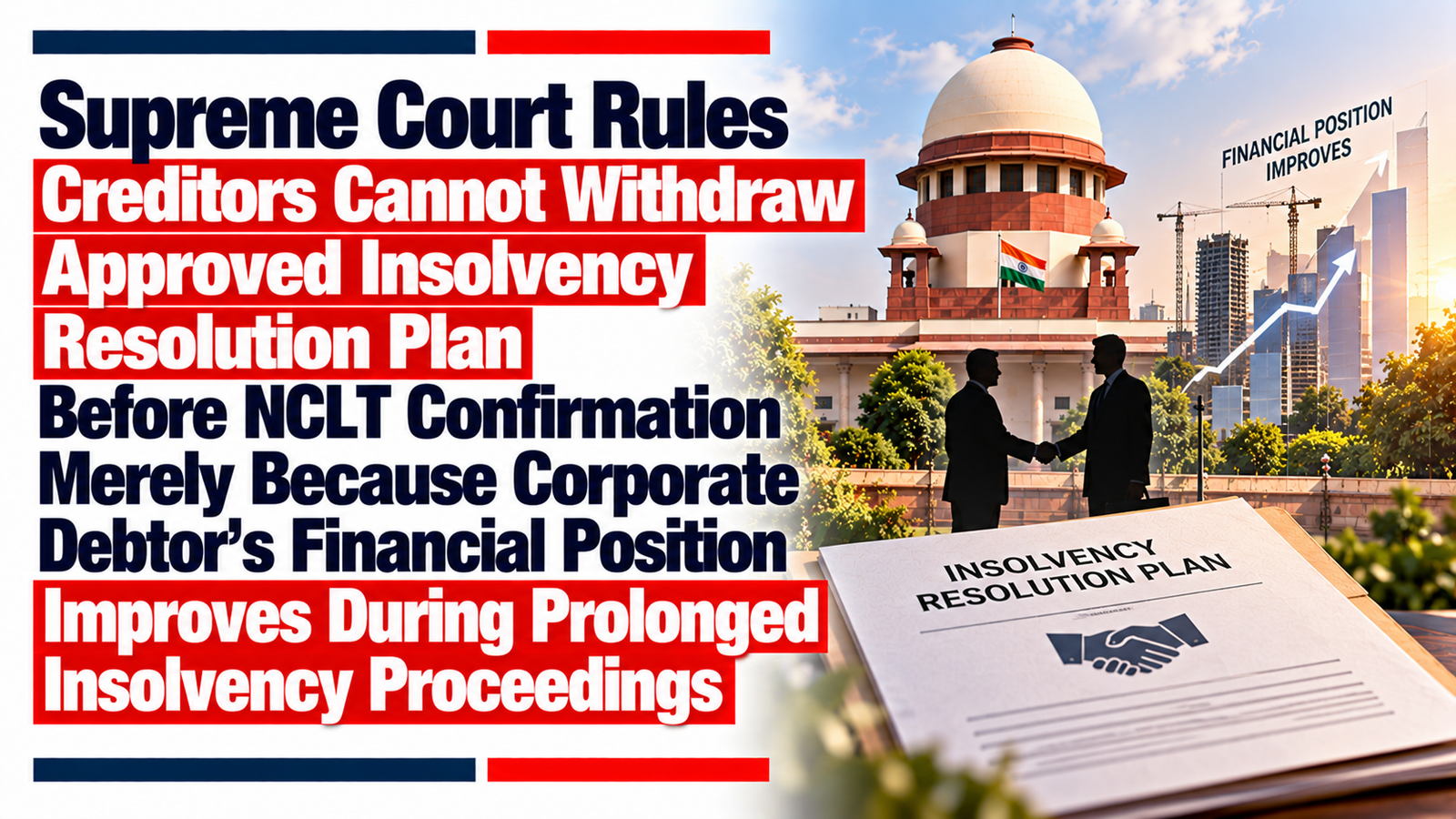
Supreme Court Upholds Binding Nature of Creditors’ Approved Resolution Plans, Directs NCLT to Decide Rival Applications and Rejects Improved Profitability Alone as Valid Withdrawal Ground
Facts
Creditors of a corporate debtor operating a national-highway toll project approved a resolution plan proposed by a successful resolution applicant (SRA), involving ₹172.55 crore. Litigation and a Supreme Court stay delayed NCLT confirmation; meanwhile, the debtor’s cash balance reportedly rose from ₹30 crore to ₹165 crore. The Committee of Creditors (CoC) unanimously sought to withdraw its approval and invite fresh expressions of interest. The debtor’s holding company separately proposed a one-time settlement (OTS) and exit from CIRP. The NCLT permitted withdrawal, but the NCLAT reversed that decision and restored consideration of the plan and OTS applications. Six CoC members appealed.
Issues
Can a CoC retract its approval of a resolution plan after voting under Section 30(4) IBC but before confirmation under Section 31 merely because the corporate debtor’s finances improve? Does Section 12A permit withdrawal of the insolvency application at this stage? What must the NCLT examine when deciding the pending resolution-plan approval and promoter-OTS applications?
Petitioner’s Arguments
The appellant creditor banks relied on the CoC’s commercial wisdom and the IBC objective of maximising asset value. The increase in cash holdings, they argued, would confer an unjustified windfall on the SRA while reducing its fresh infusion under the ₹172.55-crore plan; creditors should be allowed to reassess terms and publish a fresh Form G. They also invoked the CoC’s continued role during plan implementation and its unanimous support for withdrawal.
Respondent’s Arguments
The SRA argued that a CoC-approved plan binds both sides even before NCLT confirmation: creditors cannot renege after improvement any more than an applicant may withdraw after deterioration. Subsequent operating revenue would have belonged to the SRA had implementation occurred on time, and an improvement was contemplated by the plan. Separately, the corporate debtor’s holding company advocated its proposed OTS, saying creditors could be discharged and the CIRP closed without handing control to the SRA.
Analysis of the Law
Section 30(4) permits CoC approval by at least 66% voting share; the resulting plan is binding inter se the CoC and SRA pending NCLT consideration. Section 12A, ordinarily requiring 90% CoC approval for withdrawal of admitted CIRP, cannot be read in isolation to authorise abandonment after CoC approval of the plan and submission to the adjudicating authority. Under Sections 30(2) and 31(1), the NCLT must test statutory compliance, including prescribed treatment of creditors, rather than reopen commercial bargains solely because the debtor’s business fortunes changed.
Precedent Analysis
Ebix Singapore (P) Ltd. v. CoC of Educomp Solutions Ltd., (2022) 2 SCC 401, establishes that a CoC-approved plan binds the SRA and CoC before NCLT approval and cannot be unilaterally modified or withdrawn. Glas Trust Co. LLC v. Byju Raveendran discusses Section 12A withdrawal stages. Kalyani Transco v. Bhushan Power & Steel Ltd. recognises that the CoC survives for implementation-related decisions, but not to alter an approved plan. The Court also considered SBI v. Consortium of Murari Lal Jalan and Florian Fritsch.
Court’s Reasoning
The Supreme Court rejected the premise that post-approval commercial wisdom permits creditors to abandon an agreed plan in pursuit of a larger recovery. Once approved and filed, the resolution plan binds the CoC and SRA notwithstanding delayed adjudication. The CoC’s continuing interest in implementation is not a power to rewrite or revoke its approval. The NCLT must nonetheless consider the present financial position and cash balance against the plan and decide both pending applications in accordance with Sections 30(2) and 31(1). Improved profitability, standing alone, cannot justify refusal of a compliant plan; observations apart from its binding nature were expressly prima facie.
Conclusion
The Supreme Court declined to interfere with the NCLAT’s order and disposed of the creditors’ appeal. It requested the NCLT to hear together, and decide expeditiously, the RP’s application for confirmation of the CoC-approved resolution plan (IA No. 1505/2021) and the holding company’s OTS-related application (IA No. 1679/2025). No final approval of the resolution plan or acceptance of the OTS was granted by the Supreme Court. The central holding is that neither the CoC nor the SRA may unilaterally withdraw a CoC-approved plan pending NCLT confirmation.
Case: Bank of India & Ors. v. S.M. Kamal Pasha & Ors.
Court: Supreme Court of India, Civil Appellate Jurisdiction
Case Number: Civil Appeal No. 12045 of 2026; 2026 INSC 1154
Judge: Justice J.B. Pardiwala and Justice K. Vinod Chandran (opinion by K. Vinod Chandran, J.)
Date: 26 October 2026
Result: Appeal disposed of; NCLAT order left undisturbed; NCLT requested to decide resolution-plan and OTS applications together expeditiously.