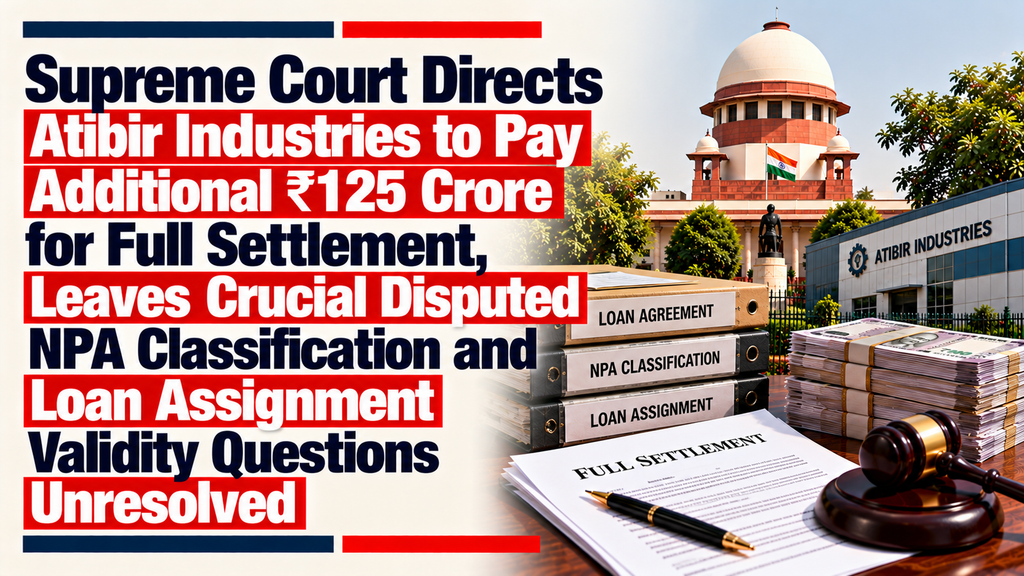
Supreme Court Directs Atibir Industries to Pay Additional ₹125 Crore for Full Settlement, Leaves Crucial Disputed NPA Classification and Loan Assignment Validity Questions Unresolved

Supreme Court Balances Borrower and Asset Reconstruction Company Interests, Orders ₹375 Crore Total Settlement and Release of All Securities Within Four Weeks After Final Payment
Facts
Atibir Industries, a steel manufacturer, borrowed from a State Bank of India-led consortium. SBI retrospectively treated the account as a non-performing asset (NPA) effective 16 October 2020, demanded substantial dues, pursued recovery before the DRT and insolvency proceedings before the NCLT, and assigned the debt to an asset reconstruction company (ARC) for ₹250 crore on 24 March 2023. A Calcutta High Court Single Judge invalidated the NPA classification and assignment in light of COVID-era RBI relief; the Division Bench reversed that ruling. In the Supreme Court, Atibir paid the ARC ₹250 crore under interim directions. A retired Supreme Court judge, Justice Anil R. Dave, reported on possible additional liability.
Issues
Whether the COVID-19 moratorium and repayment rescheduling undermined retrospective NPA classification; whether SBI validly assigned its debt under SARFAESI despite pending recovery proceedings; and, after payment of ₹250 crore, what further sum should secure final discharge of the assigned debt. The Supreme Court ultimately resolved the monetary dispute on case-specific equitable terms, expressly leaving the underlying NPA and assignment-validity questions open.
Petitioner’s Arguments
Atibir maintained that RBI pandemic measures extended the effective repayment timeline and made the 16 October 2020 NPA date premature. It challenged SBI’s quick assignment amid one-time-settlement negotiations and raised concerns that the ARC’s acquisition was funded through entities allegedly linked to a business competitor. Having paid ₹250 crore, Atibir resisted any additional commercial premium; alternatively, it proposed interest not exceeding 7.5% per annum. These allegations about funding and motive were raised by Atibir, not finally adjudicated as wrongdoing.
Respondent’s Arguments
SBI and the ARC relied on persistent cash-credit irregularities, borrower-wise NPA treatment and the bank’s commercial discretion to transfer its financial asset. The ARC argued that an assignee steps into the bank’s shoes and can recover the assigned contractual debt, rather than merely its ₹250 crore acquisition price. It stated that principal and accrued interest at assignment were substantially higher and objected to Justice Dave’s investment-return approach as overlooking the distinction between debt value and purchase consideration.
Analysis of the Law
The judgment considers RBI asset-classification and COVID-19 moratorium circulars; Section 5 and Sections 13(2)/(4) of the SARFAESI Act, 2002; debt-recovery proceedings; and Section 7 of the Insolvency and Bankruptcy Code, 2016. The Court acknowledged that assignment of bank debt and simultaneous statutory remedies may be legally permissible, but did not determine whether the disputed classification or this particular assignment was valid. The operative relief was a one-time, fact-specific settlement to balance a functioning industry’s survival against the assignee’s interests, rather than a general rule capping ARC recovery at purchase price.
Precedent Analysis
Small Scale Industrial Manufacturers Association v. Union of India, (2021) 8 SCC 511, was noted concerning COVID-era NPA restrictions. Transcore v. Union of India, (2008) 1 SCC 125, recognizes SARFAESI remedies as additional to DRT recovery. ICICI Bank Ltd. v. Official Liquidator of APS Star Industries Ltd., (2010) 10 SCC 1, affirms banks’ ability to assign debts. Bijnor Urban Cooperative Bank Ltd. v. Meenal Aggarwal, (2023) 2 SCC 805, rejects a compulsory right to one-time settlement. None was treated as conclusively resolving this transaction’s validity.
Court’s Reasoning
The Court considered the disputed retrospective NPA date, RBI moratorium, ongoing DRT/NCLT proceedings, unsuccessful settlements, accelerated e-auction and competing allegations about assignment funding. Justice Dave had proposed illustrations of 13%, 14% and 15% returns on the ARC’s ₹250 crore investment, plus possible costs; the ARC had not provided requested financial statements. Without adopting a general debt-valuation principle or ruling on misconduct, the Court fixed a further ₹125 crore, having regard to the highest illustrated return, passage of time and expenses. Together with ₹250 crore already paid, the amount produces a ₹375 crore final settlement.
Conclusion
The appeals were disposed of with directions: Atibir must pay the ARC an additional ₹125 crore within 12 weeks of 26 October 2026. Payment fully and finally settles the ARC’s claims on the assigned debt. Within four weeks of receipt, SBI and the ARC must return title documents and release all securities and guarantees; pending Section 7 IBC proceedings before NCLT Kolkata and recovery proceedings before DRT-I Kolkata stand disposed of in light of the settlement. Strict default consequence: if Atibir misses the 12-week deadline, respondents may revive proceedings and Atibir loses the judgment’s benefit. The Court did not decide NPA or assignment legality.
Case: Atibir Industries Co. Ltd. v. State Bank of India & Anr.
Court: Supreme Court of India, Civil Appellate Jurisdiction
Case Number: Civil Appeals arising out of SLP (C) Nos. 21029-21030/2024; 2026 INSC 1156
Judge: CJI Surya Kant, Justice Joymalya Bagchi and Justice V. Mohana (opinion by V. Mohana, J.)
Date: 26 October 2026
Result: Appeals disposed of; ₹125 crore additional payment ordered within 12 weeks as full settlement of the assigned debt, subject to compliance and revival on default.