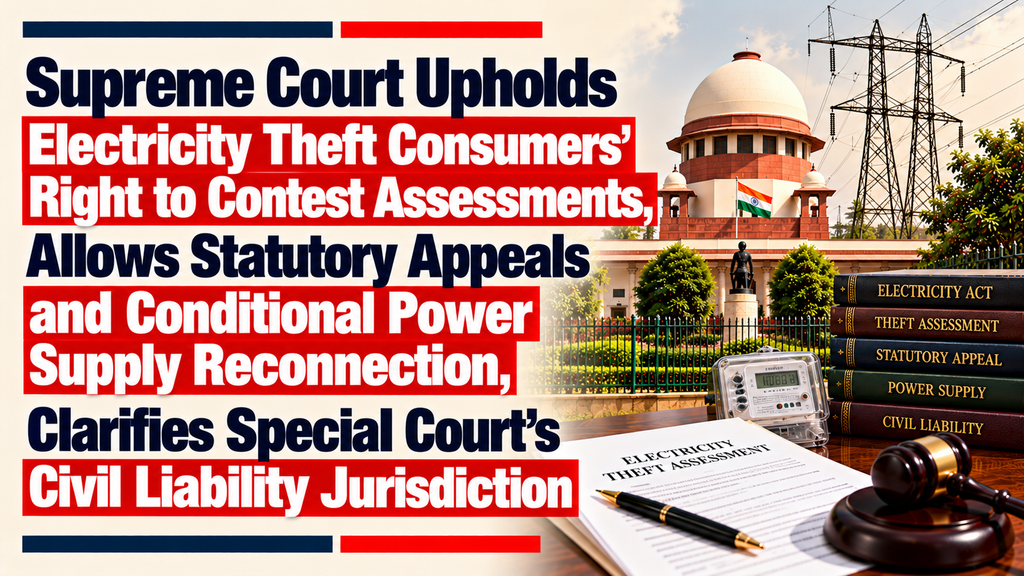
Supreme Court Upholds Electricity Theft Consumers’ Right to Contest Assessments, Allows Statutory Appeals and Conditional Power Supply Reconnection, Clarifies Special Court’s Civil Liability Jurisdiction

Supreme Court Interprets Electricity Act Sections 126, 127 and 135, Upholds Reconnection on Fifty Percent Deposit, Preserves Special Court Authority Over Electricity Theft Civil Liability
Facts
Two Gujarat electricity distribution companies challenged High Court orders concerning supplementary bills for alleged theft of electricity. Dakshin Gujarat Vij Company Ltd. demanded ₹92,99,077.55 from Vaibhav Metal Crusher, plus ₹23,45,845 towards compounding, under a notice dated 3 January 2024. A Single Judge permitted reconnection on deposit of 50% of the bill. In LPA No. 592/2024, the Division Bench allowed objections before the Executive Engineer and indicated an appeal under Section 127. In the connected Paschim Gujarat Vij Company Ltd. matter, Jamanbhai Nanajibhai Bhuva challenged a supplementary theft bill dated 1 June 2023. The High Court remanded his matter to the Single Judge. Both licensees appealed.
Issues
Whether electricity-theft demands under Section 135(1A) must follow the assessment, hearing and appellate procedure in Sections 126–127 of the Electricity Act, 2003; whether the Special Court’s power to determine civil liability under Section 154(5) excludes that assessment; whether a constitutional court may order interim restoration of supply upon deposit of 50% of the provisional demand; and whether the impugned Gujarat High Court orders required interference.
Petitioner’s Arguments
The distribution licensees submitted that theft under Section 135 is distinct from mere unauthorised use under Section 126. They asserted that an alleged thief cannot insist on an objection hearing or a Section 127 appeal against the theft-related supplementary bill; the Section 135(1A) assessment exists only to facilitate reconnection. According to the licensees, the Special Court alone finally determines civil liability under Section 154(5), and routinely reconnecting electricity against 50% payment undermines deterrence, the statutory deposit requirement and proceedings for theft.
Respondent’s Arguments
The consumers argued that the third proviso to Section 135(1A) expressly permits restoration following payment of the ‘assessed amount’ but provides no independent assessment mechanism. Accordingly, assessment must use Section 126, including objections, hearing and an appeal under Section 127. An appellate order could govern the amount payable for reconnection without displacing the Special Court’s subsequent determination of civil liability. They defended the High Court’s limited interim protection and directions permitting challenges to the supplementary demand.
Analysis of the Law
Section 126 governs assessment for unauthorised use and affords service of provisional assessment, objections, hearing and a Section 127 appeal. Theft defined in Section 135 necessarily entails unauthorised use, though every unauthorised use is not theft. Section 135(1A) permits immediate disconnection and requires restoration within 48 hours following the prescribed payment. Because neither the Act nor the relevant Gujarat Supply Code supplies a distinct theft-assessment procedure, Section 126 safeguards apply to computing the reconnection amount. The Section 127 result is final only for reconnection, not the Special Court’s civil-liability jurisdiction under Section 154(5). Section 154(6) provides refund of excess deposits.
Precedent Analysis
The Court applied West Bengal State Electricity Distribution Company Ltd. v. Orion Metal Pvt. Ltd., (2020) 18 SCC 588, which recognises Section 126 assessments alongside prosecution under Section 135 and separate civil-liability determination under Section 154. It also considered Southern Electricity Supply Company of Orissa Ltd. v. Sri Seetaram Rice Mill, (2012) 2 SCC 108, addressing the breadth of ‘unauthorised use’ under Section 126. These authorities rebutted the claim that a theft allegation completely excludes assessment or statutory procedural safeguards.
Court’s Reasoning
The Court held that assessment and appeal are needed for a timely, reviewable reconnection figure, whereas making the consumer await the Special Court would frustrate Section 135(1A). High Courts retain Article 226 power to protect against arbitrary provisional demands, but electricity theft warrants restraint: a 50% deposit is not automatic and must be supported by recorded reasons, including a prima facie arbitrary assessment. In the present circumstances, the Gujarat High Court’s 50% deposit and objection directions sufficiently protected the licensee. The Court clarified that the amount remains subject first to Section 127 appeal and then, if prosecution follows, to final civil liability under Section 154(5).
Conclusion
Both appeals were dismissed. The Supreme Court upheld the High Court order in LPA No. 592/2024 subject to clarification that the assessed amount remains appealable under Section 127 and is ultimately subject to civil liability determined by the Special Court in any theft prosecution. It declined to disturb the remand ordered in connected LPA No. 474/2024, leaving the Single Judge to decide it according to law. Excess money deposited beyond the civil liability determined by the Special Court must be refunded under Section 154(6). The judgment does not confer unconditional reconnection on 50% payment in every theft case.
Case: Dakshin Gujarat Vij Company Ltd. & Anr. v. Vaibhav Metal Crusher; connected Paschim Gujarat Vij Company Ltd. & Anr. v. Jamanbhai Nanajibhai Bhuva
Court: Supreme Court of India, Civil Appellate Jurisdiction
Case Number: Civil Appeals arising from SLP (C) Nos. 17868/2024 and 8778/2025; 2026 INSC 1157
Judge: Hon’ble Justices Manoj Misra and K.V. Viswanathan (judgment by Manoj Misra, J.)
Date: 26 October 2026
Result: Both appeals dismissed; High Court’s first order upheld with clarification; connected remand sustained; Special Court’s final civil-liability power preserved