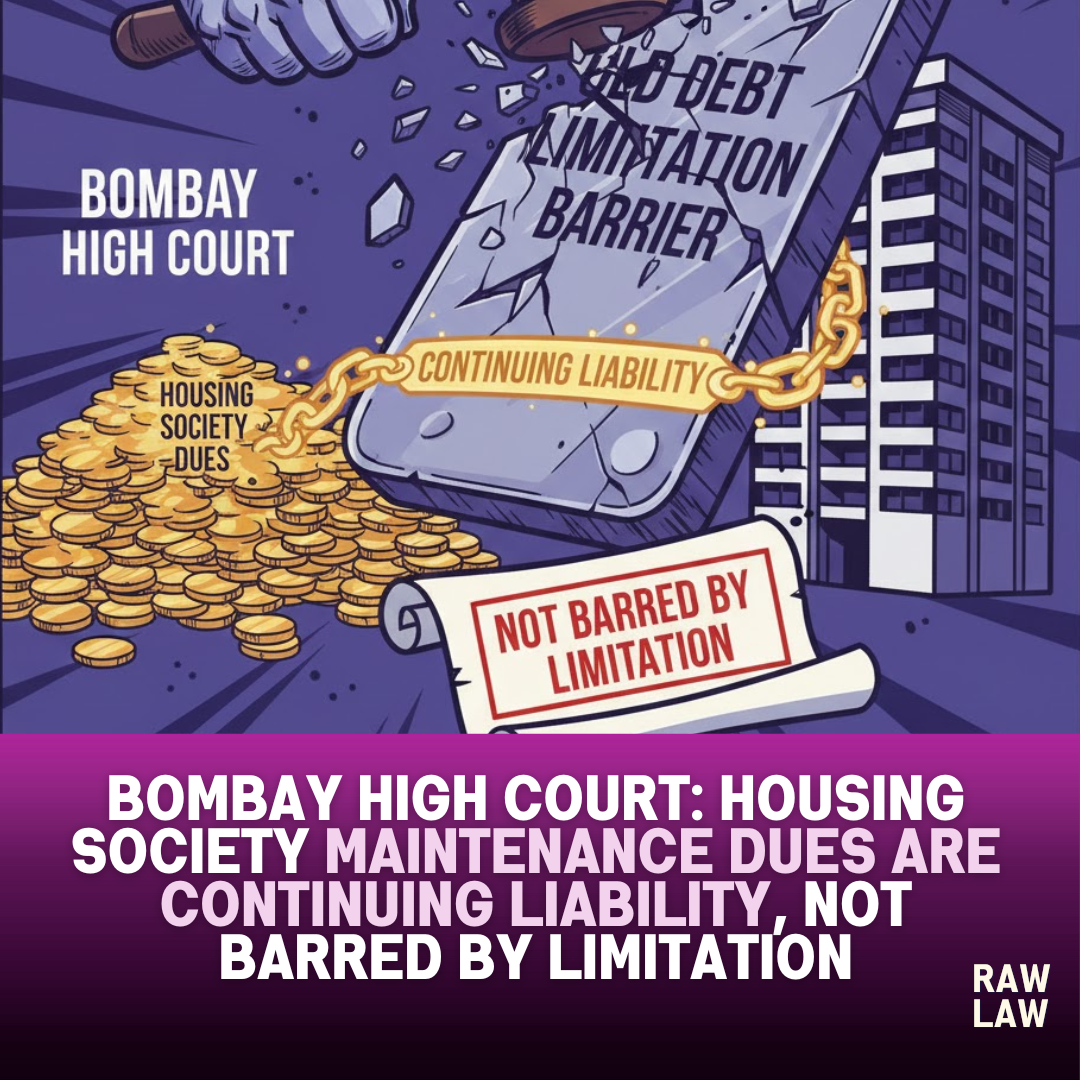
Bombay High Court: Housing society maintenance dues are continuing liability, not barred by limitation

HEADNOTE
Aspandiar Rashid Irani & Anr. v. Pasayadan Cooperative Housing Society Ltd. & Ors.
(With connected Writ Petitions)
Court: Bombay High Court
Jurisdiction: Civil Appellate Jurisdiction
Bench: Justice Amit Borkar
Date of Judgment: January 16, 2026
Citation: 2026:BHC-AS:1749
Laws / Sections Involved:
Maharashtra Cooperative Societies Act, 1960 – Section 154B-29, Section 154B-1;
Maharashtra Ownership Flats Act, 1963 – Sections 2(c), 4, 10;
Limitation Act, 1963 (principles discussed)
Keywords: Cooperative housing society dues, Section 154B-29 MCS Act, limitation, continuing liability, maintenance arrears, flat owner liability
Summary
The Bombay High Court dismissed a batch of writ petitions filed by elderly flat holders challenging recovery certificates issued for long-pending maintenance and service charges by a cooperative housing society. The Court held that society dues such as maintenance and service charges are recurring statutory obligations and constitute a continuing wrong, and therefore recovery under Section 154B-29 of the Maharashtra Cooperative Societies Act is not barred by limitation merely due to lapse of time. Emphasising the special and overriding nature of Section 154B-29, the Court ruled that the Limitation Act does not apply to such recovery proceedings. It further held that persons who enjoy possession and benefits of flats cannot evade liability by disputing formal membership or absence of a registered agreement, as society dues run with the premises.
Court’s decision
The Bombay High Court dismissed all connected writ petitions and upheld the recovery certificates issued by the Deputy Registrar under Section 154B-29 of the Maharashtra Cooperative Societies Act. The Court held that maintenance and service charges payable to a cooperative housing society are recurring and continuing statutory obligations, and recovery of such dues cannot be defeated on the ground of limitation or delay. The Court also refused to grant any stay on the operation of its judgment.
Facts
The petitioners entered into an unregistered development agreement in 1996 and received possession of four flats as consideration. A cooperative housing society was registered in 2005. According to the petitioners, they were never admitted as members and were never billed for maintenance. In 2023, the society issued a demand notice seeking arrears of maintenance from 2005 onwards and initiated recovery proceedings under Section 154B-29 of the MCS Act. Recovery certificates were issued by the Deputy Registrar and confirmed in revision, prompting the petitioners to approach the High Court.
Issues
The principal issues before the Court were whether recovery of housing society dues after several years was barred by limitation, whether Section 154B-29 of the MCS Act is governed by the Limitation Act, and whether persons in possession of flats without registered agreements or formal membership can be made liable for society dues.
Petitioners’ arguments
The petitioners argued that recovery applications filed in 2023 for dues allegedly arising from 2005 were ex facie barred by limitation. They contended that the Registrar acts as a court and therefore Article 137 of the Limitation Act applied. It was also argued that prior to the 2019 amendment, recovery proceedings could be initiated only against members and not against non-members or flat holders without registered sale agreements under MOFA. The absence of a society resolution authorising recovery was also highlighted.
Respondent’s arguments
The society contended that maintenance dues are statutory, recurring, and attached to the premises. It was argued that Section 154B-29 is a special, self-contained recovery mechanism with overriding effect and no prescribed limitation period. The society submitted that the petitioners enjoyed possession, paid taxes, and benefited from common amenities, and therefore could not evade liability by disputing formal membership. It was further contended that non-payment constituted a continuing default.
Analysis of the law
The Court analysed the scheme of the MCS Act and held that Section 154B-29 is a special provision providing an independent and summary mode of recovery with finality attached to recovery certificates. The absence of any limitation period was held to be deliberate. The Court ruled that general principles of the Limitation Act cannot be imported to defeat a statutory recovery mechanism, particularly where dues are incurred monthly for common services essential to the society’s functioning.
Precedent analysis
The Court relied on its earlier decision in Sudhakar Hanumant Pawar v. Divisional Joint Registrar, Cooperative Societies (2025) to hold that Section 92 of the MCS Act does not apply to proceedings under Section 154B-29. It also applied Supreme Court jurisprudence on continuing wrongs, including M. Siddiq v. Suresh Das and CWT v. Suresh Seth, to conclude that non-payment of recurring dues constitutes a continuing breach.
Court’s reasoning
The Bench held that society dues arise from occupation and enjoyment of common amenities and “run with the flat”. Each month of non-payment gives rise to a fresh cause of action. The Court rejected the argument that lack of a registered agreement or formal membership absolves liability, holding that persons who represent and enjoy the premises in law must bear the corresponding obligations. Permitting defaulters to escape liability due to passage of time would, the Court observed, undermine the very concept of cooperative living.
Conclusion
The Bombay High Court found no illegality in the recovery proceedings and dismissed all writ petitions, affirming the recovery certificates issued against the petitioners.
Implications
This judgment has wide ramifications for cooperative housing societies across Maharashtra. It firmly establishes that maintenance and service charges are continuing statutory liabilities and that societies can invoke Section 154B-29 to recover long-pending dues without being defeated by limitation defences, thereby strengthening financial discipline and collective responsibility in cooperative housing governance.
Case law references
• Sudhakar Hanumant Pawar v. Divisional Joint Registrar, Cooperative Societies (2025 SCC OnLine Bom 5353)
Holding: Section 92 MCS Act does not apply to recovery proceedings under Section 154B-29.
Application: Relied upon to reject limitation-based objections.
• M. Siddiq v. Suresh Das (2020) 1 SCC 1
Holding: Failure to perform a continuing legal duty constitutes a continuing wrong.
Application: Applied to characterise unpaid society dues as continuing liability.
• CWT v. Suresh Seth (1981) 2 SCC 790
Holding: Breach of a continuous obligation gives rise to a recurring cause of action.
Application: Used to negate the plea of stale claims.
FAQs
Q1. Are housing society maintenance dues barred by limitation?
No. The Bombay High Court held that such dues are recurring and constitute a continuing liability.
Q2. Can non-members be made liable for society dues?
Yes. Persons in possession who enjoy benefits of the society can be made liable even without formal membership.
Q3. Which provision governs recovery of society dues?
Section 154B-29 of the Maharashtra Cooperative Societies Act provides a special recovery mechanism.