Bombay High Court: Misuse of insolvency law to stall secured asset recovery condemned — “IBC cannot be shield for chronic defaulters, writ allowed”

Court’s decision
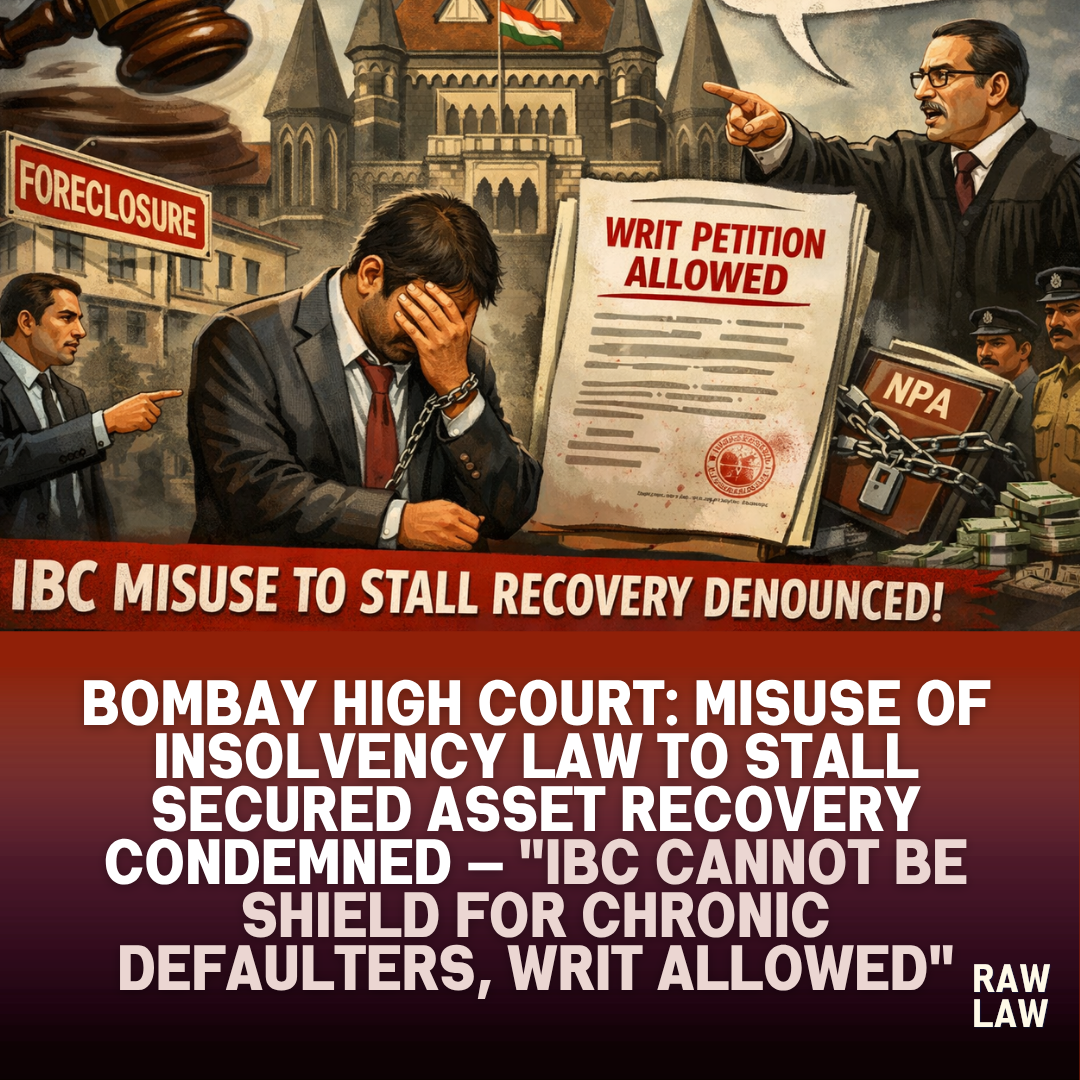
The Bombay High Court allowed the writ petition, set aside the Debts Recovery Tribunal’s order, and directed that possession of the secured asset be handed over to the auction purchaser without further delay. The Court held that repeated invocation of insolvency proceedings to trigger moratorium was a collusive abuse of law and cannot be permitted to frustrate recovery under the Securitisation Act.
Facts
The case arose from loan default by borrowers who had mortgaged property as security. The bank initiated recovery proceedings under the Securitisation Act after issuing notice in 2017.
Despite multiple opportunities, including ten One-Time Settlement (OTS) proposals, the borrowers failed to repay.
After several failed auctions, a successful auction took place in December 2024, and the petitioners emerged as auction purchasers. A sale certificate was issued and registered.
At this stage, the borrowers initiated insolvency proceedings under the Insolvency and Bankruptcy Code (IBC), triggering moratorium and stalling possession.
Even after the National Company Law Tribunal (NCLT), National Company Law Appellate Tribunal (NCLAT), and Supreme Court ruled that the secured asset was excluded from moratorium, the borrowers initiated fresh insolvency proceedings to again stall possession.
The DRT accepted this and halted proceedings, prompting the present writ petition.
Issues
The Court examined whether repeated invocation of insolvency proceedings to trigger moratorium amounted to abuse of process.
It also considered whether the DRT erred in halting possession despite prior judicial findings excluding the asset from moratorium.
Another issue was whether writ jurisdiction could be exercised despite availability of alternate remedies.
Petitioner’s arguments
The auction purchasers argued that the borrowers had adopted a deliberate strategy to frustrate lawful recovery by repeatedly invoking IBC provisions.
It was contended that after failing to challenge proceedings for years, the borrowers used insolvency applications at the last stage to stall possession.
The petitioners argued that such conduct was collusive, mala fide, and resulted in grave injustice by denying them possession despite valid sale.
They sought intervention of the High Court to prevent abuse of legal processes.
Respondent’s arguments
The borrowers contended that moratorium under the IBC was validly triggered upon filing insolvency applications.
They argued that the DRT was correct in halting proceedings until resolution of pending applications.
It was further submitted that the petitioners had an alternate remedy before the appellate tribunal and the writ petition was not maintainable.
Analysis of the law
The Court undertook a detailed examination of the interplay between the Insolvency and Bankruptcy Code and the Securitisation Act.
It emphasized that the IBC is intended to enable time-bound insolvency resolution and not to obstruct legitimate recovery proceedings.
The Court held that moratorium provisions cannot be used mechanically to override completed transactions such as concluded auctions.
It further reiterated that writ jurisdiction can be invoked where there is manifest abuse of process and failure of justice, even if alternate remedies exist.
Precedent analysis
The Court relied on:
- Arce Polymers Pvt Ltd v Alphine Pharmaceuticals Pvt Ltd (2022)
Established principles of waiver and estoppel in SARFAESI proceedings. - ITC Ltd v Blue Coast Hotels Ltd (2018)
Held that borrowers who seek repeated indulgence cannot later challenge recovery actions.
These precedents were used to conclude that borrowers had waived their rights by repeated conduct and could not obstruct recovery.
Court’s reasoning
The Court strongly condemned the conduct of the borrowers, describing it as a pattern of deliberate obstruction.
It noted that borrowers remained inactive for years, submitted multiple OTS proposals, and only approached legal forums after the auction was completed.
The Court found that insolvency applications were filed strategically to trigger moratorium and stall recovery.
It held that such actions were collusive and contrary to the object of the IBC.
Importantly, the Court observed that prior rulings had already clarified that the secured asset was outside the scope of moratorium.
Thus, the DRT’s decision to halt proceedings was legally unsustainable and amounted to jurisdictional error.
The Court concluded that allowing such conduct would encourage misuse of law and undermine financial discipline.
Conclusion
The Bombay High Court set aside the DRT’s order and directed that possession be handed over to the auction purchasers, while also directing expeditious disposal of the pending securitisation application.
Implications
This judgment sends a strong message against misuse of insolvency laws by defaulting borrowers.
It reinforces that IBC cannot be used as a tactical shield to delay recovery.
The ruling strengthens creditor rights and protects auction purchasers from prolonged litigation.
It also clarifies that courts will intervene where legal processes are abused to frustrate justice.
Case law references
- Arce Polymers Pvt Ltd v Alphine Pharmaceuticals Pvt Ltd (2022)
Waiver and estoppel in recovery proceedings. - ITC Ltd v Blue Coast Hotels Ltd (2018)
Borrowers cannot challenge after seeking repeated indulgence.
FAQs
1. Can borrowers use IBC to stop SARFAESI recovery proceedings?
Not if it amounts to abuse of process or if the asset is already excluded from moratorium.
2. Does moratorium apply to completed auction sales?
No. Completed transactions prior to moratorium are generally protected.
3. Can High Courts intervene despite alternate remedies?
Yes, in cases of clear abuse of law or failure of justice.