Bombay High Court refuses to quash deemed conveyance despite fraud and title objections — “MOFA authority’s role is summary, civil court alone can decide ownership”

1. Court’s decision
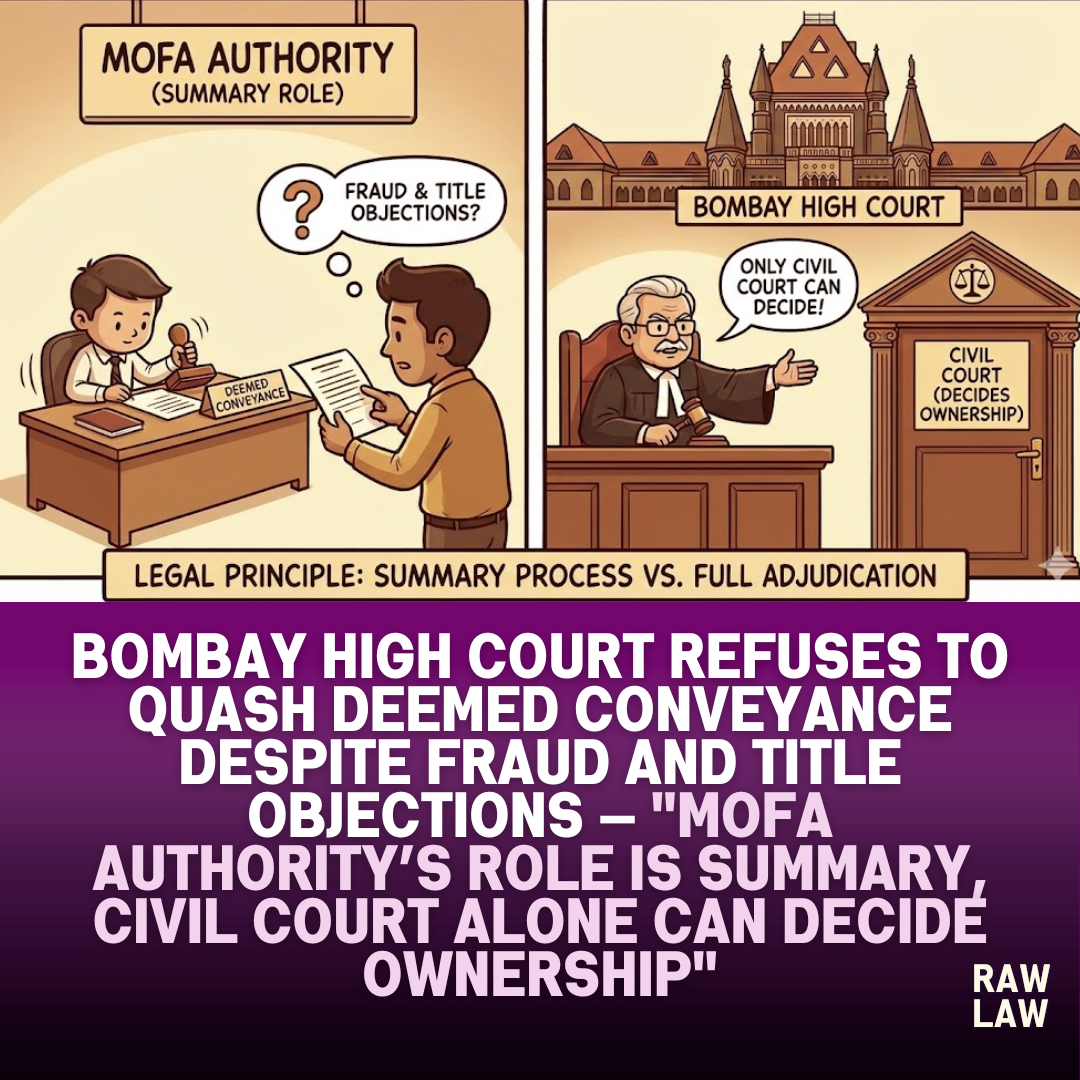
The Bombay High Court dismissed a writ petition filed by an octogenarian legal heir of the original landowner challenging a deemed conveyance granted in favour of a co-operative housing society. The Court held that proceedings under Section 11 of the Maharashtra Ownership Flats Act, 1963 are summary and enforcement-oriented, and that allegations of fraud, disputed title, extent of land, ancestral structures, and development rights cannot be adjudicated in writ jurisdiction. It ruled that the petitioner’s remedy lies before the civil court, not under Article 227.
2. Facts
The petitioner is one of the legal heirs of the original landowner of property bearing Survey Nos. 239 and 182 corresponding to CTS No. 1732 at Dahisar, Mumbai. A co-operative housing society was formed in 1989, and redevelopment followed through developers claiming derivative development rights. In 2021, the society applied for unilateral deemed conveyance under Section 11 of MOFA. The District Deputy Registrar granted deemed conveyance in May 2022, followed by registration of a unilateral conveyance deed, corrigenda, supplementary agreements, and mutation entries. The petitioner challenged these actions alleging fraud, lack of notice, suppression of ancestral chawl and temple, defective title, conveyance beyond contractual land, and violation of natural justice.
3. Issues
The principal issues were whether the deemed conveyance order and subsequent registrations could be quashed in writ jurisdiction on allegations of fraud and jurisdictional error, whether the Competent Authority exceeded its powers by conveying land allegedly beyond the agreements with flat purchasers, and whether alleged defects in notice and hearing vitiated the proceedings under Section 11 of MOFA.
4. Petitioner’s arguments
The petitioner argued that the Competent Authority acted without jurisdiction by conveying land not covered by the flat purchasers’ agreements and by ignoring serious title disputes. It was contended that notices were issued to a deceased landowner, legal heirs were not properly substituted, revised applications were entertained without formal amendment, and a forged no-objection certificate was relied upon. The petitioner asserted that ancestral structures including a chawl and temple were unlawfully included in the conveyance, resulting in deprivation of proprietary rights without due process, rendering the entire process void ab initio.
5. Respondents’ arguments
The respondents contended that proceedings under Section 11 of MOFA are summary and confined to enforcing the statutory obligation of conveyance after prolonged default. They argued that deemed conveyance does not adjudicate title and transfers only such right, title, and interest as the promoter or landowner possesses. It was submitted that several legal heirs had consented or participated, that no real prejudice was shown, and that complex disputes of ownership and extent must be resolved before a civil court.
6. Analysis of the law
The Court analysed the statutory scheme of Section 11 of MOFA, reiterating that the Competent Authority is not a civil court and cannot decide disputed questions of title, ownership, or inter se rights of heirs. The authority’s function is limited to enforcing conveyance in favour of a society based on statutory agreements and prolonged non-execution by the promoter. Writ jurisdiction cannot be invoked to convert such proceedings into a trial on title.
7. Precedent analysis
The Court relied on consistent Bombay High Court precedent, including Zainul Abedin Yusufali Massawala v. Competent Authority, Shimmering Heights CHSL v. State of Maharashtra, and P.R. Enterprises v. Competent Authority, holding that deemed conveyance does not enlarge title and does not bind civil courts. On natural justice, the Court applied the Supreme Court’s ruling in State of U.P. v. Sudhir Kumar Singh, emphasising that interference is warranted only where real prejudice is demonstrated, not on technical or speculative violations.
8. Court’s reasoning
Applying these principles, the Court found that the petitioner’s challenge centred on disputed ownership, extent of land conveyed, inclusion of structures, and alleged defects in development rights—all matters requiring detailed evidence and civil adjudication. Even assuming some procedural irregularity in service, the estate of the original owner was represented through other legal heirs, objections were considered, and no concrete prejudice affecting the outcome was shown. The Court held that deemed conveyance operates only to the extent of the transferor’s existing interest, leaving substantive civil rights untouched.
9. Conclusion
The Bombay High Court dismissed the writ petition, declining to interfere with the deemed conveyance order, registered deeds, and mutation entries. It relegated the petitioner to pursue appropriate remedies before the competent civil court for declaration of title, partition, cancellation, or rectification of conveyance. All questions of fact and law were expressly kept open.
10. Implications
This judgment reaffirms the limited and summary nature of deemed conveyance proceedings under MOFA and draws a clear boundary between statutory enforcement and civil adjudication. It cautions against invoking writ jurisdiction to resolve complex title disputes and underscores that allegations of fraud or overreach, without demonstrated prejudice, must be tested through a full-fledged civil trial.
Case Law References
- Zainul Abedin Yusufali Massawala v. Competent Authority – Held that deemed conveyance transfers only existing interest and does not adjudicate title.
- Shimmering Heights CHSL v. State of Maharashtra – Reiterated that writ courts should not decide ownership disputes arising from MOFA conveyance.
- State of U.P. v. Sudhir Kumar Singh – Applied to hold that violation of natural justice must show real prejudice.
- P.R. Enterprises v. Competent Authority – Confirmed that Section 11 proceedings are summary and not determinative of civil rights.
FAQs
Q1. Can deemed conveyance under MOFA be challenged on title disputes?
Yes, but only before a civil court. Writ courts will not adjudicate disputed ownership or extent of land in MOFA proceedings.
Q2. Does deemed conveyance extinguish landowner’s rights?
No. It transfers only such right, title, and interest as the promoter or landowner possesses. Civil rights remain open for adjudication.
Q3. Is violation of natural justice enough to quash deemed conveyance?
Only if real and demonstrable prejudice is shown. Technical irregularities without impact on outcome will not suffice.