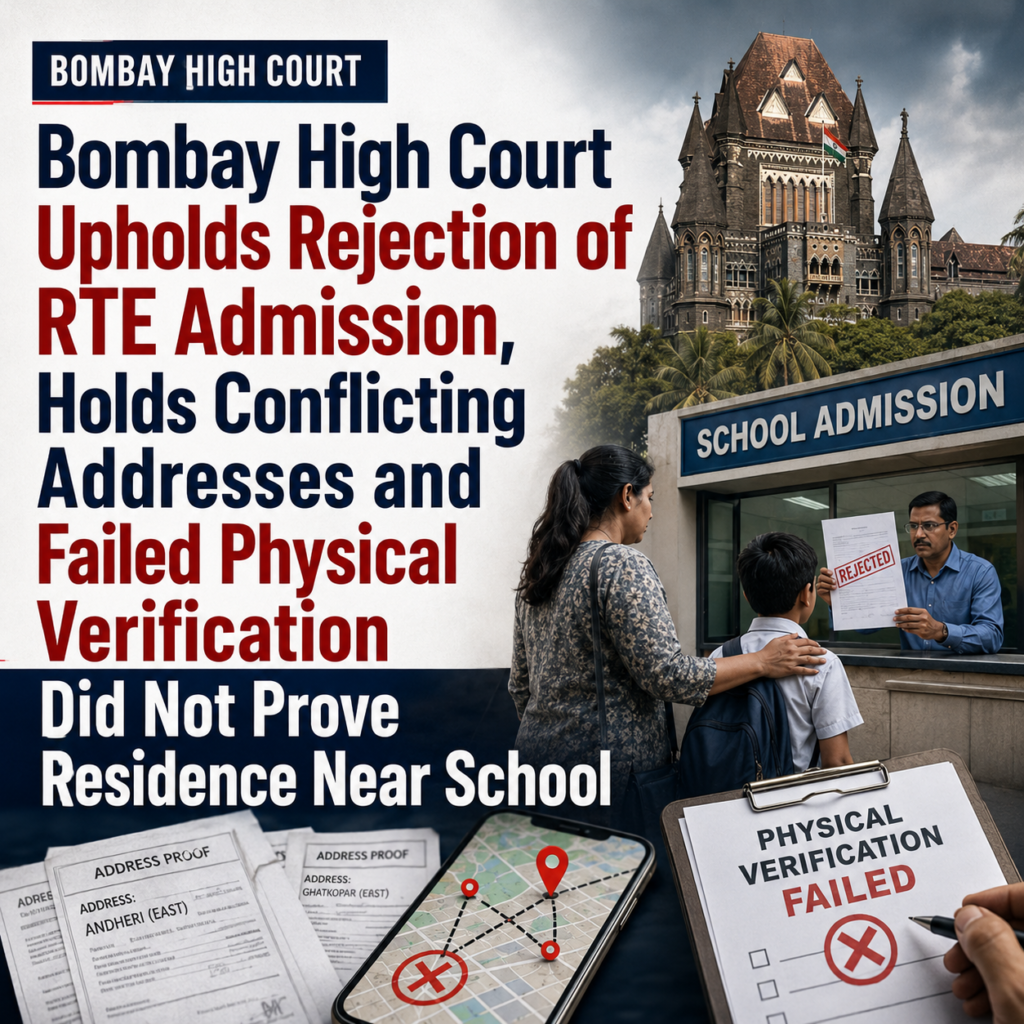
Bombay High Court Rejects RTE Admission Plea After Physical Verification Fails to Establish Child’s Residence Near School

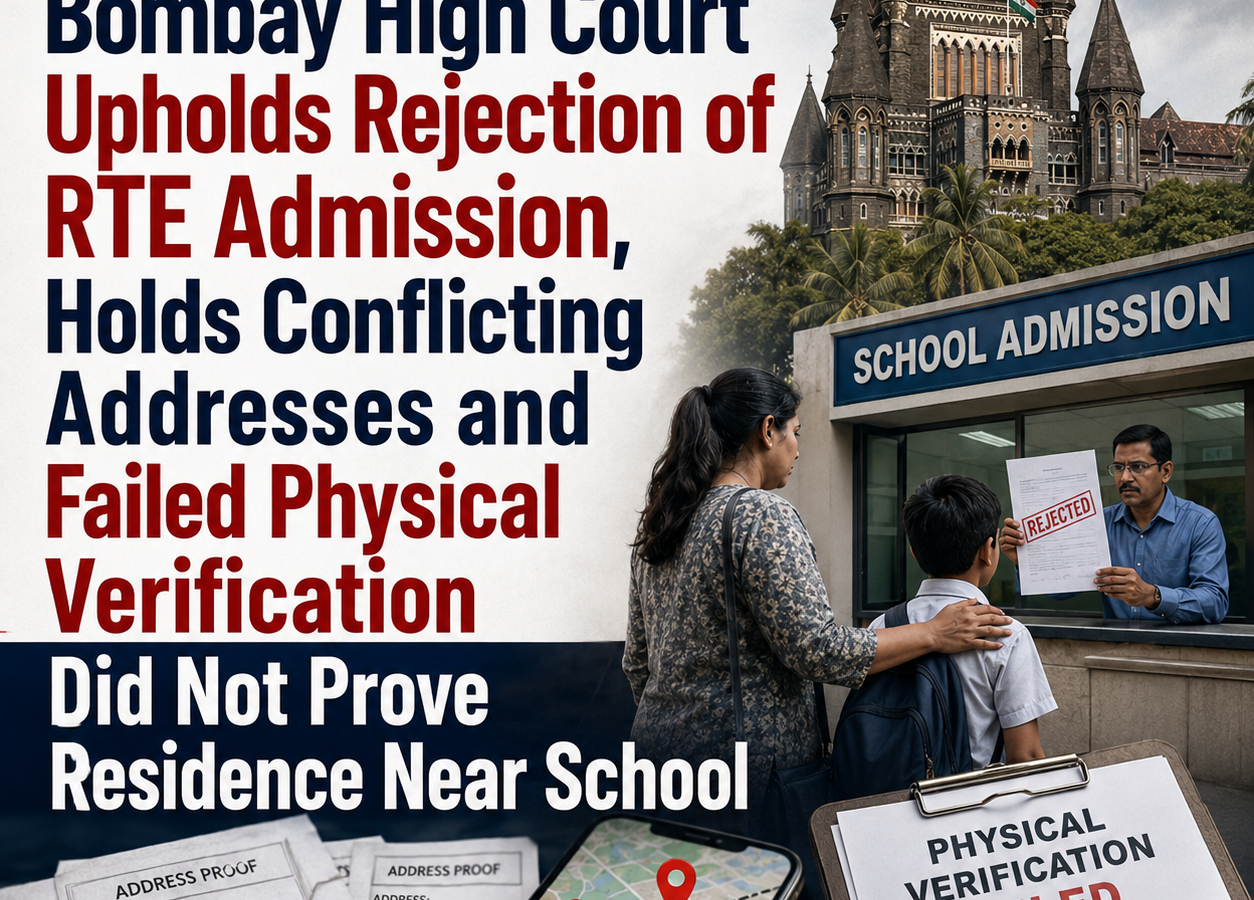
Child Denied RTE Seat as Physical Verification and Documents Failed to Establish Neighbourhood Residence: Bombay High Court
Facts
The petitioner was a minor child who approached the Bombay High Court through his father, Sandip Baburao Sathe.
He sought admission for the academic year 2026–27 to Podar International School, Wagholi, Pune, under the reserved quota provided by the Right of Children to Free and Compulsory Education Act, 2009.
The petitioner claimed that since 6 August 2025, he and his parents had been residing in premises allegedly taken on leave and licence from his grandmother.
The claimed residence was situated at Samarth Nagar, Kharadi, Pune. According to the petitioner, it was approximately 950 metres from the school and therefore satisfied the neighbourhood requirement for RTE admission.
The online admission application was rejected on 2 May 2026 because the residential proof submitted by the petitioner was not accepted as valid.
The petitioner’s father contended that the discrepancy in the address was caused by an auto-generated Google Maps error in the online application.
He submitted representations and sought physical verification of the claimed residence.
The Education Officer, Zilla Parishad, Pune, rejected the appeal on 5 May 2026. The Deputy Director of Education affirmed that decision on 22 May 2026.
The petitioner thereafter invoked the writ jurisdiction of the Bombay High Court, alleging violation of his fundamental right to education under Article 21A of the Constitution.
During the hearing, the High Court directed the Education Department to physically inspect the claimed residence.
The inspection was conducted on 19 and 20 June 2026.
The inspection revealed one bed or cot on the first floor and a small eating establishment on the ground floor operated by the petitioner’s mother. No sufficient material was found to establish that the petitioner and his family ordinarily resided at the premises.
The documents placed on record also contained different addresses. As reflected in the table on page 7 of the judgment:
- the admission form mentioned Samarth Nagar, Kharadi;
- the leave and licence agreement mentioned Flat No. 101, Survey No. 56, Kharadi;
- the Aadhaar cards mentioned Manjari Budruk, Pune; and
- the father’s voter identity card mentioned Amarapur, Ahmednagar.
Issues
- Whether the petitioner had established actual and continuous residence within the neighbourhood of the selected school.
- Whether the discrepancy in the address could be treated merely as a technical or Google Maps-generated error.
- Whether the leave and licence agreement, without supporting contemporaneous documents, was sufficient proof of residence.
- Whether the rejection of the RTE admission application violated the petitioner’s fundamental right to education under Article 21A.
- Whether the Court could direct the school to grant admission despite inconsistent addresses and an adverse physical verification report.
- Whether relaxing the residential eligibility requirement would prejudice another child who genuinely satisfied the neighbourhood condition.
Petitioner’s Arguments
The petitioner argued that he and his parents had been residing at the Kharadi premises since 6 August 2025.
He relied upon a leave and licence agreement executed in relation to the premises.
It was submitted that the premises were located approximately 950 metres from Podar International School and therefore fell within the prescribed neighbourhood.
The petitioner contended that the rejection of the application was based upon an erroneous discrepancy generated through Google Maps in the online admission form.
According to him, the address mismatch was technical and did not reflect the family’s actual residence.
The petitioner argued that the authorities should have physically verified the premises instead of rejecting the application merely on documentary discrepancies.
He also relied upon Article 21A and the RTE Act to contend that denial of admission would interfere with his fundamental right to free and compulsory education.
The petitioner sought a direction requiring the school to accept his application after verification of the actual residence and grant admission under the RTE quota.
Respondent’s Arguments
The State authorities opposed the petition on the ground that the petitioner had failed to produce satisfactory proof of actual residence.
Pursuant to the High Court’s directions, Education Department officers visited the claimed address.
The inspection revealed only one bed or cot on the first floor, while the ground floor was being used as a small eating establishment.
The authorities argued that there was no material suggesting that a family of three ordinarily resided at the premises.
They also relied upon the differing addresses appearing in the petitioner’s and his father’s identity documents.
The Aadhaar cards reflected a Manjari Budruk address, whereas the father’s voter identity card reflected an address in Ahmednagar.
The respondents submitted that no electricity bill, water bill, gas connection, bank correspondence, ration card or other contemporaneous document had been produced to establish continuous residence at Kharadi.
They argued that the burden of proving neighbourhood eligibility rested upon the petitioner.
A mere assertion of a mapping error could not replace proof of actual residence.
Analysis of the Law
Right to Education and Eligibility Conditions
Article 21A guarantees the right to free and compulsory education to children within the constitutionally prescribed age group.
The RTE Act gives effect to this right and provides for reservation of seats in specified schools for children belonging to disadvantaged groups and weaker sections.
However, the right to seek admission under a particular reserved category remains subject to the eligibility requirements prescribed under the statutory scheme.
One such requirement is that the child must satisfy the applicable neighbourhood criterion.
The Court held that this condition is substantive and not a mere procedural formality.
Burden of Proving Residence
The person seeking admission under the neighbourhood-based RTE quota must establish actual residence at the address relied upon.
A formal document such as a leave and licence agreement may be relevant, but it is not necessarily conclusive where surrounding circumstances create doubt about actual occupation.
The Court held that contemporaneous evidence could include:
- utility bills;
- ration card;
- bank correspondence;
- gas connection documents;
- school or medical records;
- voter records; and
- other documents showing ordinary and continuous residence.
In the present case, none of these documents supported the claimed Kharadi residence.
Physical Verification
The Court itself directed a physical verification to resolve the factual controversy.
The inspection reports and photographs did not support the petitioner’s claim that the premises were ordinarily used as the family residence.
The Court considered the inspection particularly significant because it provided direct, current evidence of the condition and use of the premises.
The presence of a single bed or cot and the use of the ground floor as an eating establishment did not establish normal residential occupation by a family of three.
Documentary Inconsistencies
The Court considered the multiple and materially different addresses appearing in the documents.
The table reproduced on page 7 of the judgment demonstrated that the admission form, leave and licence agreement, Aadhaar cards and voter identity card did not reflect one consistent residence.
These were not minor typographical differences.
They related to entirely different localities, including Kharadi, Manjari Budruk and Ahmednagar.
The Court therefore rejected the argument that the discrepancies were merely technical.
Google Maps Error
The Court held that an alleged auto-generated mapping error could not substitute proof of actual residence.
Even assuming that Google Maps had generated an inaccurate description, the petitioner was still required to demonstrate that he ordinarily lived at the claimed premises.
The failure to produce independent evidence remained fatal to the claim.
Protection of Other Eligible Children
The Court emphasised that neighbourhood-based eligibility protects the fairness and integrity of the RTE admission process.
Granting admission without satisfactory proof could result in the denial of a seat to another needy child who genuinely lived within the prescribed area.
Therefore, relaxing the condition in an individual case without adequate evidence would undermine the statutory scheme.
Precedent Analysis
The judgment did not undertake a detailed discussion of earlier reported decisions.
Its reasoning was primarily based upon:
- Article 21A of the Constitution;
- the scheme and object of the RTE Act;
- the neighbourhood eligibility requirement;
- the documentary evidence;
- the physical inspection reports; and
- the petitioner’s failure to discharge the burden of proving actual residence.
The ruling is therefore a fact-specific application of the principle that constitutional and statutory educational rights must be enforced within the eligibility framework governing the particular admission category.
The judgment also demonstrates that courts may direct physical verification where the authenticity of residential eligibility is disputed.
Court’s Reasoning
The Court accepted that the right to education is fundamental.
However, it held that the petitioner was not seeking education generally, but admission to a particular school under a neighbourhood-based reserved quota.
He was therefore required to prove that he fulfilled the residential condition.
The physical inspection did not support the claim of ordinary residence.
The Court found it difficult to accept that a family of three resided at premises containing only one bed or cot, particularly when part of the property was being used as an eating establishment.
No independent or contemporaneous residential documents were produced.
The different addresses appearing across the petitioner’s documents further weakened the case.
The Court held that these discrepancies could not be dismissed as technical errors.
The petitioner bore the burden of establishing residential eligibility and had failed to discharge it.
The authorities therefore committed no error in rejecting the application.
The Court also considered the wider consequence of diluting the neighbourhood requirement. An ineligible admission could deprive another genuinely eligible child of a reserved seat.
Accordingly, no constitutional or statutory violation was established.
Conclusion
The Bombay High Court dismissed the minor petitioner’s writ petition.
It upheld the rejection of his application for admission under the RTE quota to Podar International School, Wagholi.
The Court held that the petitioner had failed to establish actual residence within the prescribed neighbourhood of the school.
The leave and licence agreement, unsupported by utility bills or other contemporaneous documents, was insufficient in view of the adverse physical verification and multiple inconsistent addresses.
The Court clarified that the residential condition is an essential eligibility requirement and cannot be diluted merely by describing discrepancies as technical.
There was no order as to costs.
Case: Manas Sandip Sathe, through his father Sandip Baburao Sathe v. State of Maharashtra & Others
Court: High Court of Judicature at Bombay, Civil Appellate Jurisdiction
Case Number: Writ Petition No. 7601 of 2026
Judge: Acting Chief Justice Ravindra V. Ghuge and Justice Gautam A. Ankhad
Date: 25 June 2026
Result: Writ petition dismissed; rejection of the RTE admission application upheld for failure to establish satisfactory proof of residence within the school’s neighbourhood.