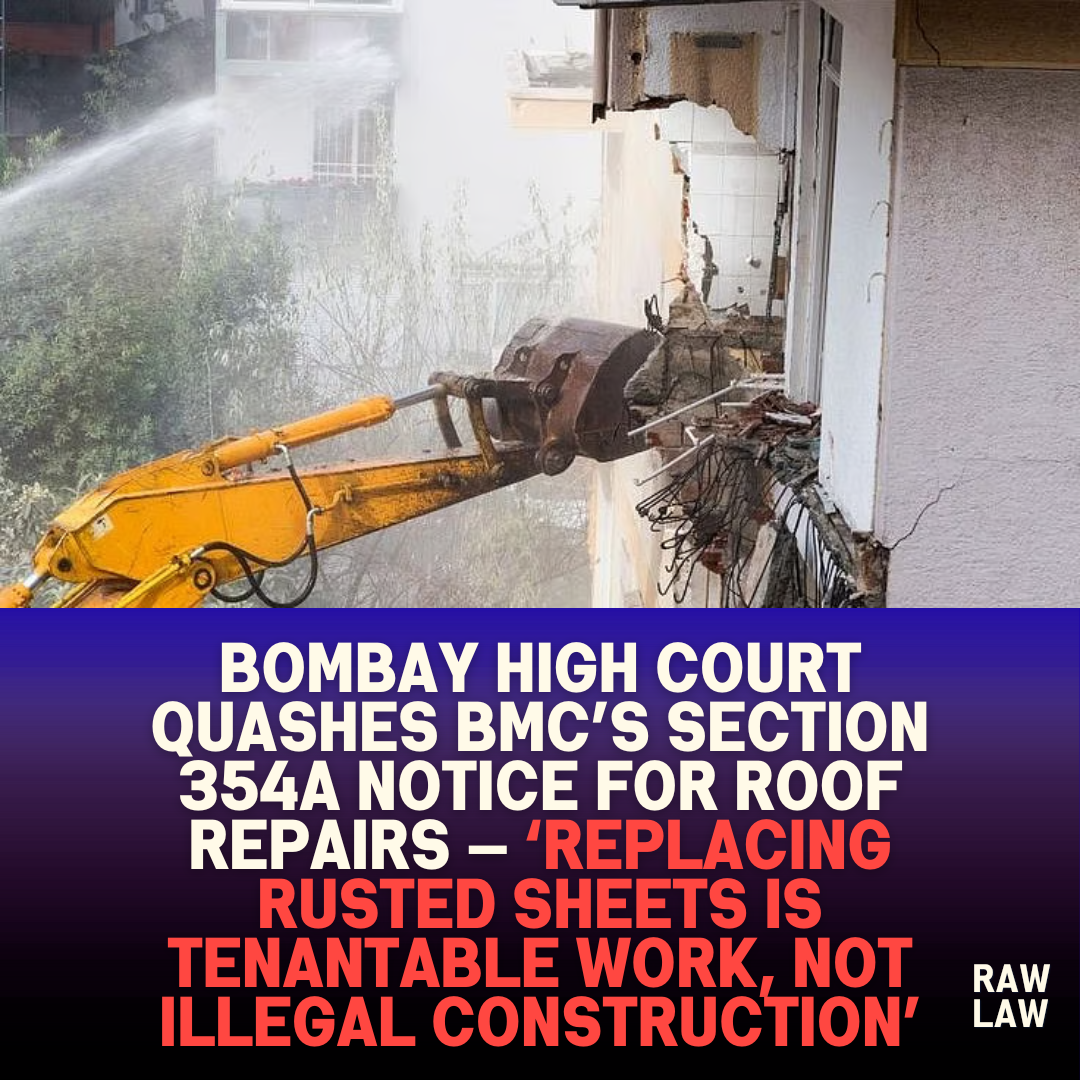
Bombay High Court Quashes BMC’s Section 354A Notice for Roof Repairs — ‘Replacing Rusted Sheets Is Tenantable Work, Not Illegal Construction’

Court’s Decision
The Bombay High Court, comprising Justice Ravindra V. Ghuge and Justice Ashwin D. Bhobe, decisively quashed a demolition notice issued by the Municipal Corporation of Greater Mumbai (BMC) under Section 354A of the Mumbai Municipal Corporation Act, 1888, holding that replacing old, rusted roof sheets with new ones constitutes tenantable repairs and not illegal construction.
The Court held that the BMC’s action was “arbitrary, high-handed, and indicative of non-application of mind,” since the corporation failed to distinguish between mere maintenance work and unauthorized building activity. It further imposed ₹25,000 in costs on the BMC, payable to a charitable institution — Shanti Avedna Sadan — within thirty days.
Justice Bhobe observed:
“Facts required to invoke Section 354A were lacking. The Respondents acted illegally and in a high-handed manner by demolishing the roof under the guise of stopping illegal work.”
Facts
The petitioner, a small-scale manufacturer operating from an old factory structure in Byculla, Mumbai, sought to repair its decades-old roof that had become severely corroded and was leaking during the monsoon. On 21 July 2025, it wrote to the BMC’s Assistant Engineer seeking permission to replace the rusted tin sheets with new GI sheets to prevent further damage.
Despite the letter, the Corporation failed to respond. Facing continued leakage, the petitioner proceeded with replacing the sheets. Soon after, on 21 August 2025, the BMC’s Designated Officer issued a Notice under Section 354A, alleging that the petitioner had undertaken unauthorized “construction” and directed the owner to stop the work within 24 hours or face demolition.
The petitioner immediately replied on 25 August 2025, clarifying that no new structure was being built, and the work was purely tenantable repair within the same horizontal and vertical dimensions. Yet, on 7 October 2025, BMC officials allegedly arrived and began puncturing and removing the roof, prompting the petitioner to approach the High Court.
Issues
- Whether replacement of old roofing sheets amounts to “erection of a building or structural work” requiring prior permission under Section 342 or falls within the ambit of tenantable repairs?
- Whether the BMC’s issuance of notice under Section 354A was arbitrary and beyond jurisdiction?
- Whether demolition without a speaking order or proper inspection violated the petitioner’s right to fair administrative action?
Petitioner’s Arguments
The petitioner argued that the structure was legal, constructed in 1970 with approved plans, and that only minor repairs were undertaken to replace worn-out tin sheets with new GI sheets.
It submitted that the repairs did not alter the structure’s height, footprint, or load-bearing elements, and thus did not amount to reconstruction. It cited Section 342, which specifically defines tenantable repairs to include “replacement of roof with the same material” and exempts such work from requiring prior permission.
The petitioner also alleged mala fide intent and procedural irregularity, asserting that BMC officials demolished part of the roof without prior intimation and without passing a speaking order. The entire action, it argued, was a case of administrative overreach that caused business disruption and financial loss.
Respondent’s Arguments
The BMC defended its action, claiming that the petitioner had carried out structural work beyond permissible limits, including changes to load-bearing members. It relied on the schedule attached to the Section 354A notice, which alleged “replacement of corroded/old roofing GI sheets with change in structural members without valid permission.”
The civic body argued that Section 354A empowers the Designated Officer to stop any work commenced unlawfully and to remove such work if no permissions are shown within 24 hours. It contended that the petitioner had commenced work without prior intimation and thus violated the Act’s provisions, justifying the demolition.
However, when questioned, the Corporation’s counsel admitted that no speaking order or recorded inspection report existed confirming structural alteration beyond tenantable repair.
Analysis of the Law
The Court closely examined Sections 342 and 354A of the Mumbai Municipal Corporation Act, 1888, which govern the distinction between permissible repairs and unauthorized construction.
Section 342 defines “tenantable repairs” as works such as plastering, painting, replacing drainage, or replacing the roof with the same material, provided there is no change in horizontal or vertical dimensions or structural members.
Section 354A, on the other hand, authorizes the BMC to stop illegal building erection or structural work. The Court emphasized that this section can be invoked only when the construction is “unlawfully commenced”—not for maintenance repairs expressly permitted by law.
Justice Bhobe held:
“The replacement of the roof with the same material, without changing the horizontal or vertical existing dimensions, falls squarely within the ambit of tenantable repairs. Section 342 does not require prior permission for such work.”
Accordingly, the BMC’s invocation of Section 354A was misconceived and legally untenable.
Precedent Analysis
While the judgment primarily relied on statutory interpretation, it aligns with prior judicial reasoning in similar matters:
- Bombay High Court (W.P. No. 2711/2019) – Held that mere replacement of damaged roof sheets does not constitute reconstruction requiring approval.
- Municipal Corporation of Greater Mumbai v. Kantilal Patel (2017) – The Court distinguished between tenantable repairs and structural alterations, clarifying that only the latter needs prior permission.
- Sopan Maruti Thopte v. Pune Municipal Corporation (2014) – Reinforced that tenantable work, when confined to original dimensions, is immune from demolition under Section 351 or 354A.
The present Bench applied these principles to reiterate that maintenance works are an incident of property ownership and cannot be treated as unlawful construction absent evidence of expansion or modification.
Court’s Reasoning
The Court observed that the petitioner’s letter dated 21 July 2025 clearly informed the Corporation of the intended repairs, and the civic body’s silence did not negate the legality of the work.
It found that no evidence supported the allegation that structural members were altered. The BMC’s own schedule and sketch annexed to the notice revealed that the work merely involved replacement of GI sheets.
Moreover, the absence of a speaking order after receiving the petitioner’s reply showed non-application of mind. The Court condemned the BMC’s action as “procedurally arbitrary” and emphasized that officials cannot invoke Section 354A without verifying whether the work is tenantable or structural.
The demolition, it held, was “illegal, arbitrary, and violative of constitutional and statutory protections.”
Conclusion
The High Court allowed the writ petition and quashed the notice dated 21 August 2025, terming it illegal and void ab initio. It ordered the BMC to:
- Cease further demolition,
- Refrain from interfering with the petitioner’s premises, and
- Pay ₹25,000 as costs to the petitioner within 30 days, which the petitioner requested be donated to Shanti Avedna Sadan, a charitable cancer hospice.
The Bench concluded:
“Respondent No. 3 has acted with material irregularity, failing to consider the basic requirements for invoking Section 354A. The facts necessary to trigger that provision were wholly absent.”
Implications
This ruling significantly curbs municipal misuse of demolition powers under Section 354A, especially where legitimate repairs are mistaken for illegal construction. It clarifies that property owners do not require prior BMC approval for tenantable repairs that do not alter structural elements.
The judgment strengthens property rights and sets a precedent for accountability in civic enforcement, warning officials against arbitrary demolition without due verification. It underscores the judiciary’s stance that maintenance work aimed at preserving safety and habitability cannot be penalized as unlawful construction.