

HEADNOTE
State of Maharashtra v. Patwardhan Infrastructure Pvt. Ltd.
Court: Bombay High Court
Jurisdiction: Civil Appellate Jurisdiction
Bench: Justice Somasekhar Sundaresan
Date of Judgment: January 17, 2026
Citation: 2026:BHC-AS:2050
Laws / Sections Involved: Arbitration and Conciliation Act, 1996 – Sections 34 & 37; Contract law principles; Public policy of India
Keywords: Section 37 appeal, force majeure clause, BOT infrastructure project, toll shortfall, minimum guaranteed return, public policy, perversity
Summary
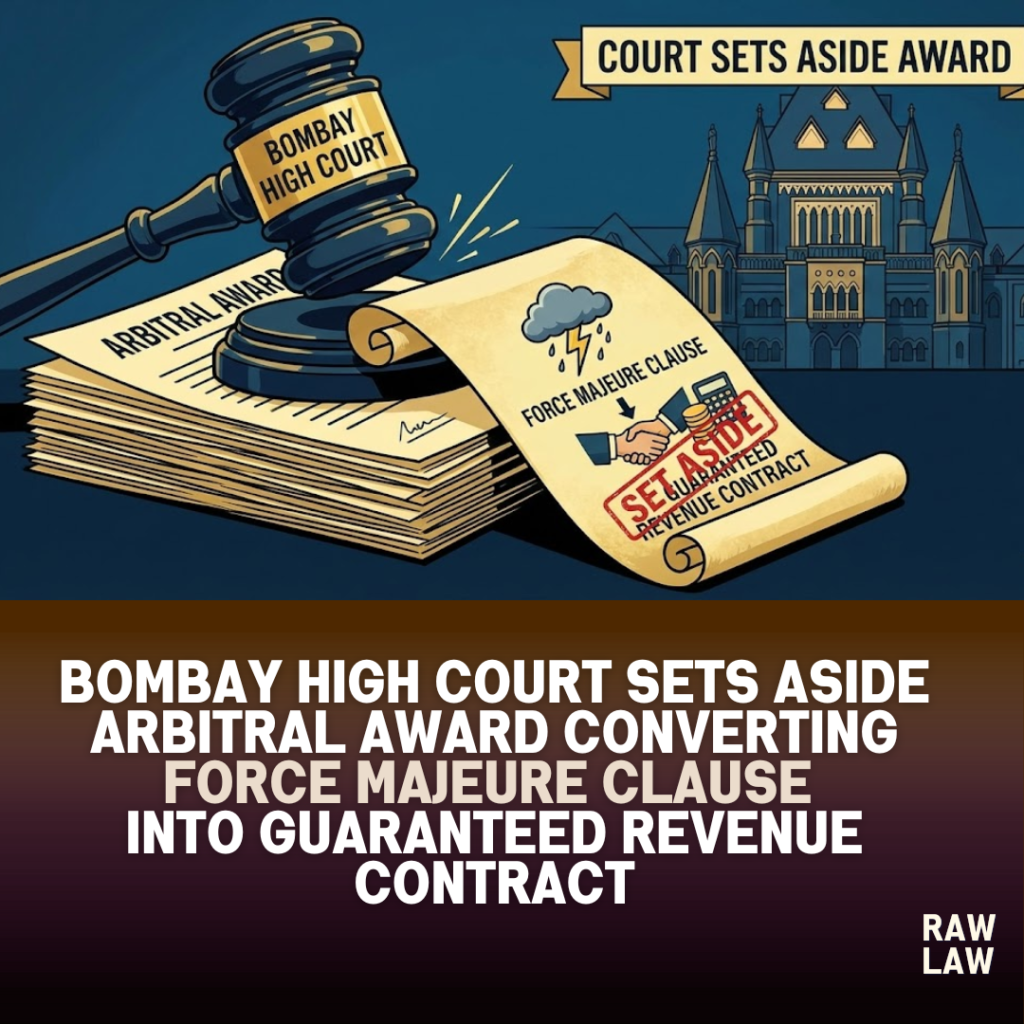
The Bombay High Court allowed a Section 37 appeal filed by the State of Maharashtra and set aside an arbitral award and the Section 34 judgment that had upheld it, holding that the arbitral tribunal adopted a manifestly perverse interpretation of the contract. The Court ruled that Minutes of Meeting (MoM) recorded during pre-award discussions could not be treated as amending a force majeure clause so as to convert a BOT toll project into a minimum guaranteed revenue contract. The Court held that the tribunal’s approach—treating every toll shortfall beyond 20% as compensable irrespective of a force majeure event—violated the fundamental public policy of Indian law and failed the business efficacy test. Finding absence of a judicial approach and foundational distortion of the risk–reward structure of the project, the Court interfered despite concurrent findings.
Court’s decision
The Bombay High Court allowed Arbitration Appeal No. 33 of 2015, quashed the arbitral award dated November 7, 2012 and the Section 34 judgment dated September 24, 2014, and held that the award was contrary to the fundamental public policy of Indian law. The Court ruled that the arbitral tribunal had failed to adopt a judicial approach and had rendered an implausible interpretation that fundamentally altered the contract’s nature.
Facts
The State awarded a BOT contract for construction of a two-lane bridge across Dharamtar Creek to a private concessionaire. The bid documents contained clauses governing traffic risk and a force majeure provision (Clause 3.4.19) permitting compensation only upon occurrence of force majeure events causing drastic toll reduction. Prior to execution, concerns were raised about a proposed Rewas–Karanja bridge, leading to Minutes of Meeting (MoM) recording observations and deferring any decision until such competing project materialised. No such bridge was ever constructed. Nonetheless, the concessionaire claimed rupee-for-rupee compensation for toll shortfalls exceeding 20%, which the arbitral tribunal allowed.
Issues
Whether the MoM materially amended Clauses 3.4.19 and 3.7.2 of the contract so as to obligate the State to compensate any toll shortfall beyond 20%, even in the absence of a force majeure event, and whether such interpretation could withstand scrutiny under Sections 34 and 37 of the Arbitration Act.
Appellant’s arguments
The State argued that the arbitral tribunal’s reading was perverse and contrary to the contract. It was submitted that the MoM merely recorded observations and an agreement to defer any decision until a competing bridge actually came into existence. Treating a force majeure clause as a guaranteed revenue mechanism, it was argued, rewrote the contract and obliterated the project’s risk-allocation framework, warranting interference on public policy grounds.
Respondent’s arguments
The concessionaire contended that the MoM reflected a conscious shift in the parties’ bargain, reducing the compensation trigger from an 80% traffic fall to a 20% toll shortfall. It was argued that the arbitral interpretation was plausible and that courts exercising jurisdiction under Sections 34 and 37 could not substitute their own view for that of the tribunal.
Analysis of the law
The Court analysed the scope of interference under Sections 34 and 37 as it stood prior to the 2015 amendments, reiterating that while interpretation lies with the tribunal, courts may interfere where findings are perverse or violate fundamental public policy. Examining Clauses 3.4.19 and 3.7.2, the Court held that they clearly envisaged compensation only upon force majeure events, and expressly excluded compensation for traffic estimation errors or other causes. The MoM, at best, deferred a future decision and did not amend these clauses.
Precedent analysis
Relying on Associate Builders v. DDA and ONGC v. Western Geco, the Court emphasised the requirement of a judicial approach and reasonableness in arbitral decision-making. It also applied the Supreme Court’s articulation of the business efficacy test in Nabha Power Ltd. v. Punjab SPCL, holding that the tribunal’s interpretation failed all five tests, including reasonableness and consistency with express contractual terms.
Court’s reasoning
Justice Somasekhar Sundaresan held that the tribunal made “multiple leaps of faith” by treating mere observations as binding amendments and by converting a conditional force majeure mechanism into a minimum guaranteed return contract. Such an outcome, the Court observed, would have distorted the competitive bidding process and offended public policy. The absence of any force majeure event or competing project further rendered the compensation award unsustainable.
Conclusion
The High Court concluded that the arbitral award suffered from manifest perversity, altered the foundational risk–reward structure of the project, and violated the fundamental policy of Indian law. Accordingly, both the award and the Section 34 judgment were set aside.
Implications
This judgment is significant for infrastructure arbitration in India. It reaffirms that force majeure clauses cannot be judicially transformed into revenue guarantees, underscores strict limits on arbitral interpretation in public contracts, and signals that courts will intervene under Sections 34 and 37 where awards fundamentally rewrite commercial bargains arising from competitive bidding.
Case law references
• Associate Builders v. DDA (2015) 3 SCC 49
Holding: Arbitral awards can be set aside for perversity and violation of public policy.
Application: Relied upon to test the tribunal’s judicial approach.
• ONGC v. Western Geco International Ltd. (2014) 9 SCC 263
Holding: Fundamental policy of Indian law includes reasonableness and non-perversity.
Application: Applied to invalidate the arbitral reasoning.
• Nabha Power Ltd. v. Punjab SPCL (2018) 11 SCC 508
Holding: Business efficacy test governs interpretation of commercial contracts.
Application: Used to reject the tribunal’s contract rewriting.
FAQs
Q1. Can Minutes of Meeting amend a force majeure clause?
No. Unless clearly incorporated as a contractual amendment, MoMs recording observations cannot rewrite express contract terms.
Q2. When can courts interfere with arbitral awards under Section 37?
When the award is perverse, lacks a judicial approach, or violates the fundamental public policy of Indian law.
Q3. Does toll shortfall automatically entitle a concessionaire to compensation?
No. Compensation arises only upon occurrence of force majeure events as stipulated in the contract.


