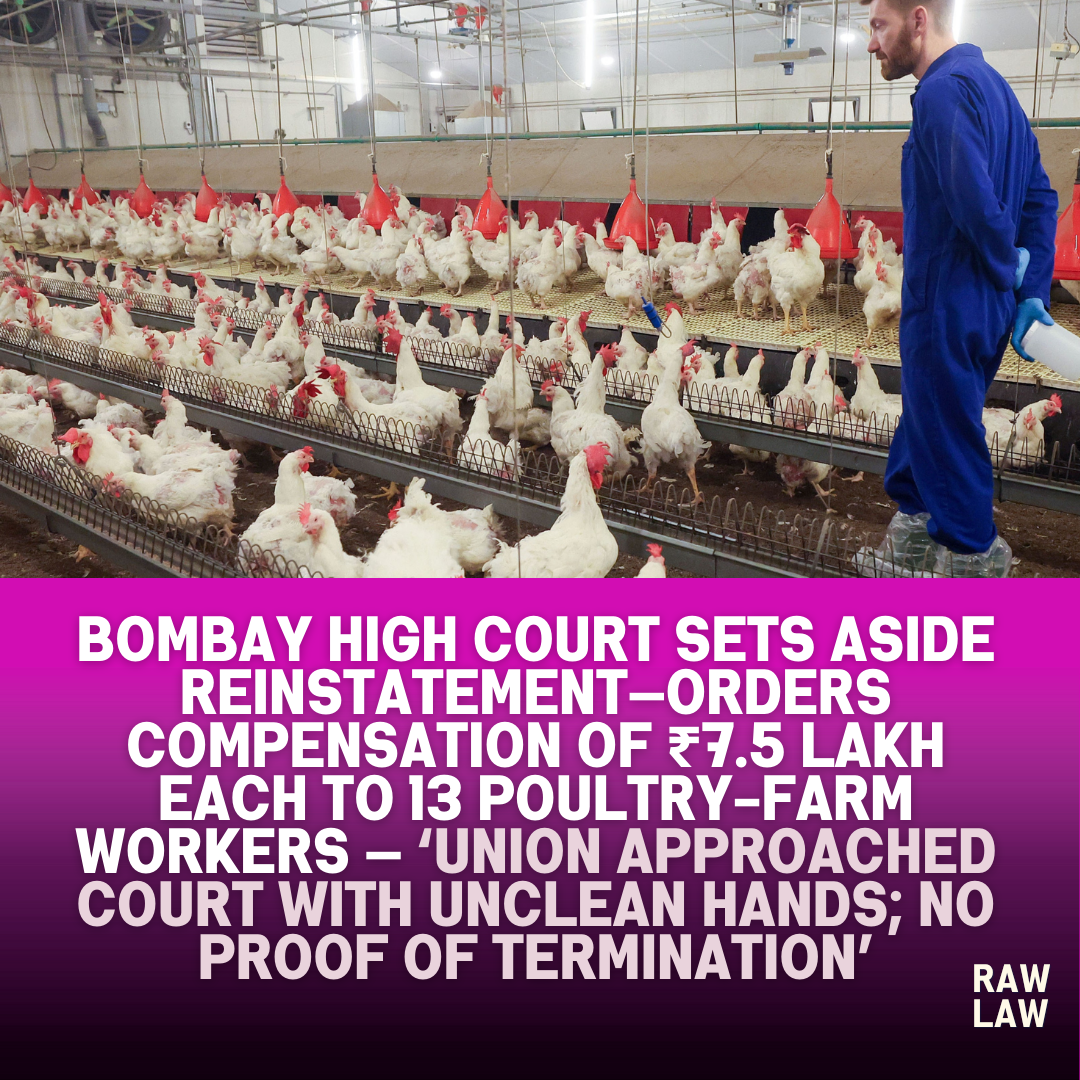
Bombay High Court sets aside reinstatement—orders compensation of ₹7.5 lakh each to 13 poultry-farm workers — ‘Union approached court with unclean hands; no proof of termination’

1. Court’s decision
The Bombay High Court partly allowed the writ petition and quashed the Labour Court’s 2014 award of reinstatement and back wages to 13 workmen. Justice Milind N. Jadhav held that the Union failed to prove any termination and that the Labour Court had acted on an erroneous premise created by the conciliation report. The Court concluded that the strike had no nexus with the alleged firing incident relied upon by the Union and that the Company had never dismissed the workers.
However, because the Company issued show-cause notices but took no lawful steps thereafter, it bore partial responsibility. Hence, instead of reinstatement, the Court ordered the Company to pay ₹7,50,000 compensation to each of the 13 workmen, including to legal heirs of two deceased workers, through the Labour Court, Satara.
2. Facts
The petitioner-company operates poultry farms in Satara and other districts. In August 2004, 91 workers from the petitioner and a sister company joined a hunger strike outside the company headquarters in Pune and stayed absent for 63 days. Show-cause notices were issued, asking workers to resume duty. In April 2005, when several workers attempted to rejoin, they alleged they were refused entry.
The Union issued a demand letter seeking reinstatement and approached the Conciliation Officer, who recorded—incorrectly, as later held—that the workmen had been dismissed. A failure report led to a reference in 2005.
In 2014, the Labour Court directed reinstatement of 12 workmen with continuity, and 1 workman (Santosh Bhargude) with continuity plus back wages. The company challenged the award.
3. Issues
The High Court examined:
• Whether the 13 workmen were terminated in violation of the Industrial Disputes Act;
• Whether the Labour Court erred in ordering reinstatement and back wages;
• Whether the Union’s reliance on an alleged firing incident justified the strike or supported the claim of dismissal;
• Whether monetary compensation, rather than reinstatement, was the appropriate remedy given the prolonged dispute and conduct of parties.
4. Petitioner’s arguments
The company argued that the Labour Court’s award was perverse, unsupported by evidence, and influenced by an erroneous conciliation report. It contended that the workmen had abandoned work and never responded to the show-cause notices. The company stressed that the alleged firing incident of October 2003 was accidental, occurred in a different village, and had no connection to the 2004 strike.
It contended that the Union used this incident to create a false narrative, leading to a criminal complaint in which all accused were acquitted. It asserted it continuously urged workers to rejoin and did not terminate anyone. Evidence from Union witnesses, it argued, confirmed that no termination occurred. The company also maintained that by 2010–2011, it had to fill vacant posts due to long absence and business losses.
5. Respondent’s arguments
The Union argued that the Labour Court’s award was justified because the workmen were prevented from rejoining after the hunger strike was called off. It maintained that the firing incident triggered unrest and that workers suffered injuries. The Union’s witnesses claimed workers attempted to rejoin on 29–30 September 2004 but were refused entry.
It argued that the refusal to permit rejoining amounted to illegal, oral termination, violating Section 25F of the ID Act. The Union claimed no formal inquiry or retrenchment procedure was followed, no seniority list was published, and workers were kept out for over two decades, causing severe hardship. It accused the employer of deliberately delaying implementation of the award.
6. Analysis of the law
The Court held that the most critical question was whether termination occurred. Under the ID Act, termination must be proved through cogent evidence. The Union relied heavily on the conciliation officer’s assumption that the workers were dismissed, but the Court held this was factually incorrect and unsupported by evidence.
The Court emphasised that oral or inferred termination requires proof of clear refusal of employment, not merely failed attempts to return. The evidence showed:
• Show-cause notices were issued, but no enquiry or termination followed;
• Several workers returned and were taken back;
• The 13 workers provided no proof of being stopped at the gate, beyond bare assertions;
• Cross-examination of Union witnesses revealed contradictions, including admission that the firing incident had no nexus with their workplace or strike.
Therefore, the Labour Court’s inference of termination was legally unsustainable.
7. Precedent analysis
The Court applied settled doctrine under the ID Act:
• Termination must be proved by the workman; mere absence or informal dispute cannot constitute retrenchment.
• False or exaggerated grounds advanced by a union undermine credibility and may disentitle equitable relief.
• Reinstatement is not automatic—especially in cases involving prolonged delay, long absence from service, or where the employer never passed a termination order.
Although the Court did not cite specific earlier judgments, its reasoning mirrors principles affirmed in Supreme Court precedents on invalid strikes, abandonment, and the discretionary nature of reinstatement.
8. Court’s reasoning
The Court found the Union had approached the Labour Court with unclean hands, by falsely asserting that the 2004 strike was prompted by a firing incident—when evidence proved the incident occurred ten months earlier in another village, during a festival ritual, and was accidental.
The strike had no relation to the alleged incident. The Union’s narrative was held to be a fabricated attempt to gain sympathy.
On termination, the Court observed:
• No termination letter was issued;
• No disciplinary proceedings were initiated;
• No evidence proved refusal of rejoining;
• The company repeatedly invited workers to return.
Thus, reinstatement was unwarranted. However, the company having failed to conduct any enquiry or issue a formal order even after prolonged absence, the Court held it must compensate the workers.
The award of full back wages to Santosh Bhargude was struck down as discriminatory and unsupported by evidence.
9. Conclusion
The High Court set aside the directions of reinstatement and back wages. It held the Labour Court erred in holding that termination occurred, and that the award was based on incorrect assumptions and improper appreciation of evidence.
The Court modified the award to the extent of granting ₹7,50,000 lump-sum compensation to each of the 13 workmen—including two deceased workers’ legal heirs and five who had already crossed superannuation. All amounts are to be deposited within four weeks before the Labour Court, Satara, for disbursement.
The writ petition was partly allowed, with no reinstatement granted.
10. Implications
• This ruling reinforces that termination cannot be presumed; it must be proved through clear evidence.
• Unions relying on false or exaggerated claims risk losing reinstatement relief even if procedural lapses by employers exist.
• Courts may decline reinstatement in disputes where workers remain absent for extended periods, where trust is irreparably damaged, or where the employer never issued a termination order.
• Monetary compensation is increasingly preferred over reinstatement in 20-year-old industrial disputes.
• Employers must comply with procedural safeguards under the ID Act; failure may still result in compensatory liability.
CASE LAW REFERENCES
• Principle of proof of termination under the ID Act — termination must be established by evidence; mere absence does not constitute retrenchment unless termination is shown.
• Doctrine of unclean hands — false pleadings affect discretionary relief, including reinstatement.
• Back wages not automatic — applied principle that back wages depend on proof of illegal termination.
FAQ SECTION
1. Does long absence from work amount to termination under the Industrial Disputes Act?
No. Absence does not automatically amount to termination unless the employer passes a lawful order or the workman proves refusal of employment.
2. Can reinstatement be denied even if an employer failed to follow due process?
Yes. Where there is no termination and the dispute is decades old or based on false premises, courts may decline reinstatement and award compensation instead.
3. Why was compensation awarded instead of reinstatement in this case?
Because the workers were never terminated, the dispute spanned 20 years, evidence was unreliable, and the company failed only in procedural follow-through—not in wrongful dismissal.