Bombay High Court: Successor in interest can be impleaded even after 14 years — “No limitation for impleadment under Order XXII Rule 10 CPC”

1. Court’s decision
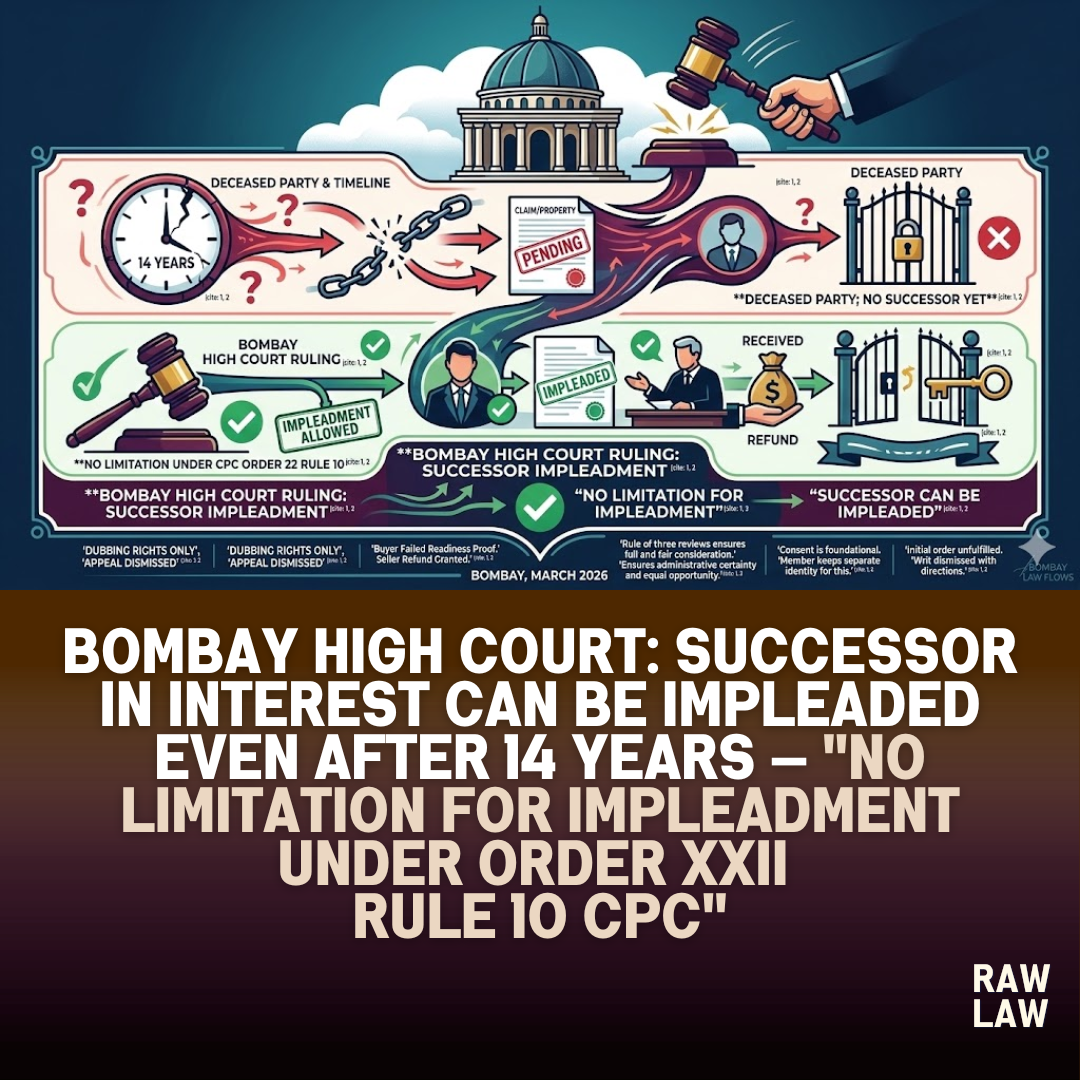
The Bombay High Court allowed an interim application filed by a real estate partnership firm seeking impleadment in a property appeal pending since 2011.
The Court held that the firm had acquired the entire right, title and interest in the disputed property through registered conveyances and therefore qualified as a successor in interest.
Observing that the provisions of Order XXII Rule 10 of the Code of Civil Procedure, 1908 permit impleadment in cases of assignment or devolution of interest during litigation, the Court allowed the firm to be added as a respondent in the appeal.
The Court clarified that there is no fixed limitation period for such applications, though delays must be reasonably explained.
2. Facts
The dispute arose from a suit for possession of property filed in 1974 before the City Civil Court in Mumbai.
The plaintiffs succeeded in the suit, and the court passed a decree in their favour on 7 September 2011. The defendants subsequently filed an appeal before the High Court challenging the decree.
During the pendency of the suit and prior to the appeal proceedings, multiple transfers of rights occurred among the plaintiffs and their family members through registered deeds.
Eventually, in September 2012, the rights in the suit property were conveyed to a partnership firm, which later sought to be impleaded in the appeal as the successor in interest to the original plaintiffs.
3. Issues
The High Court examined whether the applicant firm could be impleaded as a party respondent in the appeal on the basis of devolution of interest in the property.
A related issue was whether the significant delay of about fourteen years in seeking impleadment barred the application.
The Court also considered whether such impleadment would prejudice the defendants or lead to abatement of the appeal proceedings.
4. Petitioner’s arguments
The applicant firm argued that the case involved devolution of interest and not substitution due to death, and therefore the provisions governing abatement under Order XXII Rules 3 and 4 of the Civil Procedure Code were not applicable.
It further contended that Order XXII Rule 10 of the Code does not prescribe any limitation period for filing an application seeking impleadment after transfer of interest.
The applicant explained that the delay occurred because the appeal had been continuously prosecuted by the original plaintiffs, some of whom were partners of the applicant firm, leading to a bona fide belief that a separate impleadment application was unnecessary.
The need for impleadment was realised only in 2025 when the defendants sought clarification regarding the status of the parties.
5. Respondent’s arguments
The defendants opposed the application and argued that there was an inordinate delay in seeking impleadment, which indicated collusion between the applicant and the original plaintiffs.
They also contended that the suit had effectively abated because the successor in interest had not been brought on record within a reasonable time.
The defendants further argued that the original plaintiffs could continue the appeal as trustees for the applicant firm and that impleadment of the firm was unnecessary.
6. Analysis of the law
The Court analysed the provisions of Order XXII Rule 10 of the Code of Civil Procedure, 1908, which deal with assignment, creation, or devolution of interest during the pendency of litigation.
The Court observed that this rule allows a successor in interest to seek leave of the court to continue the proceedings.
Importantly, unlike substitution in cases of death under Rules 3 and 4, the rule does not prescribe a specific limitation period for seeking impleadment.
Consequently, applications for impleadment under Rule 10 may be made at any stage of the proceedings, subject to judicial discretion and explanation for delay.
7. Precedent analysis
The Court relied on several landmark rulings of the Supreme Court of India concerning impleadment of transferees during pending litigation.
In Raj Kumar v. Sardari Lal, the Supreme Court held that a transferee pendente lite is treated as a representative in interest and remains bound by the decree passed in the case.
The Court also relied on Saila Bala Dassi v. Nirmala Sundari Dassi, where it was held that persons claiming through a party may continue proceedings under Section 146 of the Code of Civil Procedure.
These precedents established that a transferee of property during litigation may be permitted to participate in proceedings to protect their interests.
8. Court’s reasoning
The Court noted that the applicant firm had acquired rights in the property through registered conveyances executed after the suit decree but during the pendency of the appeal.
Since the firm had become the successor in interest to the original plaintiffs, its participation in the appeal was necessary to effectively defend the decree.
The Court also rejected the defendants’ argument that the appeal had abated, clarifying that abatement provisions apply primarily to substitution due to death and not to cases involving transfer of interest.
Although there was a delay of fourteen years in seeking impleadment, the Court accepted the applicant’s explanation that the original plaintiffs had been prosecuting the appeal under a bona fide belief that separate impleadment was unnecessary.
9. Conclusion
The High Court concluded that the applicant firm was a necessary party to the proceedings because it had acquired the rights of the original plaintiffs in the disputed property.
The Court allowed the impleadment application and permitted the firm to be added as a respondent in the appeal.
However, considering the delay in filing the application, the Court directed the applicant to pay costs of ₹50,000 to the defendants.
10. Implications
The ruling clarifies the procedural framework governing impleadment of successors in interest during ongoing litigation.
It emphasises that applications under Order XXII Rule 10 CPC are not constrained by strict limitation periods, though courts may scrutinise delays and impose costs where appropriate.
The judgment also reinforces the principle that litigation should not be defeated merely because ownership or interest in the disputed property changes during the pendency of proceedings.
Case Law References
- Raj Kumar v. Sardari Lal (2004)
The Supreme Court held that a transferee pendente lite is treated as a representative of the transferor and is bound by the decree passed in the litigation. - Saila Bala Dassi v. Nirmala Sundari Dassi (1958)
The Court held that persons claiming under a party to litigation may continue proceedings under Section 146 CPC to protect their legal interests. - Dhurandhar Prasad Singh v. Jai Prakash University (2001)
The Supreme Court clarified that Order XXII Rule 10 CPC allows continuation of proceedings by or against a person upon whom interest in the subject matter has devolved.
FAQs
1. Can a transferee of property be added as a party during ongoing litigation?
Yes. Under Order XXII Rule 10 of the Code of Civil Procedure, a person who acquires interest in property during litigation may seek leave of the court to be impleaded as a party.
2. Is there a limitation period for impleadment under Order XXII Rule 10 CPC?
No specific limitation period is prescribed. However, courts expect applications to be filed within a reasonable time and may examine explanations for delay.
3. Does litigation abate if the property is transferred during the case?
No. Transfer of interest during litigation does not cause abatement. The proceedings can continue with the original party or the successor in interest with court permission.