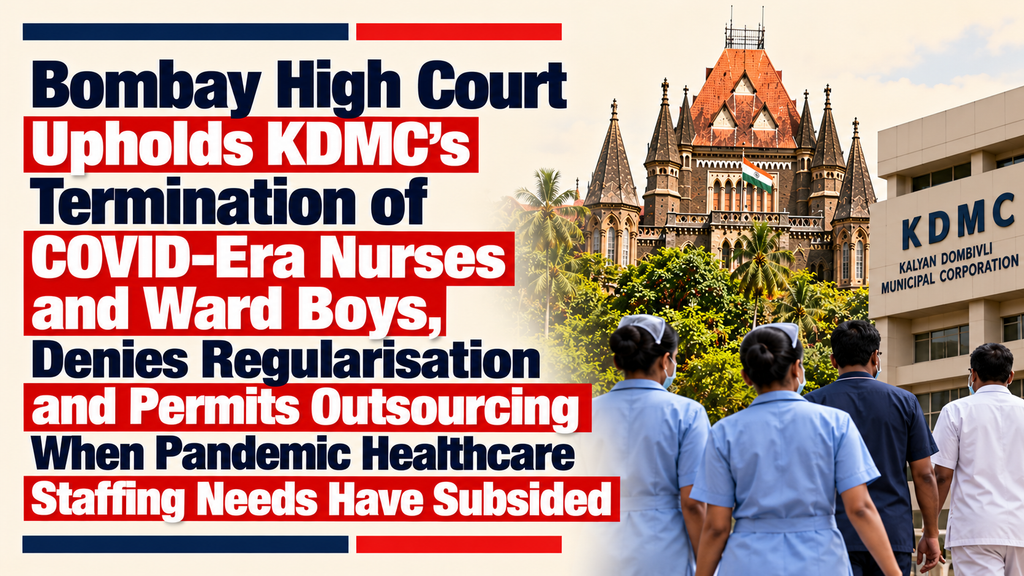
Bombay High Court Upholds KDMC’s Termination of COVID-Era Nurses and Ward Boys, Denies Regularisation and Permits Outsourcing When Pandemic Healthcare Staffing Needs Have Subsided

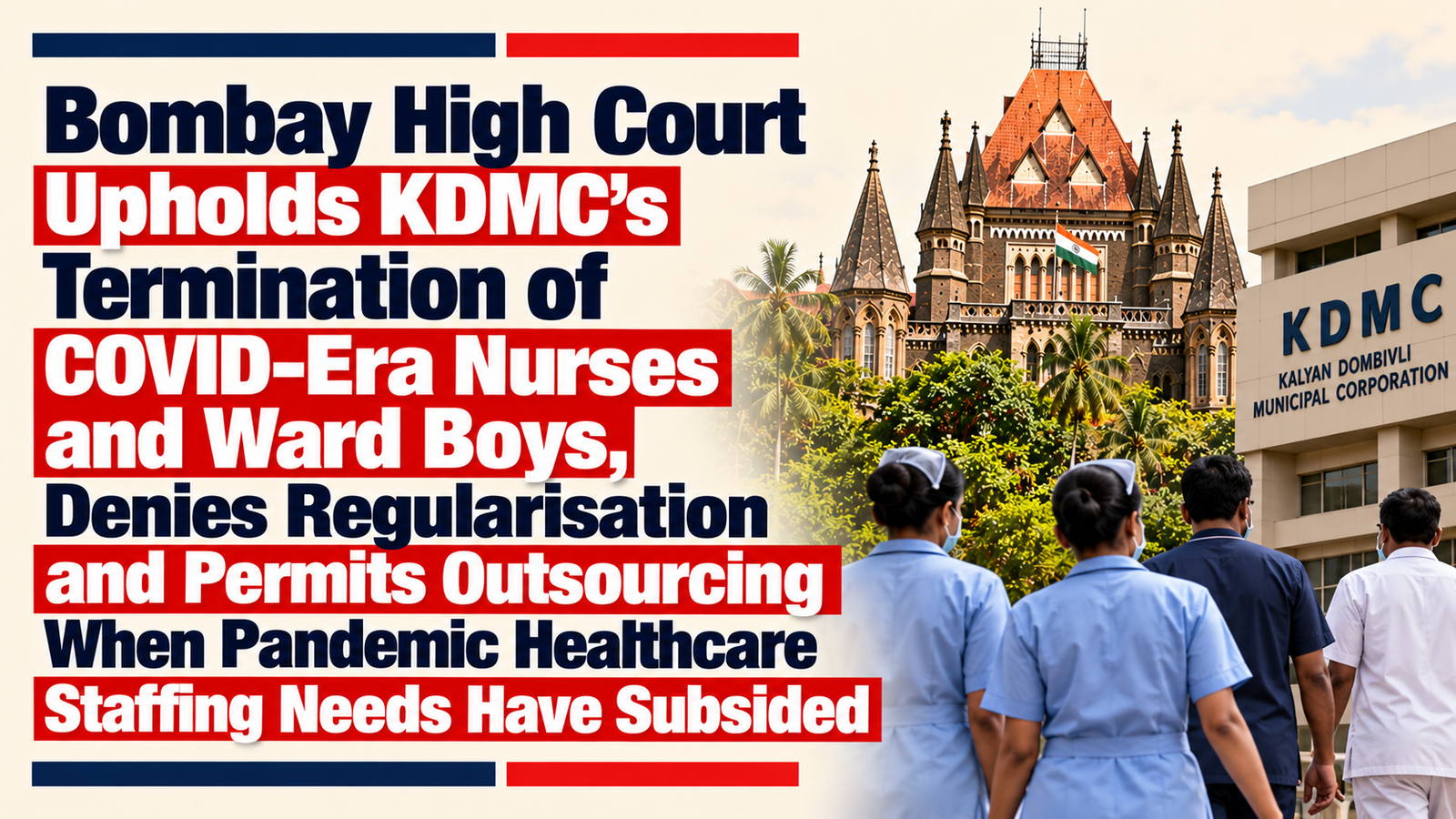
Nurses and Ward Boys Hired for COVID-19 Emergency Cannot Demand Permanent Municipal Employment or Retain Jobs Through Earlier Interim Court Protection, Bombay High Court Rules
Facts
The Kalyan Dombivli Municipal Corporation (KDMC) recruited staff nurses, auxiliary nurse midwives (ANMs) and ward boys during the COVID-19 emergency through advertisements and walk-in interviews conducted in June–July 2020. The petitioners received temporary, fixed-pay contractual appointments, renewed approximately every three months. The advertisements expressly linked employment to pandemic requirements and excluded claims to municipal absorption or service protection. On 22 March 2022, KDMC decided to outsource Health Department manpower for three years or until recruitment against vacant posts, whichever occurred earlier. Its order dated 19 April 2022 discontinued the petitioners’ services with effect from 30 April 2022. Following unsuccessful unfair-labour-practice proceedings before the Industrial Court, the workers filed two writ petitions. The High Court stayed termination on 29 April 2022, enabling continued service pending adjudication.
Issues
Whether healthcare personnel engaged exclusively for the pandemic acquired a right to continuation or regularisation; whether the principle against replacing ad hoc employees with other ad hoc personnel prohibited KDMC’s outsourcing policy; whether the employees’ qualifications, vacancies and extended service altered the contractual character of their appointments; and whether continuation under an interim judicial order created enforceable service rights.
Petitioner’s Arguments
The staff nurses, ANMs and ward boys argued that they were selected through a publicly advertised process, satisfied the prescribed qualifications and had served the municipal health system continuously. They cited favourable recommendations from hospital medical officers and asserted that more than 150 posts remained vacant. Their principal contention was that existing ad hoc personnel could not lawfully be displaced by a fresh outsourced or similarly temporary workforce. Relying on Manish Gupta v. President, Jan Bhagidari Samiti and the interim protection granted in April 2022, they sought to set aside the termination and outsourcing decisions, obtain regularisation or, alternatively, continue until regular appointments were made.
Respondent’s Arguments
KDMC maintained that recruitment was an emergency response to COVID-19 rather than appointment to a permanent municipal cadre. The advertisements and appointment orders specified fixed-term contractual engagement, automatic cessation on abatement of the pandemic and no entitlement to absorption. The Corporation submitted that the extraordinary patient load had subsided, the appointments had served their purpose and continued staffing imposed an unsustainable financial burden. It also referred to the State’s establishment-expenditure ceiling of 35% when sanctioning posts. KDMC asserted managerial discretion to outsource manpower and relied on Secretary, State of Karnataka v. Umadevi and other service-law authorities opposing automatic regularisation.
Analysis of the Law
A temporary engagement made for a defined project or emergency is ordinarily co-terminus with that assignment. Under the constitutional scheme of public employment, Articles 14 and 16 prevent contractual appointments from becoming permanent merely through renewal or the employee’s satisfactory performance. The limited Umadevi exception, reiterated in State of Karnataka v. M. L. Kesari and Madan Singh v. State of Haryana, concerns certain irregular—not illegal—appointments against sanctioned posts involving at least ten years of qualifying service without judicial protection. The Court distinguished genuinely continuing schemes, where artificial interruptions may be impermissible, from COVID-specific appointments that expressly ended with the emergency. An interlocutory stay does not itself create a substantive right to regularisation.
Precedent Analysis
The Bench relied on Mohd. Abdul Kadir v. Director General of Police, Assam, (2009) 6 SCC 611, for the principle that scheme-based employment ordinarily concludes with the scheme, even though employees may be protected from artificial breaks while a scheme subsists. It discussed ATMA Employees’ Welfare Association v. Union of India on the same distinction. Umadevi, (2006) 4 SCC 1, M. L. Kesari, (2010) 9 SCC 247, and Madan Singh, 2026 INSC 379, informed the regularisation analysis. Manish Gupta, (2022) 15 SCC 540, was distinguished because the recruitment there was not confined by express COVID-emergency conditions. State of H.P. v. Nodha Ram reinforced that project closure and interim continuation do not confer permanency.
Court’s Reasoning
Justices G. S. Kulkarni and Neela Gokhale found the recruitment advertisements decisive: they openly described a COVID-19 contingency, permitted applications even from retired personnel and specified automatic termination when the need ended. The selection could not be equated with recruitment to regular vacancies because applicants seeking permanent posts may not have participated in the expressly temporary process. The workers therefore could not convert project-based contracts into municipal service rights. The Court found no illegality in KDMC’s termination or its decision to formulate an outsourcing policy. Continued service pursuant to the 2022 interim stay did not improve the petitioners’ legal position, since that protection remained subject to the final judgment.
Conclusion
By its common judgment dated 14 October 2026, the Bombay High Court dismissed both writ petitions, upheld KDMC’s termination order and rejected regularisation. It vacated the interim orders dated 29 April 2022 and refused a post-pronouncement request to continue that protection. The connected interim applications were disposed of, Rule was discharged and no costs were awarded. The decision concerns appointments expressly made for the COVID-19 emergency, not a blanket ruling that every long-serving temporary worker may be replaced by another contractor.
Case: Manisha Santosh Gaikwad & Ors. v. Kalyan Dombivli Municipal Corporation & Ors. (with Sagar Ramchandra Pawar & Ors. v. KDMC & Ors.)
Court: High Court of Judicature at Bombay, Civil Appellate Jurisdiction
Case Number: Writ Petitions Nos. 5395 and 8812 of 2022; Interim Applications Nos. 9909 and 9883 of 2022
Judge: Justices G. S. Kulkarni and Dr. Neela Gokhale
Date: 14 October 2026 (reserved on 22 September 2026)
Result: Both petitions dismissed; contractual termination upheld, regularisation refused and 29 April 2022 interim protection vacated; no costs.