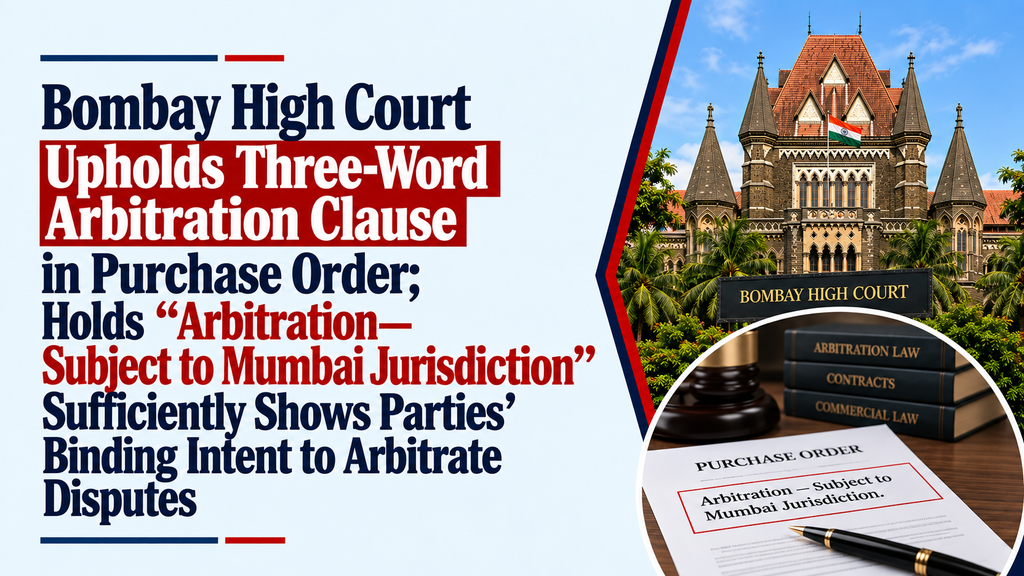
Bombay High Court Upholds Three-Word Arbitration Clause in Purchase Order; Holds “Arbitration—Subject to Mumbai Jurisdiction” Sufficiently Shows Parties’ Binding Intent to Arbitrate Disputes

Bombay High Court Holds “Arbitration—Subject to Mumbai Jurisdiction” Is a Valid Arbitration Agreement Despite Absence of Detailed Appointment Procedure or Mandatory Language
Facts
Lion Rubber Industries Private Limited and Sachin Navinchandra Goradia filed an application under Section 11(6) of the Arbitration and Conciliation Act, 1996 seeking appointment of an arbitrator against Santec Exim Private Limited, Richa Sangal and Umakant Sangal. The application relied upon Clause 9 of the parties’ Purchase Order.
In January 2024, the applicants invited quotations for purchase of a machine. The respondents submitted a quotation dated 18 June 2024, following which the applicants issued a domestic Purchase Order dated 19 June 2024 containing technical and commercial terms for purchase of the machine.
Disputes subsequently arose regarding performance of the contract. In November 2025, the applicants received proceedings in a commercial suit instituted by the respondents before a Gurugram court.
The applicants thereafter invoked arbitration on 11 February 2026, proposing names for appointment as sole arbitrator. The respondents denied the existence of a valid arbitration agreement.
The controversy centred on Clause 9 of the Purchase Order, which read:
“9. Arbitration ~ Subject to Mumbai Jurisdiction.”
Issues
The principal issues were:
- whether the short clause “Arbitration—Subject to Mumbai Jurisdiction” constituted a valid arbitration agreement under Section 7;
- whether absence of expressions such as “shall be referred to arbitration” or “will be referred to arbitration” rendered the clause non-binding;
- whether absence of a mechanism for appointment of the arbitrator, governing procedure or express “final and binding” language defeated the agreement;
- whether “Mumbai Jurisdiction” converted the clause merely into an exclusive civil-court jurisdiction clause;
- whether the applicants’ participation in the Gurugram suit or claimed Section 8 proceedings affected existence of the arbitration agreement; and
- whether an arbitrator should consequently be appointed under Section 11(6).
Applicants’ Arguments
The applicants argued that Clause 9 was a valid and subsisting arbitration agreement.
They contended that the respondents had violated that agreement by instituting proceedings before the Gurugram court.
According to them, the words “Subject to Mumbai Jurisdiction” also indicated that Mumbai was the agreed jurisdiction connected with the arbitral process, making the Gurugram proceedings contrary to the contractual arrangement.
They relied on Enercon (India) Ltd. v. Enercon GmbH, Visa International Ltd. v. Continental Resources, Hitesh Coal Traders and English decisions involving very short arbitration clauses to argue that commercial dispute-resolution clauses should be interpreted pragmatically rather than technically.
Respondents’ Arguments
The respondents argued that Clause 9 did not amount to an arbitration agreement at all.
They emphasised that the clause did not state that disputes “shall” or “will” be referred to arbitration, did not specify any procedure for appointing an arbitral tribunal and did not state that the award would be final and binding.
They relied on Jagdish Chander v. Ramesh Chander, K.K. Modi v. K.N. Modi, Mahanadi Coalfields Ltd. v. IVRCL AMR Joint Venture and BGM and M-RPL-JMCT (JV) v. Eastern Coalfields Ltd. to argue that arbitration requires clear and mandatory consent.
The respondents further argued that the applicants were inconsistently treating the same Clause 9 both as:
- an arbitration agreement excluding civil adjudication; and
- an exclusive jurisdiction clause conferring jurisdiction upon Mumbai civil courts.
According to them, those two interpretations could not coexist.
Analysis of the Law
1. Section 7 Does Not Prescribe Magic Words
The High Court held that Section 7 does not require any prescribed formula or specific terminology for a valid arbitration agreement.
A clause need not be drafted with the precision expected from a specialist arbitration lawyer.
The decisive question is whether, read in the context of the entire contract, the parties intended their disputes to be determined through arbitration rather than ordinary litigation.
2. Short Drafting Does Not Mean No Arbitration Agreement
Justice Amit Borkar rejected the argument that Clause 9 failed merely because it was extremely brief.
The Court noted that the Purchase Order was itself a commercial document containing concise terms regarding delivery, payments, installation, commissioning and warranty. The arbitration provision had to be understood in the same commercial setting.
The Court held that a short clause can nevertheless be legally meaningful if its commercial meaning is reasonably ascertainable.
3. Direct Use of “Arbitration” Distinguished From Optional Language
The Court drew a clear distinction between the present clause and clauses which use expressions such as:
- “may be referred to arbitration”;
- “if mutually agreed”; or
- “if parties so decide”.
Such language would indicate that further consent is required before arbitration can occur.
Clause 9 contained no such condition. It directly used the word “Arbitration” as a final numbered commercial term.
Therefore, the Court treated the clause as an existing arbitration agreement, not merely an agreement to consider arbitration in the future.
4. “Mumbai Jurisdiction” Did Not Destroy the Arbitration Agreement
The Court held that the words “Arbitration” and “Subject to Mumbai Jurisdiction” had to be read together.
It rejected the respondents’ approach because that interpretation would give effect to “Mumbai Jurisdiction” while rendering the word “Arbitration” meaningless.
The more commercially sensible interpretation was that arbitration was the agreed dispute-resolution mechanism, with Mumbai supplying the relevant territorial or supervisory jurisdictional connection.
The Court therefore held that:
arbitration was agreed and the arbitration arrangement was made subject to Mumbai jurisdiction.
5. Missing Appointment Procedure Was Not Fatal
The absence of any procedure for appointing an arbitrator did not mean that there was no arbitration agreement.
The Court distinguished:
- consent to arbitrate, which must arise from agreement; and
- machinery for appointment, which can be supplied by the Arbitration Act where the contract is silent.
A failure to agree on the identity of an arbitrator is therefore different from a failure to agree to arbitration itself.
6. “Final and Binding” Need Not Be Expressly Written
The Court relied upon Babanrao Rajaram Pund v. Samarth Builders & Developers to hold that the absence of the words “final and binding” does not necessarily invalidate an arbitration agreement.
Once a valid agreement to arbitrate exists, the legal consequences of the Arbitration and Conciliation Act follow automatically; parties need not reproduce the entire statutory regime in their contract.
Precedent Analysis
K.K. Modi v. K.N. Modi
The Supreme Court identified the essential attributes of arbitration, including consensual tribunal jurisdiction, judicial determination of substantive rights and an enforceable intention to submit disputes to such determination.
The High Court clarified that these attributes need not each be separately recited verbatim in the arbitration clause.
Babanrao Rajaram Pund v. Samarth Builders & Developers
This was heavily relied upon by the Court.
It supported a substance-over-form approach and established that absence of expressions such as “final and binding” does not necessarily defeat arbitration where the parties’ intention is otherwise clear.
Jagdish Chander v. Ramesh Chander
The Court accepted the principle that a mere possibility of future agreement to arbitrate does not amount to a binding arbitration agreement.
However, Clause 9 was distinguishable because there was no language making arbitration conditional upon future consent.
BGM and M-RPL-JMCT (JV) v. Eastern Coalfields Ltd.
The clause in that case stated that settlement “may be sought” through arbitration.
The Supreme Court held that such language was merely enabling and did not impose a binding obligation.
The Bombay High Court distinguished it because Clause 9 here contained no equivalent permissive expression.
Enercon (India) Ltd. v. Enercon GmbH
The judgment supported a pragmatic, commercially sensible interpretation rather than a pedantic approach to apparently incomplete arbitration clauses.
The Court emphasised that arbitration clauses should, within permissible limits, be made workable where the commercial intention to arbitrate is evident.
Tritonia Shipping Incorporated v. South Nelson Forest Products Corporation
The English Court of Appeal had enforced a very brief clause:
“Arbitration to be settled in London.”
The Bombay High Court treated it as persuasive support for the proposition that brevity alone does not destroy an arbitration agreement.
Hobbs Padgett & Co. v. J.C. Kirkland Ltd.
The English court had similarly interpreted the words “Suitable Arbitration Clause” as sufficient in the commercial context.
The Bombay High Court relied upon the broader principle that courts should not adopt an excessively technical approach merely because commercial drafting is short or inelegant.
Court’s Reasoning
The Court adopted the perspective of an ordinary commercial person reading the Purchase Order as a whole.
Clause 9 appeared as a numbered commercial term alongside operative provisions concerning the machine transaction.
The word “Arbitration” could not simply be discarded.
Nor was there any language requiring a later agreement or further mutual consent before arbitration could occur.
The Court held that imperfect drafting is not equivalent to absence of agreement.
It also clarified that the question whether the Gurugram civil court itself lacked territorial jurisdiction did not need to be finally decided in the Section 11 application. That issue could be determined separately by the competent court. For Section 11 purposes, it was sufficient that the Mumbai-jurisdiction words did not destroy the arbitration agreement.
The applicants’ later conduct in invoking arbitration or referring to Section 8 proceedings also neither created nor destroyed the arbitration agreement. Its existence had to be determined from the Purchase Order itself.
Conclusion
The Bombay High Court held that Clause 9—
“Arbitration ~ Subject to Mumbai Jurisdiction”
—constituted a valid and binding arbitration agreement under Section 7 of the Arbitration and Conciliation Act, 1996.
The Court rejected the respondents’ argument that absence of elaborate procedural machinery or mandatory phrases rendered the clause unenforceable.
Accordingly, the Section 11 application was allowed and Mr. Shadab Jan, Advocate, was appointed as Sole Arbitrator to decide disputes arising from the parties’ contractual relationship.
Case Details
Case: Lion Rubber Industries Private Limited & Anr. v. Santec Exim Private Limited & Ors.
Citation: 2026:BHC-OS:19813.
Court: High Court of Judicature at Bombay, Ordinary Original Civil Jurisdiction, Commercial Division.
Case Number: Commercial Arbitration Application (L) No. 23526 of 2026.
Judge: Justice Amit Borkar.
Reserved on: 2 September 2026.
Pronounced on: 7 September 2026.
Subject: Section 7 and Section 11(6) Arbitration and Conciliation Act; short-form arbitration agreement; Purchase Order; Mumbai jurisdiction; appointment of sole arbitrator; commercial interpretation of arbitration clauses.
Result: Application allowed. Clause 9 was held to constitute a valid arbitration agreement, and Mr. Shadab Jan, Advocate, was appointed Sole Arbitrator to adjudicate the disputes between the parties.