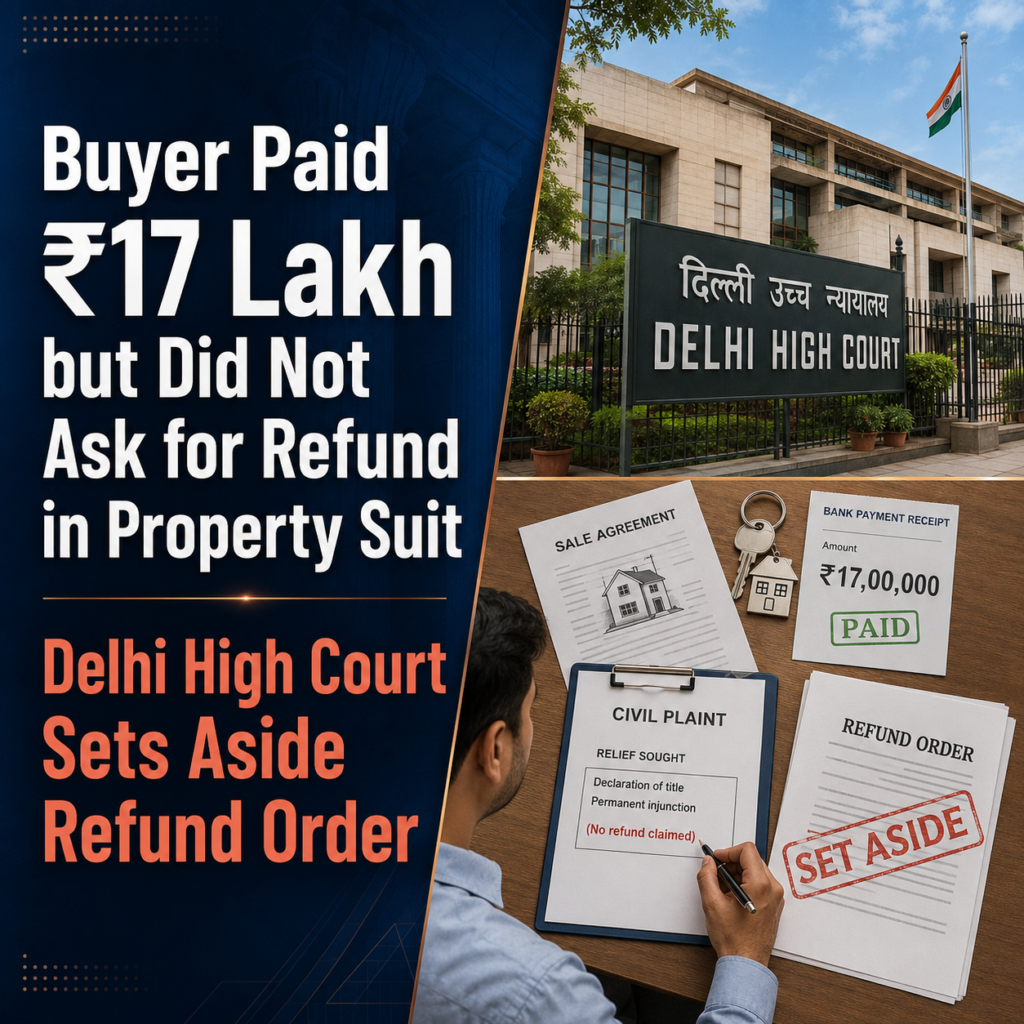
Buyer Paid ₹17 Lakh but Did Not Ask for Refund in Property Suit; Delhi High Court Sets Aside Refund Order

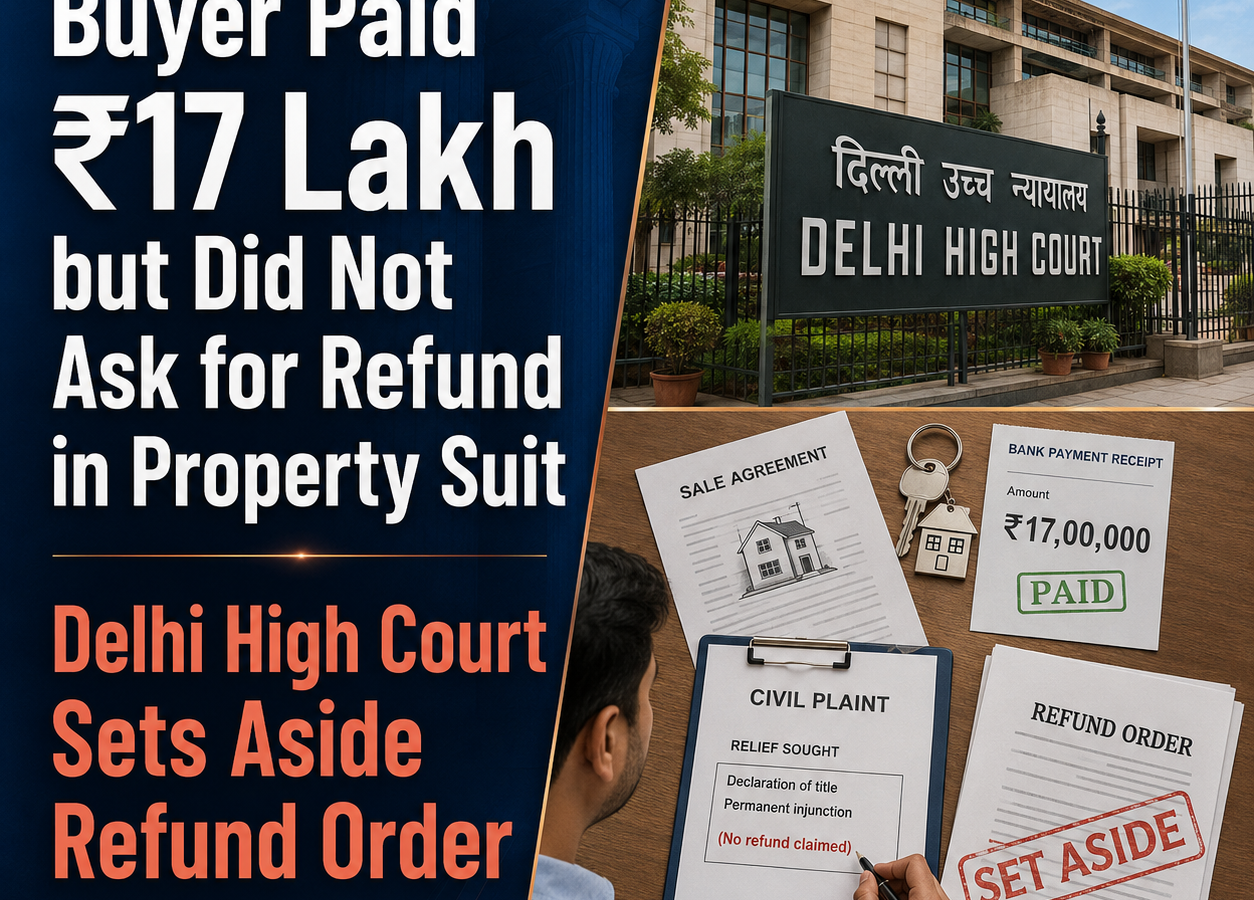
Court Cannot Refund Advance Money After Rejecting Property Sale Claim Unless Buyer Specifically Requests It: Delhi High Court
Facts
Sumitra, an elderly widow, owned a 100-square-yard property bearing No. 10-J Extension, Laxmi Nagar, Delhi. Rajesh Kumar contacted her through a property dealer for purchasing the property.
The parties executed their first Agreement to Sell on September 23, 2011. The agreed sale consideration was ₹61 lakh. The buyer claimed that he initially paid ₹2 lakh as earnest money and subsequently made several further payments.
Disputes arose when the buyer allegedly asked the seller to produce the original title documents. The seller issued a legal notice dated July 21, 2012, indicating that she no longer wished to proceed with the transaction. The buyer disputed her allegations through a reply dated July 25, 2012.
The parties subsequently entered into another Agreement to Sell dated August 7, 2013, for the same property. Under the new agreement:
- The sale consideration was increased to ₹79 lakh.
- The seller acknowledged receiving ₹17 lakh as advance or earnest money.
- The remaining ₹62 lakh was to be paid on or before September 5, 2013.
- The title documents and possession were to be transferred upon payment of the balance.
- If the buyer defaulted, the seller could forfeit the advance.
- If the seller defaulted, she would be liable to pay twice the advance amount.
The buyer claimed that he was ready with the balance consideration of ₹62 lakh and appeared at the Sub-Registrar’s office on September 5, 2013, but the seller did not attend. He subsequently issued a legal notice and initiated criminal proceedings, resulting in the registration of an First Information Report against the seller.
The buyer filed a civil suit on August 9, 2016, seeking:
- Specific performance of the Agreement to Sell dated August 7, 2013.
- A permanent injunction preventing the seller from transferring the property to anyone else.
The plaint did not contain any specific or alternative prayer seeking a refund of the ₹17 lakh advance. The buyer did not subsequently amend the plaint to add such a claim.
The seller opposed the suit, alleging that the buyer repeatedly failed to pay the balance amount. She claimed entitlement to forfeit the advance under the agreement.
The District Judge held that the 2013 agreement replaced the 2011 agreement and that the suit was filed within limitation. However, the buyer failed to prove continuous readiness and willingness to complete the transaction. He produced no documentary evidence showing the availability of ₹62 lakh and did not comply with an order directing him to furnish a fixed deposit receipt for the balance amount.
The District Judge therefore dismissed the claims for specific performance and permanent injunction. Nevertheless, to balance the equities between the parties, the Court directed Sumitra to refund ₹17 lakh with pendente lite and future interest at 8% per annum.
Sumitra appealed against the refund direction and the finding that the suit had been filed within limitation.
Issues
- Whether the trial court could order a refund of ₹17 lakh when the buyer had not specifically claimed that relief.
- Whether a general prayer for “such other relief as the Court may deem fit” could be treated as a claim for refund.
- Whether the general powers under Order VII Rule 7 or Order XLI Rule 33 of the Code of Civil Procedure could override Section 22(2) of the Specific Relief Act, 1963.
- Whether equitable considerations and prevention of unjust enrichment justified an unrequested refund.
- Whether the buyer could have amended his plaint to claim a refund at the appellate stage.
- Whether the 2013 agreement was merely a continuation of the 2011 agreement or a fresh contract replacing it through novation.
- From which agreement and date the limitation period for filing the specific-performance suit had to be calculated.
- Whether the buyer’s delay, conduct and failure to prove continuous readiness and willingness disentitled him to equitable relief.
Petitioner’s Arguments
The defendant-appellant, Sumitra, argued that the trial court had already found that the buyer failed to establish his continuous readiness and willingness to perform the 2013 agreement.
The buyer had not proved that he possessed the balance sale consideration of ₹62 lakh. He also failed to comply with the trial court’s direction to furnish a fixed deposit receipt for that amount.
According to the appellant, once the buyer was found to be in default and denied specific performance, the trial court could not order a refund contrary to the contractual forfeiture clause.
She further argued that neither the original plaint nor its prayer clause contained any claim for refund of ₹17 lakh. No application had ever been filed to amend the plaint and introduce such an alternative relief.
Sections 21(5) and 22(2) of the Specific Relief Act expressly require compensation or refund of earnest money to be specifically claimed. The trial court could not bypass this requirement merely to balance the equities.
The appellant also challenged the finding on limitation. She contended that the agreement dated August 7, 2013, was only supplementary to or a continuation of the agreement dated September 23, 2011. If limitation were calculated from the earlier transaction, the suit filed in August 2016 would be time-barred.
She further submitted that the buyer waited until close to the end of the limitation period to institute the suit without satisfactorily explaining his inactivity. Such conduct disentitled him to equitable relief.
Respondent’s Arguments
The buyer supported the trial court’s refund direction on the ground that otherwise the seller would retain ₹17 lakh despite the sale not being completed. According to him, this would amount to unjust enrichment.
He argued that the trial court possessed sufficient authority under Order VII Rule 7 of the Code of Civil Procedure to grant appropriate consequential relief even where it had not been expressly requested.
He also relied upon Order XLI Rule 33, which gives an appellate court broad powers to pass orders necessary to do complete justice between the parties.
The respondent submitted that the refund was justified on equitable considerations and that the absence of a separate prayer should not defeat substantive justice.
He also maintained that he had always been ready and willing to perform his obligations under the agreement and that the suit had correctly been found to be within limitation.
Analysis of the Law
Refund under Section 22 of the Specific Relief Act
Section 22(1)(b) permits a person suing for specific performance of a contract involving immovable property to seek refund of earnest money or a deposit if specific performance is refused.
Section 22(2), however, expressly provides that such relief cannot be granted unless it has been specifically claimed.
The proviso allows the plaintiff to amend the plaint at any stage of the proceedings to add the missing relief. This procedural flexibility does not remove the requirement of an express claim.
Therefore, refund may be granted only when:
- It was claimed in the original plaint; or
- The plaint was subsequently amended to add the claim.
A general or residuary prayer asking for any other relief considered appropriate by the Court does not satisfy this statutory requirement.
Amendment at the appellate stage
The expression “at any stage of the proceeding” is wide enough to include the trial, appeal and execution stages.
A plaintiff who initially omitted the refund claim may seek permission to amend the plaint even during an appeal. However, the Court cannot amend the pleadings on the plaintiff’s behalf or grant the relief automatically.
In the present case, the buyer did not seek an amendment before the trial court or during the appeal.
General powers under the Code of Civil Procedure
Section 22 of the Specific Relief Act begins with a non-obstante clause and specifically governs the reliefs available in a suit for specific performance.
Consequently, the general powers under Order VII Rule 7 and Order XLI Rule 33 of the Code of Civil Procedure cannot override the express prohibition in Section 22(2).
Equity and statutory restrictions
Specific performance and related alternative remedies are equitable in nature. Nevertheless, Indian courts exercise equity within the statutory framework of the Specific Relief Act.
Equity may supplement the law where the law is silent. It cannot contradict an express statutory requirement.
Therefore, considerations such as preventing unjust enrichment, doing broad justice or balancing equities cannot authorise a court to grant a refund that Section 22(2) prohibits in the absence of a specific claim.
Novation under Section 62 of the Contract Act
Section 62 of the Indian Contract Act, 1872, recognises novation. Where parties agree to substitute a new contract for an earlier one, the earlier agreement need not be performed.
The Court compared the two agreements and found material differences:
- The sale price increased from ₹61 lakh to ₹79 lakh.
- The acknowledged advance changed from ₹6 lakh under the first arrangement to ₹17 lakh under the second.
- The first agreement specified no final completion date.
- The second agreement fixed September 5, 2013, for completion.
- The second agreement contained complete reciprocal obligations and consequences of default.
- It did not incorporate or refer to the earlier agreement.
These features established that the 2013 agreement was a fresh contract replacing the 2011 agreement.
Limitation for specific performance
Under Article 54 of the Limitation Act, 1963, a suit for specific performance must be filed within three years:
- From the date fixed for performance; or
- If no date is fixed, from the date when the plaintiff receives notice that performance has been refused.
The second agreement fixed September 5, 2013, as the performance date. The suit filed on August 9, 2016, was therefore within three years and was not barred by limitation.
Readiness and willingness
Under Section 16(c) of the Specific Relief Act, a buyer seeking specific performance must plead and prove continuous readiness and willingness to perform his contractual obligations.
Mere attendance at the Sub-Registrar’s office does not establish financial readiness. Evidence demonstrating the availability or capacity to pay the balance consideration is relevant.
The buyer failed to prove the availability of ₹62 lakh and did not comply with the direction to furnish a fixed deposit receipt. The denial of specific performance was consequently justified.
Precedent Analysis
Desh Raj v. Rohtash Singh, (2023) 3 SCC 714
The Supreme Court held that a plaintiff seeking specific performance may also claim alternative relief, including refund of earnest money. However, the alternative relief must be expressly included in the plaint or introduced through amendment.
The prayer clause is a necessary condition for granting a refund. A court cannot award it on its own merely because specific performance has been refused.
This precedent directly supported the seller’s appeal.
K.R. Suresh v. R. Poornima, Civil Appeal No. 5822 of 2025, decided May 2, 2025
In this case, specific performance was refused because the purchaser failed to establish readiness and willingness. The purchaser had not claimed refund of the advance and relied only on a general prayer for other appropriate relief.
The Supreme Court held that refund under Section 22(1)(b) does not automatically follow the rejection of specific performance. It must be explicitly claimed.
Although an amendment may be sought even at the appellate stage, the court cannot grant a refund on its own where the plaintiff fails to seek that amendment.
The Delhi High Court found this decision squarely applicable.
Manickam v. Vasantha, 2022 SCC OnLine SC 2096
The Supreme Court held that possession which necessarily follows a decree for specific performance may not require a separate prayer. It also held that amendment may be permitted at any stage, including appeal or execution.
The Delhi High Court distinguished possession from refund. Possession may be ancillary to specific performance, whereas refund does not automatically flow from such a decree and must be separately claimed.
Lata Construction v. Dr. Rameshchandra Ramniklal Shah, (2000) 1 SCC 586
The Supreme Court explained that novation requires complete substitution of a new contract for the earlier contract. The parties’ terms and conduct must show an intention to extinguish the original contract and replace it.
Applying this principle, the High Court found that the 2013 agreement replaced the 2011 agreement.
Universal Petro Chemicals Ltd. v. B.P. PLC, Civil Appeal No. 3128 of 2009, decided February 18, 2022
The Supreme Court held that equitable considerations cannot be used to ignore statutory provisions. Where equity conflicts with an express legal requirement, equity must yield to law.
This principle prevented the trial court from using “broad justice” to bypass Section 22(2).
Kamal Kumar v. Premlata Joshi, (2019) 3 SCC 704
The Supreme Court recognised that specific performance is a discretionary and equitable remedy. However, entitlement to specific performance and alternative reliefs must be determined according to the statutory requirements contained in the Specific Relief Act.
The relevant claims must be properly pleaded and proved before the Court exercises its discretion.
Pydi Ramana alias Ramulu v. Davarasetty Manmadha Rao, (2024) 7 SCC 515
The Supreme Court held that although a specific-performance suit may be filed on the final permissible day of limitation, unexplained delay and inaction may still disentitle the plaintiff to equitable relief.
The plaintiff must explain the steps taken between the agreement and institution of the suit. Filing within limitation does not automatically establish equitable entitlement.
C.S. Udayakumar v. Palaniammal
The buyer relied on this Madras High Court decision to argue that a court could grant consequential relief under the Code of Civil Procedure.
The Delhi High Court held that this ruling could not prevail over the binding Supreme Court decisions in Desh Raj and K.R. Suresh, which directly interpreted Section 22 of the Specific Relief Act.
Court’s Reasoning
The buyer’s plaint sought only specific performance and a permanent injunction. It did not contain an alternative prayer for return of the ₹17 lakh advance.
The buyer did not seek to amend the plaint before the District Judge. More importantly, he did not seek amendment even after the seller challenged the refund direction before the High Court.
Written submissions defending the refund on equitable grounds could not substitute the specific pleading required by Section 22(2).
The buyer’s general prayer for any other appropriate relief was also insufficient. A refund is a distinct statutory remedy which must be expressly requested.
The High Court rejected reliance on Order VII Rule 7 and Order XLI Rule 33 of the Code of Civil Procedure. General procedural powers could not override the specific restriction imposed by Section 22(2).
Although the trial court intended to prevent the seller from retaining the ₹17 lakh without completing the sale, its equitable motivation could not justify an order contrary to the statute.
On limitation, however, the High Court agreed with the trial court. The 2013 agreement represented a fresh transaction because it contained a revised price, a different advance amount, a fixed completion date and an independent set of obligations. It therefore replaced the earlier agreement through novation.
Since September 5, 2013, was the fixed date for performance under the new agreement, the suit instituted on August 9, 2016, was within the three-year period prescribed by Article 54.
The buyer nevertheless remained disentitled to specific performance because he failed to establish continuous readiness and willingness. That finding was supported by his failure to prove the availability of the ₹62 lakh balance consideration.
Conclusion
The Delhi High Court held that refund of earnest money cannot be granted automatically when specific performance is refused.
Section 22(2) of the Specific Relief Act requires the plaintiff to specifically claim a refund, either in the original plaint or through an amendment. A general prayer, written submissions or equitable considerations cannot replace this requirement.
Although the buyer could have sought amendment even during the appeal, he failed to do so. The trial court therefore lacked authority to order refund of ₹17 lakh with 8% interest.
The Court upheld the finding that the 2013 agreement replaced the 2011 agreement and that the suit was filed within limitation. However, the suit ultimately failed because the buyer was not entitled to specific performance, injunction or the unclaimed refund.
The seller’s appeal was allowed, the ₹17 lakh refund direction was set aside, and the buyer’s suit was dismissed in its entirety.
Case Details
Case: Sumitra v. Rajesh Kumar
Court: High Court of Delhi at New Delhi
Case Number: Regular First Appeal 214/2025 with CM Applications 13040/2025, 13042/2025 and 13044/2025
Judge: Justice Neena Bansal Krishna
Date: July 17, 2026
Result: Appeal allowed; direction requiring the seller to refund ₹17 lakh with 8% interest set aside; buyer’s suit dismissed.