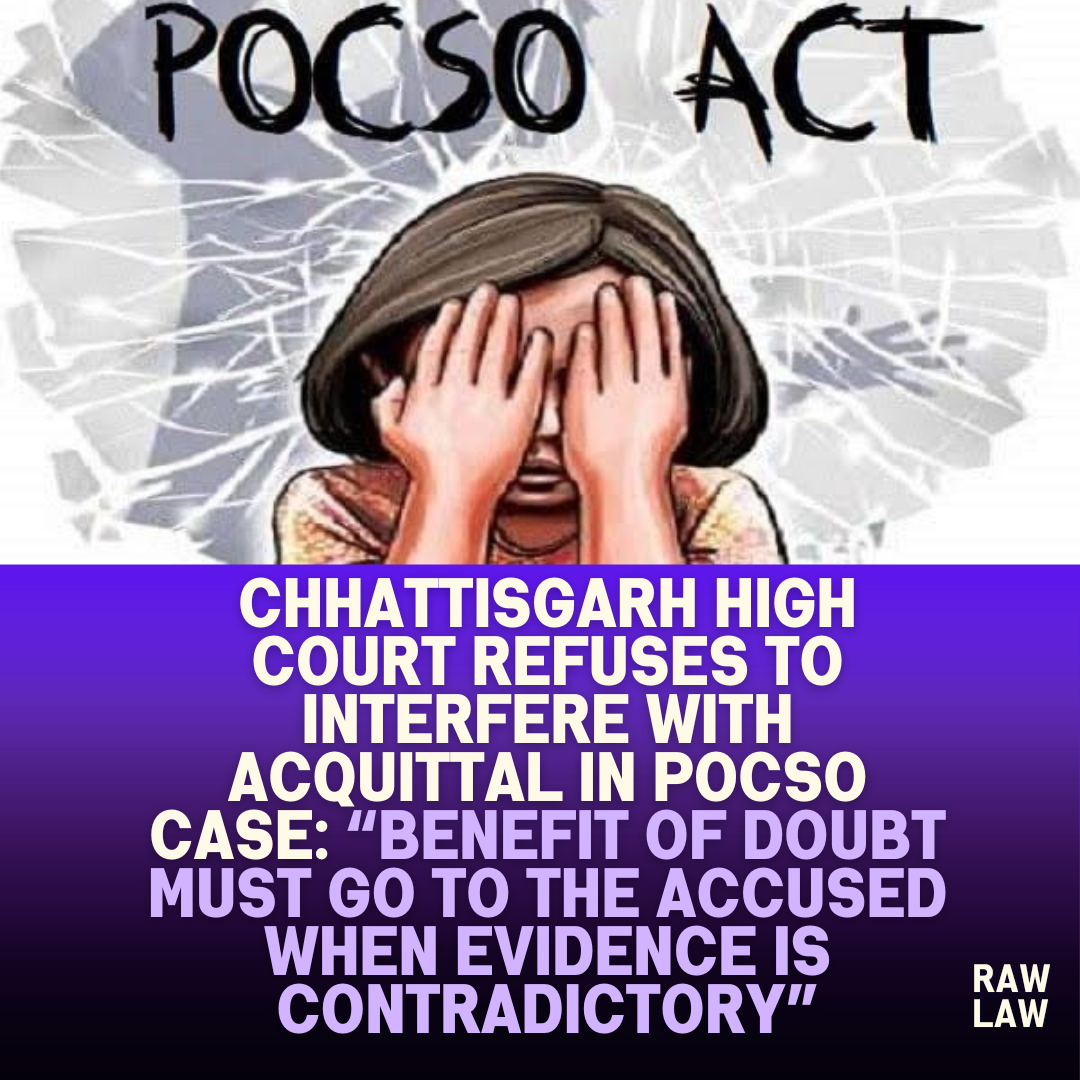
Chhattisgarh High Court Refuses to Interfere with Acquittal in POCSO Case: “Benefit of Doubt Must Go to the Accused When Evidence Is Contradictory”

Court’s Decision
The Chhattisgarh High Court dismissed the State’s application seeking leave to appeal under Section 419(3) of the Bharatiya Nagarik Suraksha Sanhita, 2023, against the acquittal of the accused under Section 363 of the Indian Penal Code and Section 6 of the Protection of Children from Sexual Offences (POCSO) Act. The Court held:
“It cannot be held that the findings recorded by the learned trial Court acquitting the respondent/accused… are perverse or contrary to record.”
The application for condonation of 395 days delay was allowed, but the appeal itself was rejected.
Facts
The case stems from a complaint filed by the mother of a minor boy aged 14 years and 5 months, who had gone missing. The boy was later found with the accused, a neighbour, in Janjgir. According to the prosecution, the accused had cajoled the boy into accompanying her and had established physical relations with him. It was further alleged that obscene photos and videos of the minor and the accused were recovered from the minor’s mobile phone.
A charge sheet was filed against the accused under Section 363 IPC (kidnapping) and Section 6 of the POCSO Act (aggravated penetrative sexual assault). The trial court, however, acquitted the accused.
Issues
- Whether the acquittal of the accused by the trial court was legally sustainable in light of the evidence on record?
- Whether the trial court erred in giving undue weight to the minor’s contradictory testimony?
- Whether the prosecution’s evidence was sufficient to prove the offences beyond reasonable doubt?
Petitioner’s Arguments
The State contended that the trial court failed to appreciate critical evidence and erred in giving weight to the minor victim’s consent, despite his legal incapacity to consent due to being below 18 years of age. The State argued:
- The victim’s testimony, though inconsistent, did include admissions about the accused having physical relations and capturing obscene videos and photos.
- The accused and the victim were found cohabiting at Janjgir, suggesting abduction and illicit conduct.
- Obscene materials recovered from the boy’s mobile corroborated the allegations.
- The trial court erroneously relied on minor contradictions and omissions to discard the prosecution’s version.
Respondent’s Arguments
The defence successfully demonstrated before the trial court that:
- The victim did not consistently support the prosecution’s case and, in fact, stated that he left home on his own will to escort the accused to safety.
- In cross-examination, the victim denied any physical relations with the accused, contradicting his earlier acceptance of the prosecution’s suggestion.
- The alleged photographs were not admissible due to lack of proper certification under the Indian Evidence Act regarding safe custody and authenticity.
- The medical expert opinions were inconsequential in light of the victim’s categorical denial of physical relations.
Analysis of the Law
The Court examined the trial court’s reasoning and found that it was firmly grounded in the principle of giving benefit of doubt to the accused when prosecution evidence is inconsistent or unreliable. It reaffirmed that a minor’s consent is legally invalid in sexual offences, but that principle alone cannot override the prosecution’s burden to prove its case beyond reasonable doubt.
It also considered that technical evidence like digital images must conform to evidentiary safeguards for admissibility.
Precedent Analysis
The High Court did not cite any particular precedents in this order, but the following principles were implicitly followed:
- Benefit of doubt: Acquittal is appropriate if material contradictions arise in the prosecution’s story.
- Standard of proof: Prosecution must establish guilt beyond reasonable doubt in criminal cases, especially under POCSO where severe consequences follow.
- Inadmissibility of evidence: Photographic or digital evidence must be properly certified and preserved to be admissible under the Indian Evidence Act and Information Technology Act.
Court’s Reasoning
The Court found that the trial court had conducted a careful scrutiny of the testimonies and had correctly found the victim’s testimony to be unreliable due to contradictions. It noted:
- The trial court did not ignore the serious nature of the offence but rightly found that no consistent and credible material was available to establish guilt.
- The photographs were not admissible without a certificate showing proper maintenance and integrity.
- Medical opinion regarding the victim’s sexual maturity was rendered irrelevant once the victim denied any sexual contact.
Hence, the acquittal was not based on irrelevant or perverse reasoning but on cautious application of legal standards.
Conclusion
The Chhattisgarh High Court held that the trial court’s findings could not be termed perverse or unsustainable. There was no justification to grant leave to appeal in the absence of glaring errors in the trial court’s analysis. The State’s application was therefore dismissed.
Implications
- The judgment reaffirms the burden on the prosecution to prove guilt beyond reasonable doubt, even in POCSO matters.
- Courts remain cautious about relying on digital evidence that is not supported by certification as per statutory requirements.
- Victim testimony is crucial and must be clear and consistent to establish offences under POCSO.
FAQs
Q1. Can a child’s inconsistent statement lead to acquittal in a POCSO case?
Yes. While the child’s consent is immaterial, inconsistent or contradictory statements may create doubt about the occurrence of the alleged offence, warranting acquittal.
Q2. Are photos and videos admissible without certification in criminal cases?
No. Digital evidence like photographs and videos must be properly certified and their integrity preserved to be admissible under the Indian Evidence Act.
Q3. What is the role of medical opinion when the victim denies any sexual act?
Medical opinions on the victim’s sexual maturity lose relevance if the victim categorically denies any physical contact, as held in this case.