Supreme Court Overturns Conviction in Honour Killing Case, Calls for Caution in Solely Relying on Unreliable Eyewitnesses and Flawed Circumstantial Evidence: “Suspicion, However Strong, Cannot Replace Legal Proof”


Court’s Decision
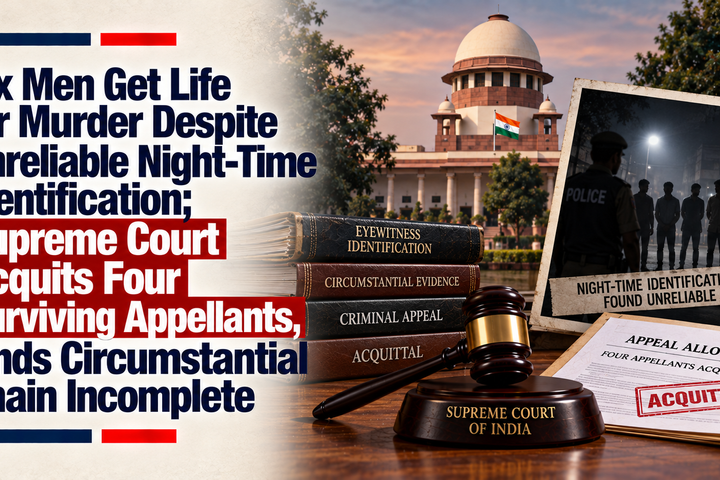
The Supreme Court allowed the criminal appeals and acquitted the appellants who were previously convicted under Sections 302, 120-B, and 201 of the Indian Penal Code in a murder case involving a young woman, her fiancé, and co-accused. The Court ruled that the prosecution failed to establish the guilt of the accused beyond reasonable doubt, observing serious infirmities in the evidence of key witnesses, improper reliance on call data records (CDRs), and lack of credible motive evidence. The Court held that the accused deserved the benefit of doubt, emphasizing the principle that “suspicion, however strong, cannot take the place of legal proof.”
Facts
The case revolved around the murder of a 26-year-old software engineer who was engaged to marry a 20-year-old law student. After the engagement, the young woman allegedly conspired with her college friend and his relatives to eliminate the fiancé whom she did not want to marry. On the night of the incident, the deceased took the woman for dinner, after which he was attacked and fatally assaulted at an airport viewing point. The prosecution alleged a conspiracy hatched among the woman, her friend, and his relatives, leading to the brutal killing. The trial court convicted all four accused, which was affirmed by the Karnataka High Court.
Issues
- Whether the testimonies of the alleged eyewitnesses could be relied upon.
- Whether the call data records were legally admissible and reliable.
- Whether the prosecution proved the chain of circumstances beyond reasonable doubt.
- Whether the motive attributed to the accused was credibly established.
Petitioner’s Arguments
The appellants argued that the two main eyewitnesses were planted witnesses, as their statements were recorded after undue delay without reasonable explanation, casting serious doubt on their credibility. They pointed out contradictions in testimonies, including unnatural post-incident conduct of the eyewitnesses, and failure to examine other crucial witnesses like occupants of the car used to shift the deceased. The call data records, heavily relied upon by the prosecution, were challenged for non-compliance with Section 65-B of the Indian Evidence Act, as the certification was defective and issued by incompetent officers. The alleged motive of the woman to avoid marriage was said to be based on unreliable witnesses with inconsistent versions. The defence contended that the case rested on inadmissible and unreliable evidence, meriting acquittal.
Respondent’s Arguments
The prosecution argued that despite minor discrepancies, the overall evidence, including eyewitness accounts, motive, call data records, and recovery of weapons, established the guilt of the accused beyond reasonable doubt. The prosecution maintained that the chain of circumstances was complete, showing consistent communication among the accused, the presence of motive, and direct involvement of the accused in the crime. The state counsel submitted that discrepancies were inconsequential and did not dilute the credibility of the prosecution’s case.
Analysis of the Law
The Court reiterated the settled principle that in cases based on circumstantial evidence, the chain of evidence must be so complete as to leave no reasonable ground for conclusion consistent with the innocence of the accused. The Court applied the five golden principles laid down in Sharad Birdhichand Sarda v. State of Maharashtra and emphasized that the circumstances must be fully established and exclude every hypothesis except guilt.
Further, the Court relied on precedent regarding the necessity of reliable certification under Section 65-B of the Indian Evidence Act for electronic evidence, citing Arjun Panditrao Khotkar v. Kailash Kushanrao Gorantyal, and reiterated that defective certification renders electronic evidence inadmissible.
Precedent Analysis
- Sharad Birdhichand Sarda v. State of Maharashtra (1984): Applied for five golden principles in circumstantial evidence cases.
- Arjun Panditrao Khotkar v. Kailash Kushanrao Gorantyal (2020): Cited on the importance of proper certification under Section 65-B for electronic records.
- Vadivelu Thevar v. State of Madras (1957): Referenced on the appreciation of witness testimony and the distinction between wholly reliable and unreliable witnesses.
- Rajesh Yadav v. State of U.P. (2022): Cited regarding the standard of proof and appreciation of evidence.
These precedents were crucial in guiding the Court’s reasoning to discard unreliable and inadmissible evidence.
Court’s Reasoning
The Court found the testimonies of PW-15 and PW-16, the alleged eyewitnesses, to be untrustworthy due to their unnatural conduct, unexplained delay in recording statements, and contradictions in evidence. The Court was critical of the prosecution’s failure to examine material witnesses like the car occupants or Intel security staff who could corroborate the eyewitnesses’ version.
Regarding motive, the Court dismissed the statements of prosecution witnesses PW-8 and PW-11, finding them unreliable and tainted by inconsistencies and prior associations with the deceased’s family. The only credible motive evidence was from PW-23, a college friend of the accused, who merely confirmed that the young woman was unwilling to marry the deceased, which by itself was insufficient to establish a conspiracy to murder.
The Court held the call data records inadmissible due to defective certification under Section 65-B and further highlighted the limitations in tower location data, which could not accurately pinpoint the accused’s locations.
Observing that the chain of circumstances was incomplete, with no credible direct or corroborative evidence, the Court concluded that the benefit of doubt must go to the accused.
Conclusion
Setting aside the judgments of the trial court and High Court, the Supreme Court acquitted all accused, emphasizing that in the absence of credible direct evidence or a complete chain of circumstances, conviction cannot stand. The Court remarked, “It is well settled that strong suspicion cannot substitute proof beyond reasonable doubt,” and underscored the fundamental principle that the prosecution must stand on its own legs, especially in cases based on circumstantial evidence.
Implications
This judgment reinforces the requirement for courts to scrutinize evidence meticulously in cases based on circumstantial evidence. It clarifies that:
- Unreliable witnesses and procedural lapses in collecting evidence can vitiate the prosecution’s case.
- Electronic evidence like CDRs must strictly comply with legal admissibility standards under the Indian Evidence Act.
- Motive, although not always mandatory, plays a crucial role in circumstantial cases.
The judgment underscores judicial restraint and the protection of fundamental rights against wrongful convictions.
FAQs
1. Can eyewitnesses be disregarded in murder cases?
Yes, if the eyewitnesses are found to be unreliable due to contradictions, delayed statements, or unnatural behavior, courts can discard their testimonies, as done in this case.
2. Is call data record evidence automatically admissible in court?
No, call data records must comply with Section 65-B of the Indian Evidence Act, requiring proper certification from competent authorities. Failure to meet this condition renders them inadmissible.
3. How important is motive in circumstantial evidence cases?
Motive plays a significant role in cases based on circumstantial evidence. If motive is unproven or the prosecution’s witnesses are unreliable, the court may extend the benefit of doubt to the accused.
Also Read: Chhattisgarh High Court Refuses to Interfere with Acquittal in POCSO Case