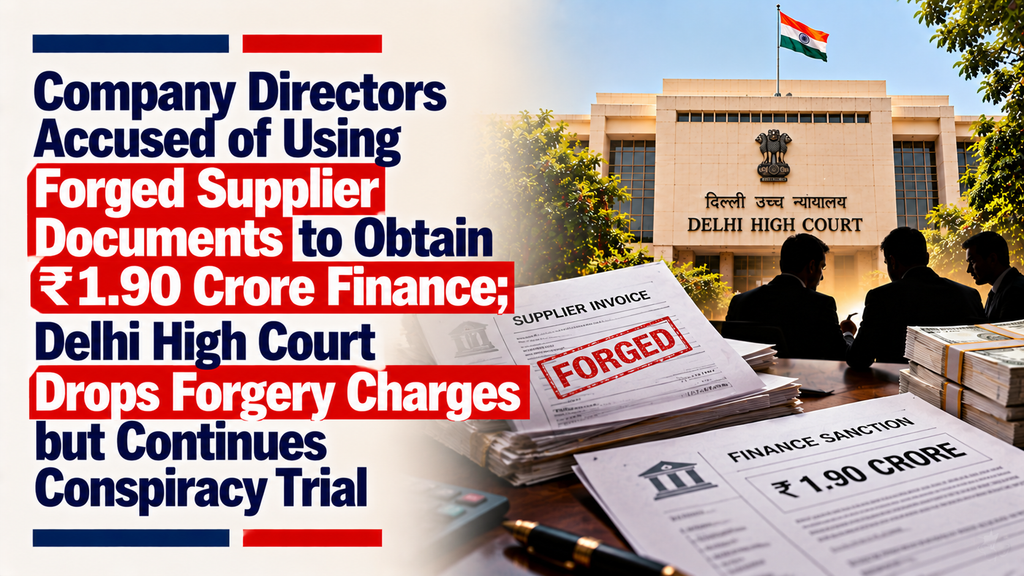
Company Directors Accused of Using Forged Supplier Documents to Obtain ₹1.90 Crore Finance; Delhi High Court Drops Forgery Charges but Continues Conspiracy Trial

Forged Documents Do Not Bear Directors’ Signatures; Delhi High Court Drops Direct Forgery Charges but Retains Criminal Conspiracy and Cheating
Facts
The petition was filed by Rita Singh and Natasha Singh under Section 482 CrPC challenging the Revisional Court’s order which had set aside their discharge and the subsequent order framing charges against them under Section 120B read with Sections 420, 467, 468 and 471 IPC, along with substantive offences.
The case arose from a CBI FIR registered in August 1998 involving M/s Mideast Integrated Steels Ltd. (MISL). Rita Singh was its Managing Director and Natasha Singh a Director.
MISL had sought approximately ₹2 crore in lease finance from Ashok Leyland Finance Ltd. (ALFL) by representing that it had acquired “Air Pre-heaters” from Kesoram Refractories.
CBI alleged that documents relating to earlier transactions with Kesoram Refractories were altered and used to support this financing transaction. These included a proforma invoice, an allegedly altered receipt and a bill.
On the strength of these documents, ALFL sanctioned ₹1,90,18,501, and after adjustment of the stated advance, issued a cheque for ₹1,68,41,547 in favour of Kesoram Refractories.
Alleged Fictitious Supplier Account
According to CBI, the cheque was not deposited with the actual Kesoram Refractories in Calcutta.
Instead, it was deposited into a Vijaya Bank account in Delhi opened in the name “Kesoram Refractories”, showing co-accused Deepak Singh as proprietor. CBI alleged that this was a fictitious concern created to encash the ALFL cheque.
After encashment, substantial amounts were allegedly transferred to different MESCO group companies, including entities allegedly controlled by late J.K. Singh and the petitioners.
CBI also relied upon the statement of a Kesoram Refractories representative who stated that the company neither manufactured nor dealt in Air Pre-heaters and had not issued the documents relied upon for their purported supply.
Procedural History
The Chief Metropolitan Magistrate initially discharged the petitioners on 30 September 2020, observing, among other things, that none of the allegedly forged documents bore their signatures.
CBI challenged the discharge.
The Revisional Court set it aside on 27 August 2022, holding that the material had to be examined cumulatively rather than circumstance by circumstance. Charges were consequently framed on 22 November 2022.
Petitioners’ Arguments
The petitioners argued that criminal liability was effectively being imposed merely because they were Managing Director/Director of MISL and associated group companies.
They submitted that the IPC does not impose vicarious criminal liability upon directors merely because of their corporate designation.
Their principal contentions were:
- none of the disputed documents bore their signatures;
- they were not alleged to have prepared, altered or forged any document;
- the only direct material was a supplementary statement recorded approximately 15 months after the witness’s first statement;
- discussions regarding a financing transaction did not prove participation in forgery or conspiracy;
- transfer of money to MESCO group entities could not itself establish their criminal involvement; and
- an earlier acquittal involving related transactions attracted double jeopardy or issue estoppel.
They also contended that the financial dispute between MISL and ALFL had subsequently been settled, making continuation of the prosecution unnecessary.
CBI’s Arguments
CBI argued that the prosecution case could not be dissected into isolated circumstances at the stage of charge.
It relied upon the cumulative chain consisting of:
the petitioners’ participation in negotiations for lease finance; the allegedly fabricated documents subsequently submitted; sanction and disbursal of finance; deposit of the cheque into the alleged fictitious account; and movement of the proceeds into MESCO group companies.
CBI emphasised that conspiracy is ordinarily proved through circumstantial evidence, because direct evidence of an agreement between conspirators is rarely available.
It also argued that even if the financial liability was subsequently settled, settlement could not automatically extinguish allegations of conspiracy, cheating, forgery and use of forged documents.
Analysis of the Law
1. Threshold at the Stage of Framing Charge
The High Court reiterated that framing of charge does not require the prosecution to establish guilt.
If the material, taken at face value, gives rise to the requisite suspicion that the accused “might have committed the offence,” the matter may proceed to trial.
At the same time, framing of charge is not mechanical. The prosecution material must have a discernible connection between the particular accused and the alleged offence. Mere corporate office or association with other accused is insufficient.
2. Earlier Acquittal Did Not Create Double Jeopardy
The petitioners had previously been acquitted in another CBI prosecution involving MISL.
The High Court rejected the argument that the present case was barred by Article 20(2) or Section 300 CrPC.
The earlier prosecution concerned letters of credit and associated financing arrangements. The present case involved a separate lease-finance transaction with ALFL based on different documents concerning Air Pre-heaters allegedly supplied by Kesoram Refractories.
The fact that some accused, companies and surrounding circumstances overlapped did not make the two prosecutions the same.
3. But Issue Estoppel Still Protected Facts Already Finally Decided
The Court drew an important distinction between double jeopardy and issue estoppel.
Issue estoppel does not prevent a trial for a distinct offence. Instead, it prevents the prosecution from reopening a specific factual issue already directly and finally determined between the same parties.
Certain factual issues concerning the Vijaya Bank account, movement of funds and Kesoram Refractories had been specifically examined in the earlier trial.
Accordingly, while the present prosecution could continue, CBI could not simply seek a contrary finding on an identical factual issue conclusively decided in the earlier trial while that acquittal remained operative.
Directors Cannot Be Prosecuted Merely Because They Are Directors
The High Court accepted the petitioners’ legal proposition that the IPC does not create automatic vicarious criminal liability for company directors.
Relying on Sunil Bharti Mittal v. CBI, it held that a person acting for a company may be prosecuted where material shows an active role accompanied by the necessary criminal intent.
But the Court found that the CBI case here went beyond their corporate designations.
A prosecution witness specifically attributed to both petitioners participation in discussions concerning the lease-finance transaction shortly before execution of the agreement. During those discussions, the assets were allegedly represented as having been acquired from Kesoram Refractories.
That evidence could not be discarded merely because it appeared in a later supplementary statement. Its credibility and weight were matters for trial.
Conspiracy Charge Survives
The Court stressed that conspiracy is usually established through surrounding circumstances rather than direct proof of an express agreement.
Here, the alleged representation concerning the supplier was made shortly before finance was granted, and documents purportedly emanating from that supplier were thereafter used to obtain finance.
At the charge stage, the Court found this sufficient to move the case beyond the petitioners’ mere corporate status and raise the requisite suspicion of participation in the alleged conspiracy.
Accordingly, the charge under Section 120B read with Sections 420, 467, 468 and 471 IPC was allowed to continue.
Cheating Charge Also Survives
The substantive Section 420 IPC charge was also retained.
The prosecution witness attributed to the petitioners a representation concerning the supplier during negotiations with ALFL.
Whether that representation was actually made, whether it was dishonest from inception and whether it induced ALFL to release funds were questions requiring evidence at trial.
Forgery Charges: Crucial Distinction
This is the most important part of the judgment.
The Court found no material showing that either petitioner personally made, signed or altered any of the disputed documents. The documents did not bear their signatures.
Relying upon Sheila Sebastian v. R. Jawaharaj, the Court reiterated:
A person who is not the maker of a false document cannot be prosecuted for forgery merely because that person may have derived benefit from it.
The chargesheet itself attributed submission of the proforma invoice and receipt to another accused, Rajiv Raisinghani.
There was no material showing that Rita Singh or Natasha Singh physically prepared, altered, executed or made those documents.
Therefore, their substantive charges under Sections 467 and 468 IPC could not survive.
However, this did not prevent the alleged forgery from continuing as an object or act of the wider criminal conspiracy under Section 120B.
Section 471 — Using Forged Document as Genuine
The Court applied the same distinction to Section 471 IPC.
For substantive liability, the prosecution had to identify an act by which the petitioners themselves fraudulently or dishonestly used the forged document as genuine, knowing or having reason to believe it was forged.
The disputed documents were allegedly submitted by co-accused Rajiv Raisinghani. No separate act was identified showing either petitioner personally presented, tendered or otherwise used them as genuine.
Accordingly:
Substantive Section 471 charge — set aside.
Section 120B read with Section 471 — survives as part of the alleged conspiracy.
Settlement Does Not Erase Alleged Criminal Fraud
The petitioners also relied on an alleged settlement of the financial liability.
The Court noted first that the alleged full and final settlement could not be independently verified because the concerned bank’s old records were unavailable.
More importantly, even an established repayment or settlement would not automatically terminate this prosecution.
The allegations were not simply about non-payment of a commercial debt. They concerned allegedly inducing a financial institution to release substantial money through fabricated documents pursuant to a criminal conspiracy.
Thus, the alleged criminality was independent of subsequent repayment or adjustment of the financial liability.
Precedent Analysis
The Court applied several significant precedents:
State of Maharashtra v. Som Nath Thapa — at charge stage, material supporting the view that the accused “might have committed” the offence can justify framing charge.
Sunil Bharti Mittal v. CBI — directors do not incur criminal liability merely because of their corporate position; material must demonstrate an active role with the requisite criminal intent.
Sheila Sebastian v. R. Jawaharaj — substantive forgery liability attaches to the maker of the false document; merely benefiting from the forged document does not make a person its maker.
Manipur Administration v. Thokchom Bira Singh — issue estoppel prevents re-litigation of a specific factual issue already conclusively determined between the same parties, even though a distinct prosecution itself may continue.
Gian Singh, Parbatbhai Aahir, Vikram Anantrai Doshi, Sushil Suri and Maninder Singh — settlement of monetary liability does not necessarily justify quashing where allegations involve pre-planned fraud or fabrication of documents.
Court’s Reasoning
The High Court ultimately drew a careful distinction between participation in the alleged fraudulent scheme and personal commission of forgery.
There was enough material, at the relatively low threshold applicable to framing of charge, to require the petitioners to face trial for:
criminal conspiracy under Section 120B read with Sections 420, 467, 468 and 471 IPC, and the substantive offence of cheating under Section 420 IPC.
But there was no specific material showing that either woman herself made, altered or used any forged document as genuine.
Consequently, their individual substantive liability under Sections 467, 468 and 471 IPC could not be sustained.
Conclusion
The Delhi High Court partly allowed the petition.
The following charges will continue:
Section 120B read with Sections 420, 467, 468 and 471 IPC — continues.
Substantive Section 420 IPC — continues.
The following substantive charges against Rita Singh and Natasha Singh were set aside:
Section 467 IPC — set aside.
Section 468 IPC — set aside.
Section 471 IPC — set aside.
The Trial Court was directed to proceed in accordance with law without being influenced by the High Court’s observations on the merits.
Case: Rita Singh & Anr. v. Central Bureau of Investigation
Court: Delhi High Court
Case No.: CRL.M.C. 589/2023
Judge: Justice Madhu Jain
Reserved: 8 September 2026
Pronounced: 24 September 2026
Result: Petition partly allowed; substantive forgery and use-of-forged-document charges under Sections 467, 468 and 471 IPC set aside, while conspiracy and cheating charges continue to trial.