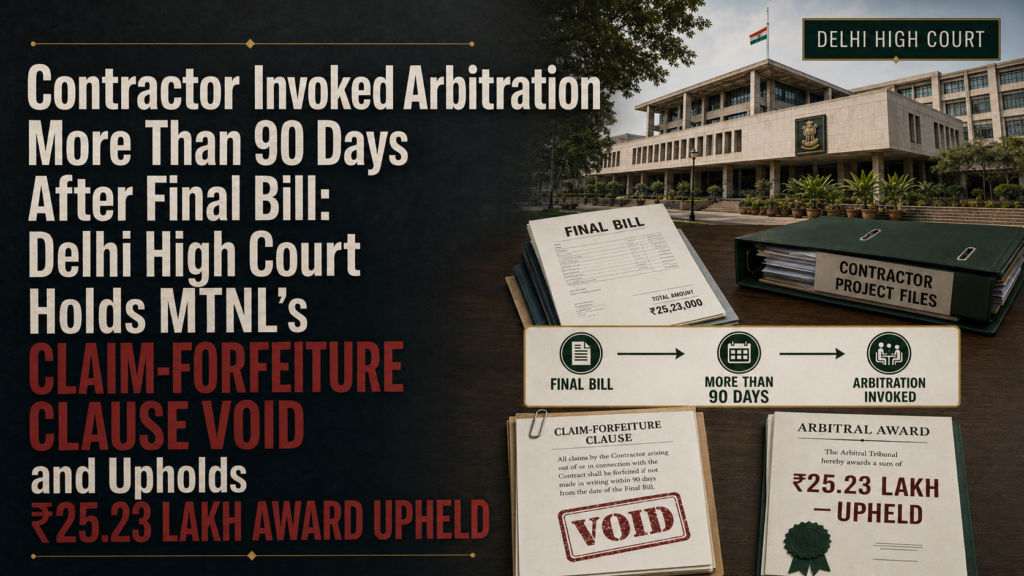
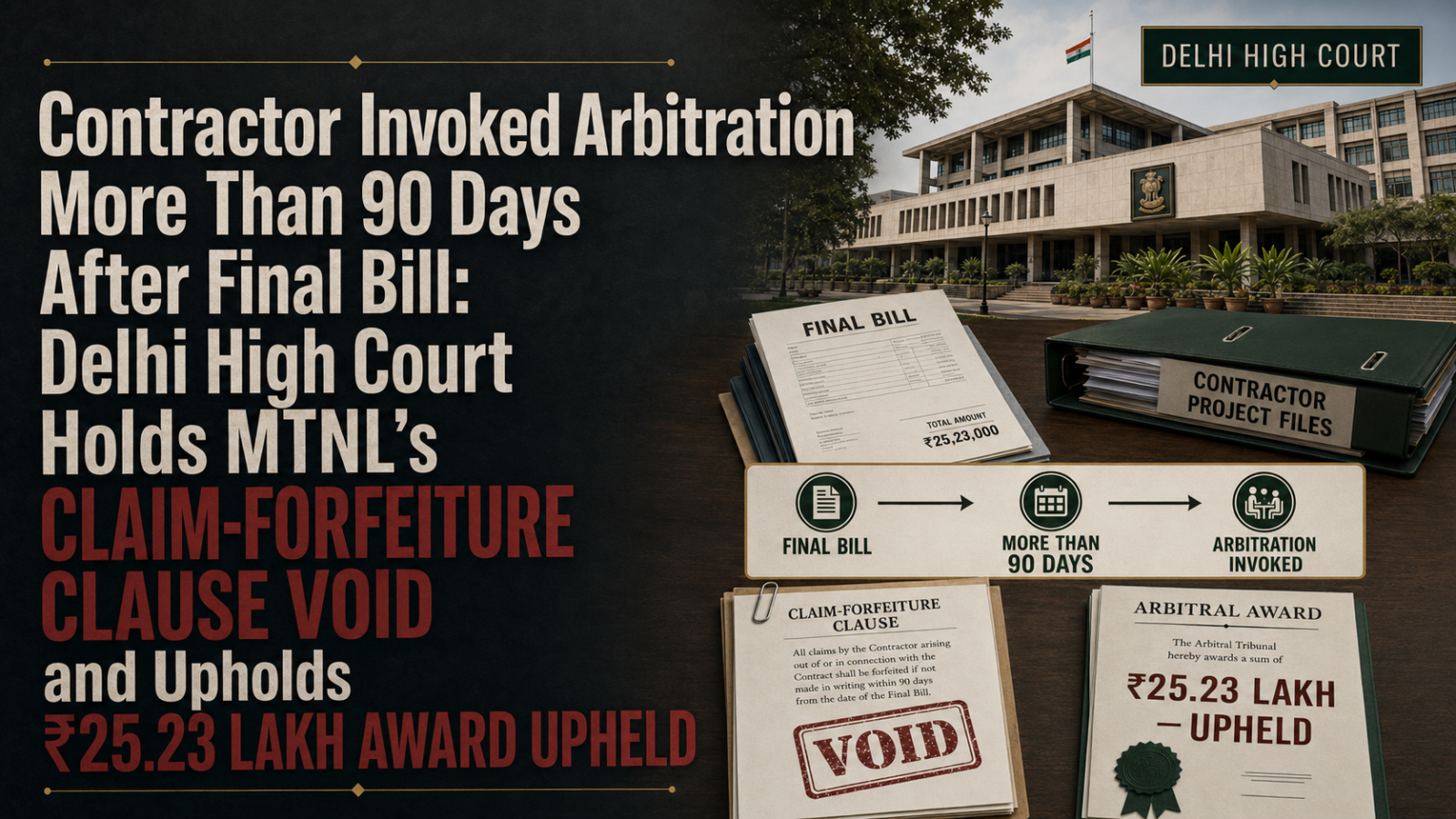
Contractor Invoked Arbitration More Than 90 Days After Final Bill: Delhi High Court Holds MTNL’s Claim-Forfeiture Clause Void and Upholds ₹25.23 Lakh Award

Construction Delayed by MTNL’s Own Hindrances: Delhi High Court Upholds Compensation to Contractor and Rejects 90-Day Time Bar
Facts
Mahanagar Telephone Nigam Limited invited tenders in 2010 for completing the balance construction work relating to 240 Type-III residential quarters at GH-17, Paschim Vihar, New Delhi. The work had been left unfinished after an earlier contract was rescinded.
M/s Rukma Decor and Construction Company, a proprietorship of Shanti Prakash Goenka, was awarded the contract on 15 November 2010 for ₹40,55,046. Work was to begin on 25 November 2010 and be completed within four months, by 24 March 2011.
The project was actually completed on 3 May 2012, resulting in a delay of 406 days. MTNL alleged that the contractor caused the delay by adopting a casual approach, making slow progress and failing to deploy sufficient labour, material, tools and machinery.
The contractor, however, attributed the delay to hindrances created by MTNL. These allegedly included:
- Failure to take measurements of work performed by the earlier contractor;
- Delay in deciding how construction debris left by the earlier agency should be removed;
- Failure to decide issues relating to blocked and incomplete pipes;
- Delay in approving substituted items and deviated quantities; and
- Failure of MTNL’s electrical agency to align the lift-opening gates.
The lift-gate issue prevented cladding and finishing work in the lift-lobby area for more than nine months, although the entire contract was originally scheduled to be completed in four months.
MTNL granted provisional extensions of time, with the last extension running until 15 May 2012. After completion, Rukma Decor signed the final bill on 15 March 2013. Payment was made on 30 May 2013.
In June 2013, MTNL issued a show-cause notice proposing compensation for delay under Clause 15 of the General Conditions of Contract. A second notice was issued on 11 March 2015. On 5 November 2015, MTNL imposed compensation of ₹92,942 upon the contractor.
Meanwhile, Rukma Decor raised monetary claims on 4 April 2015 and invoked arbitration on 26 September 2015. MTNL refused to appoint an arbitrator, asserting that the claims were barred by Clause 53 of the contract.
Clause 53 required the contractor to demand arbitration within 90 days of being informed that the final bill was ready. If arbitration was not invoked within that period, the contractor’s claims would be treated as waived and absolutely barred, and MTNL would stand discharged from all contractual liability.
The Delhi High Court subsequently appointed a sole arbitrator. The arbitrator held that the 90-day claim-extinguishment provision was void under Section 28 of the Indian Contract Act, 1872. The arbitration had been invoked within the normal three-year limitation period and was therefore maintainable.
On the merits, the arbitrator found MTNL responsible for the project delay. Various claims were allowed, resulting in a total award of ₹25,23,225, with future interest at 12% per annum from 28 November 2018 until payment. No future interest was payable if the award was satisfied within three months.
MTNL challenged the award under Section 34 of the Arbitration and Conciliation Act, 1996. The Commercial Court dismissed the challenge on 6 August 2024. MTNL then appealed to the Delhi High Court under Section 37.
Issues
- Whether Clause 53, which required arbitration to be invoked within 90 days and extinguished the contractor’s claims after that period, was valid and enforceable.
- Whether Clause 53 was void under Section 28(b) of the Indian Contract Act following the 1997 amendment.
- Whether Section 43(3) of the Arbitration and Conciliation Act independently validated the contractual 90-day deadline.
- Whether the Arbitration and Conciliation Act, as a special law, prevailed over the Indian Contract Act in determining the validity of Clause 53.
- Whether the contractor’s arbitration invocation dated 26 September 2015 was within the statutory limitation period.
- Whether the arbitrator exceeded his jurisdiction by examining and invalidating MTNL’s levy of ₹92,942 as compensation for delay.
- Whether MTNL or the contractor was responsible for the 406-day delay.
- Whether the arbitral award contained patent illegality, perversity or jurisdictional excess warranting interference under Sections 34 or 37.
Petitioner’s Arguments
MTNL, the appellant before the High Court, argued that Rukma Decor had failed to invoke arbitration within 90 days of the intimation dated 21 November 2012 that the final bill was ready.
Under Clause 53, the contractor’s claims consequently stood waived and absolutely barred. MTNL was also contractually discharged from all liability relating to those claims. According to MTNL, the arbitrator therefore lacked jurisdiction to entertain them.
MTNL contended that an arbitrator is a creature of the contract and cannot disregard, rewrite or act contrary to its express provisions. By ignoring the 90-day deadline, the arbitrator allegedly exceeded his jurisdiction and committed patent illegality.
It maintained that the deadline should be calculated from 21 November 2012, when the contractor was informed that the final bill was ready, rather than 30 May 2013, when payment was actually made.
MTNL relied upon Wildlife Institute of India v. Vijay Kumar Garg and P. Manohar Reddy v. Maharashtra Krishna Valley Development Corporation to argue that contractual clauses prescribing a period for lodging claims are valid.
It further relied upon Section 43(3) of the Arbitration and Conciliation Act. That provision empowers courts to extend contractual deadlines for commencing arbitration where refusal would cause undue hardship. MTNL argued that this necessarily recognised the validity of contractual time limits such as Clause 53.
MTNL also invoked the principle that special legislation prevails over general legislation. Relying on In Re: Interplay Between Arbitration Agreements under the Arbitration and Conciliation Act, 1996 and the Indian Stamp Act, 1899, it argued that Section 43(3) of the Arbitration Act should prevail over Section 28 of the Contract Act.
Regarding the project delay, MTNL contended that the contractor had worked slowly, failed to deploy sufficient resources and did not submit the required work programme.
It also argued that the decision of MTNL’s competent authority to impose compensation under Clause 15 was final and binding. The arbitrator allegedly had no jurisdiction to examine or invalidate that levy.
Respondent’s Arguments
Rukma Decor argued that the arbitrator’s interpretation of Clause 53 was legally correct and, at the least, constituted a plausible view which could not be disturbed under Sections 34 or 37.
The contractor submitted that the 1997 amendment to Section 28 of the Indian Contract Act had materially changed the law. An agreement is now void if it extinguishes a party’s contractual rights or discharges another party from liability merely because a specified period has expired.
Clause 53 did precisely this by declaring the contractor’s claims waived and absolutely barred and releasing MTNL from liability if arbitration was not invoked within 90 days. It was therefore void under Section 28(b).
The contractor maintained that Article 137 of the Limitation Act, 1963 provided a three-year period for invoking arbitration. Its invocation dated 26 September 2015 was within three years of both the intimation that the final bill was ready and its eventual payment.
It also contended that the bill paid on 30 May 2013 was not genuinely final because MTNL had withheld amounts and made unilateral deductions. The contractor had not issued an unconditional certificate accepting the payment as a full and final settlement.
Rukma Decor relied upon Bharat Sanchar Nigam Limited v. Nortel Networks India Limited to support the application of the three-year limitation period.
It also cited several Delhi High Court decisions holding contractual clauses similar to Clause 53 void after the amendment to Section 28.
On the merits, the contractor relied on MTNL’s own Hindrance Register. The register recorded multiple obstructions attributable to MTNL, particularly the failure of its electrical wing to complete the alignment and levelling of lift doors.
Analysis of the Law
Effect of Section 28 of the Indian Contract Act
Before the 1997 amendment, Section 28 principally invalidated agreements that absolutely restricted a party from enforcing contractual rights through ordinary legal proceedings or shortened the period for doing so.
The 1997 amendment introduced Section 28(b). It expressly invalidates clauses that:
- Extinguish a party’s contractual rights after a specified period; or
- Discharge another party from contractual liability after that period,
where the effect is to restrict the enforcement of contractual rights.
Clause 53 did more than prescribe a procedural deadline for invoking arbitration. It provided that failure to comply would extinguish the contractor’s claims and discharge MTNL from all liability. It therefore fell squarely within Section 28(b) and was void to that extent.
Interaction with Section 43(3) of the Arbitration Act
Section 43(3) enables a court to extend a contractual period for commencing arbitration where refusing an extension would cause undue hardship.
The High Court held that this provision does not independently validate every contractual time-bar clause. It operates only where the underlying clause is otherwise legally valid.
The validity of a contractual term must first be determined under the Indian Contract Act. If the term is already void under Section 28(b), Section 43(3) cannot revive it.
The two provisions operate in different fields:
- Section 28 determines the substantive validity of contractual provisions.
- Section 43(3) provides limited procedural relief from a valid contractual deadline.
Arbitrator as a Creature of the Contract
An arbitrator ordinarily has to act within the terms of the parties’ agreement. However, that principle applies only to legally valid terms.
An arbitrator is not bound to enforce a clause that is void from its inception under a statutory provision. In the eyes of the law, such a term has no enforceable existence.
Limitation Period
Even if Clause 53 were assumed to be valid, the contractor’s arbitration invocation was within the normal three-year limitation period under Article 137 of the Limitation Act.
Arbitration was invoked on 26 September 2015, which was within three years of:
- 21 November 2012, when the final bill was stated to be ready; and
- 30 May 2013, when payment was made.
The claims were consequently within statutory limitation in either case.
Scope of Review Under Sections 34 and 37
Courts considering challenges under Sections 34 and 37 do not act as appellate courts on the merits of an arbitral award.
They cannot reappreciate evidence or replace the arbitrator’s findings merely because another interpretation is possible. Interference is permissible only where the award suffers from patent illegality, perversity, conflict with public policy or jurisdictional excess.
Precedent Analysis
Punj Lloyd Ltd. v. National Highways Authority of India
The Delhi High Court held that Section 43(3) of the Arbitration Act does not override the amended Section 28 of the Contract Act. A clause extinguishing contractual claims after a short period remains void.
Chander Kant & Co. v. Delhi Development Authority
The Court held that the Supreme Court authorities concerning the pre-amendment version of Section 28 could not govern contractual disputes arising after the 1997 amendment.
Hindustan Construction Company v. Delhi Development Authority, Kalyan Chand Goyal v. Delhi Development Authority and Explore Computers Private Limited v. Cals Limited
These decisions formed part of the consistent line of Delhi High Court authority treating claim-extinguishment clauses as void under the amended Section 28.
Union of India v. Pt. Munshi Ram & Associates Private Limited, Silicon Graphics Systems (India) Private Limited v. Sterling and Wilson Electricals Private Limited and B.L. Kashyap & Sons Ltd. v. Airports Authority of India
These judgments similarly held that contractual provisions forfeiting or extinguishing claims after a specified period could not survive the amended Section 28(b).
Wildlife Institute of India v. Vijay Kumar Garg and P. Manohar Reddy v. Maharashtra Krishna Valley Development Corporation
MTNL relied upon these decisions to support contractual limitation clauses. The High Court distinguished them because they concerned causes of action arising before the 1997 amendment. The Supreme Court therefore had no occasion to consider the expanded Section 28(b).
Bharat Sanchar Nigam Limited v. Nortel Networks India Limited
This decision supported the contractor’s submission that Article 137 of the Limitation Act generally provides a three-year period for invoking arbitration.
In Re: Interplay Between Arbitration Agreements and the Indian Stamp Act
The High Court rejected MTNL’s reliance on this decision. The Supreme Court had considered the relationship between the Arbitration Act and the Stamp Act, not the validity of a contractual claim-extinguishment clause under the Contract Act.
The principle that special legislation prevails over general legislation did not allow an invalid contract term to be enforced. Section 28 addressed the anterior question of whether the contractual provision was legally valid at all.
Associate Builders v. Delhi Development Authority and Ssangyong Engineering & Construction Co. Ltd. v. National Highways Authority of India
These decisions reinforce minimal judicial interference in arbitral awards and prohibit courts from reassessing evidence or correcting ordinary factual and legal errors under Sections 34 and 37.
Court’s Reasoning
The High Court held that Clause 53 had two effects. First, it prescribed a 90-day deadline for demanding arbitration. Second, and more importantly, it declared the contractor’s claims waived and absolutely barred and discharged MTNL from every related liability.
This second effect was legally decisive. The clause extinguished substantive contractual rights instead of merely regulating the procedure for approaching an arbitral tribunal. It was therefore directly hit by Section 28(b).
The Court rejected MTNL’s argument based on Section 43(3). That provision assumes the existence of an otherwise valid time-bar clause and gives courts a limited power to extend time to prevent undue hardship. It does not convert a provision already void under the Contract Act into an enforceable term.
The Court also held that the arbitrator did not exceed his jurisdiction. Although an arbitrator derives authority from the agreement, he cannot be compelled to enforce an illegal provision. A clause void from its inception is no clause in law.
Even independently of Clause 53’s invalidity, the contractor had invoked arbitration within three years. The claims were therefore not barred under the Limitation Act.
On the question of project delay, the arbitrator had relied on MTNL’s own Hindrance Register. It established that various impediments attributable to MTNL continued for months beyond the original completion date.
The most significant hindrance was MTNL’s electrical agency’s failure to complete the alignment of lift doors. This held up the contractor’s stone, granite and finishing work for more than nine months.
The arbitrator consequently found that MTNL had failed to perform its reciprocal contractual obligations and was responsible for the governing delay.
The ₹92,942 compensation imposed upon the contractor was invalid for two independent reasons:
- The evidence established that MTNL, rather than the contractor, caused the delay.
- The compensation was imposed on 5 November 2015, more than three years after the work was completed on 3 May 2012.
The Court rejected MTNL’s contention that the compensation decision was exclusively reserved for its Chief Engineer. The arbitration clause covered contractual disputes, including disputes over liquidated damages and delay compensation.
The arbitrator had also given reasoned findings on the individual monetary claims, relying on the Local Commissioner’s measurements, contractual provisions, Central Public Works Department guidelines and documentary evidence. MTNL failed to establish any patent illegality or perversity in those findings.
Conclusion
The Delhi High Court dismissed MTNL’s appeal and upheld both the Commercial Court’s order and the arbitral award.
It declared Clause 53 void to the extent that it extinguished the contractor’s claims and discharged MTNL from liability merely because arbitration had not been invoked within 90 days.
The Court held that Section 43(3) of the Arbitration and Conciliation Act did not validate a clause that was otherwise void under Section 28(b) of the Indian Contract Act.
The contractor’s invocation of arbitration was within the applicable three-year limitation period. The findings that MTNL was responsible for the construction delay and that its delay penalty was wrongful were supported by evidence.
The award of ₹25,23,225 was affirmed in full, including future interest at 12% per annum from 28 November 2018 until payment, subject to the terms of the award.
Case Details
Case: Mahanagar Telephone Nigam Ltd. v. M/s Rukma Decor and Construction Co.
Court: High Court of Delhi at New Delhi
Case Number: FAO (COMM) 190/2024 and CM Application 55443/2024
Judges: Hon’ble Mr Justice Anil Kshetrapal and Hon’ble Mr Justice Amit Mahajan
Date: 16 July 2026
Result: MTNL’s appeal dismissed; the Commercial Court’s order upheld and the ₹25,23,225 arbitral award affirmed in full.