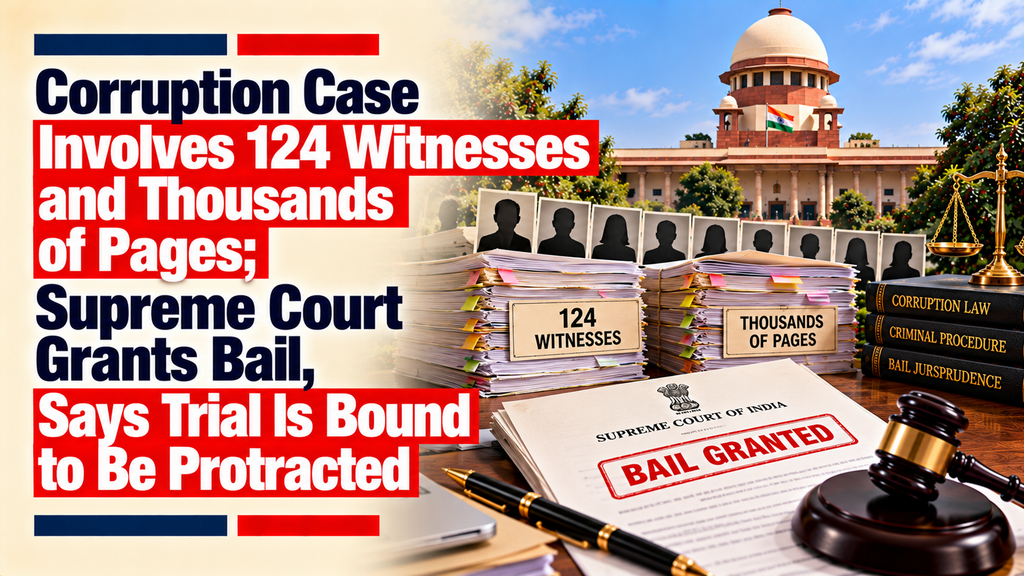
Corruption Case Involves 124 Witnesses and Thousands of Pages; Supreme Court Grants Bail, Says Trial Is Bound to Be Protracted

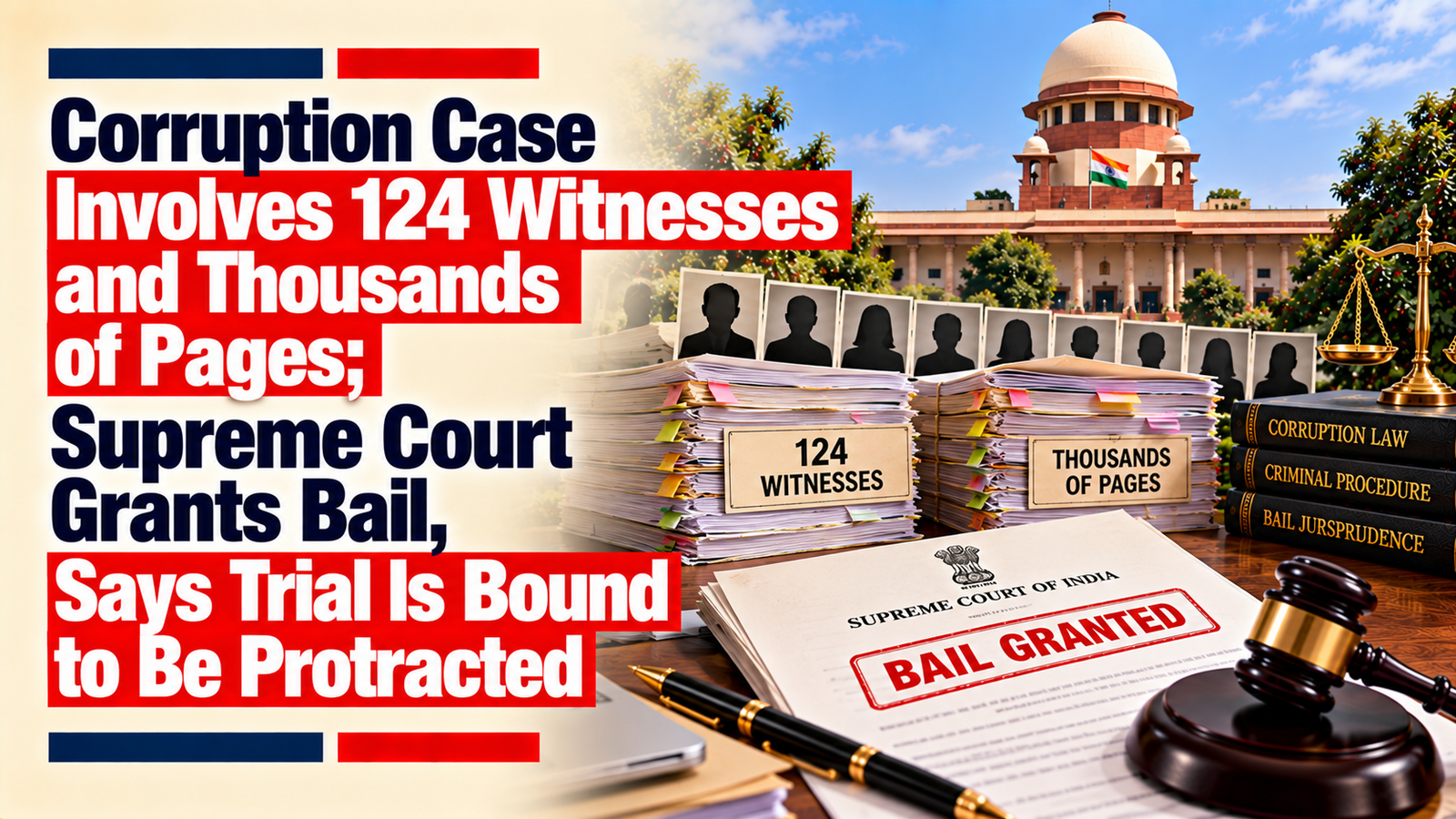
Thousands of Documents Seized in Jal Jeevan Mission Corruption Probe; Supreme Court Says Evidence-Tampering Risk Substantially Reduced and Grants Bail
Facts
The appeals arose from the Rajasthan High Court’s refusal to grant regular bail to Sanjay Badaya and Shubhanshu Dixit. Their respective bail applications had been rejected on 13 August 2026 and 1 June 2026. SANJAY BADAYA SANJAY BADAYA
The prosecution originated from Preliminary Enquiry No. 06/2024 dated 18 January 2024, which culminated in FIR No. 245/2024 dated 30 October 2024 at the Anti-Corruption Bureau Police Station, Jaipur. The FIR invoked several provisions of the Prevention of Corruption Act, 1988 and the IPC, including criminal breach of trust, forgery, falsification of accounts and criminal conspiracy. SANJAY BADAYA
The allegations concerned the execution of the Jal Jeevan Mission in Rajasthan.
According to the prosecution, two private contractors—M/s Shri Ganpati Tubewell Company and M/s Shri Shyam Tubewell Company—acted in connivance with public servants and private intermediaries and used forged work-experience and completion certificates purportedly issued by IRCON International Limited.
On the strength of those documents, the firms allegedly became eligible for and secured approximately 104 tenders worth ₹979.45 crore. SANJAY BADAYA
The ACB filed its main charge-sheet on 12 April 2026, followed by a supplementary charge-sheet on 29 June 2026. The prosecution proposed to examine 124 witnesses and rely upon documentary material running into thousands of pages. SANJAY BADAYA
Allegations Against Shubhanshu Dixit
Shubhanshu Dixit was a public servant who served as Secretary of the Rajasthan Water Supply and Sewerage Management Board from 30 December 2022 to 13 February 2024 and concurrently functioned as the de facto Secretary of the PHED Finance Committee.
The prosecution alleged that despite receiving specific complaints and legal notices highlighting the use of forged IRCON certificates, he failed to take effective action.
It further alleged that he suppressed complaints in conspiracy with senior officials and contractors and participated in Finance Committee meetings where financial bids of the allegedly tainted firms were approved.
By issuing minutes of those meetings, he allegedly facilitated the award of tenders to ineligible contractors.
He was arrested on 17 February 2026. SANJAY BADAYA
Allegations Against Sanjay Badaya
Sanjay Badaya was a private individual.
The prosecution portrayed him as a central intermediary or broker allegedly acting for the then PHED Cabinet Minister, Mahesh Chandra Joshi.
Although Badaya held no official departmental position, the prosecution alleged that he exercised influence over:
- movement of tender files;
- vigilance inquiries;
- transfers and postings of engineers; and
- Awaiting Posting Orders.
He was further accused of collecting cash bribes from contractors in exchange for favourable treatment, suppression of inquiries and clearance of inflated bills.
The prosecution principally relied upon intercepted telephone conversations and alleged that Badaya facilitated routing of bribe money through bank accounts belonging to relatives or acquaintances, from which money was subsequently transferred to M/s Sumangalam Landmark LLP, allegedly owned by the then Minister’s son.
Badaya was arrested on 11 May 2026. SANJAY BADAYA
Issues
The central issue was whether the seriousness of the alleged ₹979.45 crore economic offence justified continued pre-trial incarceration when:
- investigation against the appellants was complete;
- charge-sheets had already been filed;
- documentary and electronic evidence had been seized;
- charges had not yet been framed;
- 124 witnesses were proposed;
- thousands of pages of evidence were involved; and
- completion of the trial was unlikely in the near future.
State’s Case Against Bail
The State stressed the seriousness of the alleged economic offence and the alleged deep-rooted conspiracy involving public officials, private contractors and intermediaries.
The Supreme Court expressly accepted that economic offences involving such conspiracies must be viewed seriously and acknowledged that the State was justified in opposing bail.
However, it held that seriousness could not be considered in isolation from the other circumstances relevant to personal liberty. SANJAY BADAYA
Appellants’ Case for Bail
The appellants sought regular bail principally on the basis that the investigation concerning them was complete and the charge-sheet had been filed.
The prosecution case was predominantly documentary and electronic. The relevant records and electronic material had already been seized by the investigating agency.
They also relied upon the likely duration of the trial and the fact that other persons connected with the alleged conspiracy had already received bail or protection.
Analysis of the Law
1. Serious Economic Offence Does Not End the Bail Inquiry
The Supreme Court did not minimize the seriousness of economic offences.
It expressly observed that:
economic offences involving deep-rooted conspiracies must be viewed seriously.
But the seriousness of the allegations is only one consideration.
A bail court must simultaneously examine the stage of investigation, nature of evidence, likelihood of tampering, expected duration of trial, custody already undergone and the constitutional protection of personal liberty.
Thus, the label of an “economic offence” cannot by itself justify indefinite incarceration before guilt is determined. SANJAY BADAYA
2. Investigation Was Complete
A critical factor favouring bail was that investigation qua both appellants had been completed and charge-sheets had already been filed.
The continued custodial requirement of the appellants was therefore substantially diminished.
The prosecution was no longer at a stage where the appellants’ physical custody was necessary for gathering the principal evidence against them. SANJAY BADAYA
3. Documentary Evidence Was Already Seized
The prosecution’s case was predominantly based upon:
- documentary records; and
- electronic trails.
Those materials had already been seized and were in the investigating agency’s safe custody.
The Supreme Court therefore held that the apprehension of the accused tampering with evidence was “substantially obliterated.” SANJAY BADAYA
This is particularly significant for bail applications in documentary economic offences: once the evidentiary trail has been secured, the prosecution must demonstrate why continued physical custody remains necessary.
4. Trial Had Not Even Commenced
Despite the investigation having progressed substantially, the criminal trial remained at a very early stage.
The Supreme Court noted that:
- charges had not been framed;
- trial had not commenced;
- investigation against some other accused was continuing;
- two accused were absconding; and
- sanction under Section 19 of the Prevention of Corruption Act for six public-servant co-accused had been granted only on 6 September 2026. SANJAY BADAYA
These circumstances indicated that conclusion of the proceedings was nowhere near imminent.
5. 124 Witnesses and Thousands of Pages Meant Protracted Trial
The prosecution proposed examining 124 witnesses, besides relying upon thousands of pages of documentary evidence. SANJAY BADAYA
The Supreme Court considered the sheer volume of evidence and concluded that the trial was “bound to be a protracted exercise.” SANJAY BADAYA
The accused therefore faced the realistic possibility of spending a substantial period in custody before the trial court could determine guilt.
6. Pre-Trial Incarceration Cannot Become Punishment
This is the key proposition emerging from the order.
The Supreme Court stated:
“Pre-trial incarceration cannot masquerade as punitive detention.” SANJAY BADAYA
An accused awaiting trial has not yet been convicted.
Continued incarceration therefore cannot effectively impose punishment before guilt has been judicially determined, particularly where neither commencement nor conclusion of the trial is reasonably imminent.
7. Article 21 Requires Courts to Protect Liberty Where Trial Will Take Years
The Court directly connected prolonged pre-trial detention with Article 21 of the Constitution.
It held that the Supreme Court must intervene to safeguard personal liberty when a criminal trial cannot reasonably be concluded in the near future. SANJAY BADAYA
The judgment therefore applies the constitutional dimension of bail jurisprudence even in a serious corruption/economic offence.
The issue is not simply how grave the allegation appears, but whether continued imprisonment before trial remains proportionate and legally necessary.
8. Parity With Co-Accused Was Relevant
The Supreme Court also considered the treatment of other accused persons.
Co-accused Arun Srivastava had already been granted bail by the Rajasthan High Court on 1 June 2026.
More significantly, the former PHED Minister Mahesh Chandra Joshi, described by the Court as the “principal political executive,” had been granted bail by the Supreme Court in the corresponding PMLA proceedings arising from the same FIR on 3 December 2025. SANJAY BADAYA
Although parity was not the sole basis for relief, it was an additional factor favouring release.
Court’s Reasoning
The Supreme Court balanced the seriousness of the allegations against the practical and constitutional realities of continued custody.
The allegations were undoubtedly serious: forged certificates were allegedly used to secure 104 tenders worth approximately ₹979.45 crore, with allegations extending to corruption, conspiracy, bribery and manipulation of public contracts.
But bail could not be denied merely because the alleged offence was economically significant.
The decisive circumstances were:
First, investigation against Badaya and Dixit was complete.
Second, charge-sheets had been filed.
Third, the prosecution’s principal evidence was documentary and electronic and had already been secured.
Fourth, the risk of tampering with that evidence was consequently substantially reduced.
Fifth, charges had not even been framed.
Sixth, 124 prosecution witnesses and thousands of pages of evidence meant that the trial would inevitably take substantial time.
Seventh, other persons implicated in the broader alleged conspiracy had already received bail or protection.
Against this background, the Court concluded that keeping the appellants in further pre-trial custody would serve no fruitful purpose. SANJAY BADAYA
Conclusion
The Supreme Court allowed both appeals.
The Rajasthan High Court’s orders dated 1 June 2026 and 13 August 2026, refusing bail to Shubhanshu Dixit and Sanjay Badaya respectively, were set aside. SANJAY BADAYA
Both appellants were directed to be released on bail, unless required in another case, upon furnishing bail bonds to the satisfaction of the Trial Court and subject to conditions imposed by it. SANJAY BADAYA
Because investigation against some other accused was still pending, Badaya and Dixit were directed to cooperate and attend the police station whenever called by the investigating officer for purposes connected with filing further reports. SANJAY BADAYA
The Court also directed them to diligently participate in the trial. Unjustified absence or violation of bail conditions would permit the Trial Court to cancel bail. SANJAY BADAYA
Importantly, the Supreme Court clarified that none of its observations constituted an opinion on the merits, the appellants’ alleged roles or the evidentiary value of the prosecution material. Those questions were expressly left for the Trial Court. SANJAY BADAYA
Case Details
Case: Sanjay Badaya v. State of Rajasthan with Shubhanshu Dixit v. State of Rajasthan
Court: Supreme Court of India
Neutral Citation: 2026 INSC 1065
Case Nos.: Criminal Appeals arising out of SLP (Crl.) No. 15347 of 2026 and SLP (Crl.) No. 13461 of 2026. SANJAY BADAYA
Bench: Justice Dipankar Datta and Justice Sheel Nagu
Order authored by: Justice Dipankar Datta. SANJAY BADAYA
Date: 29 September 2026
Impugned Orders: Rajasthan High Court, Jaipur Bench orders dated 1 June 2026 and 13 August 2026 refusing regular bail. SANJAY BADAYA
Result: Appeals allowed; High Court orders set aside; Sanjay Badaya and Shubhanshu Dixit granted regular bail, subject to conditions and continued cooperation with the investigation and trial.