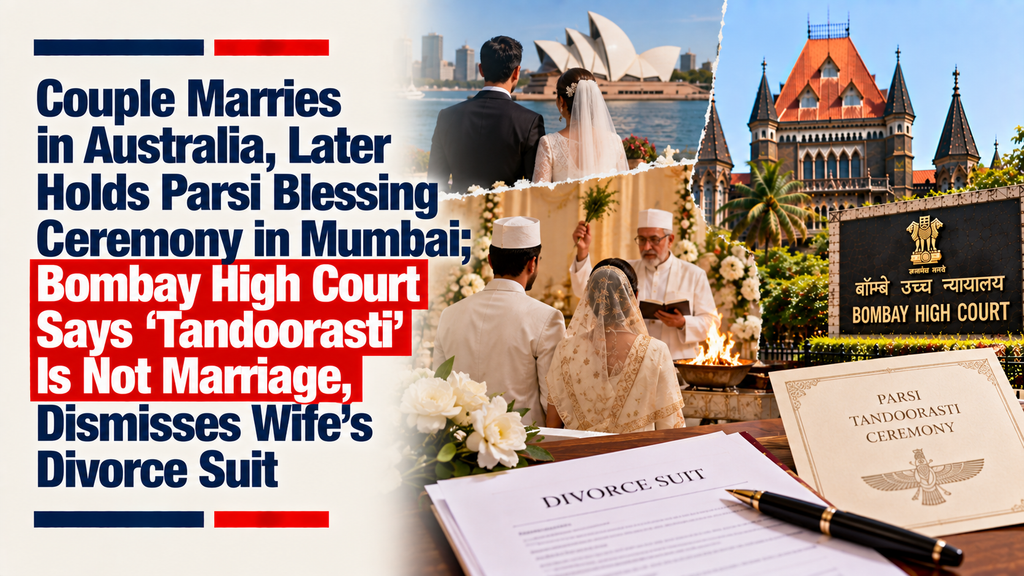
Couple Marries in Australia, Later Holds Parsi Blessing Ceremony in Mumbai; Bombay High Court Says ‘Tandoorasti’ Is Not Marriage, Dismisses Wife’s Divorce Suit

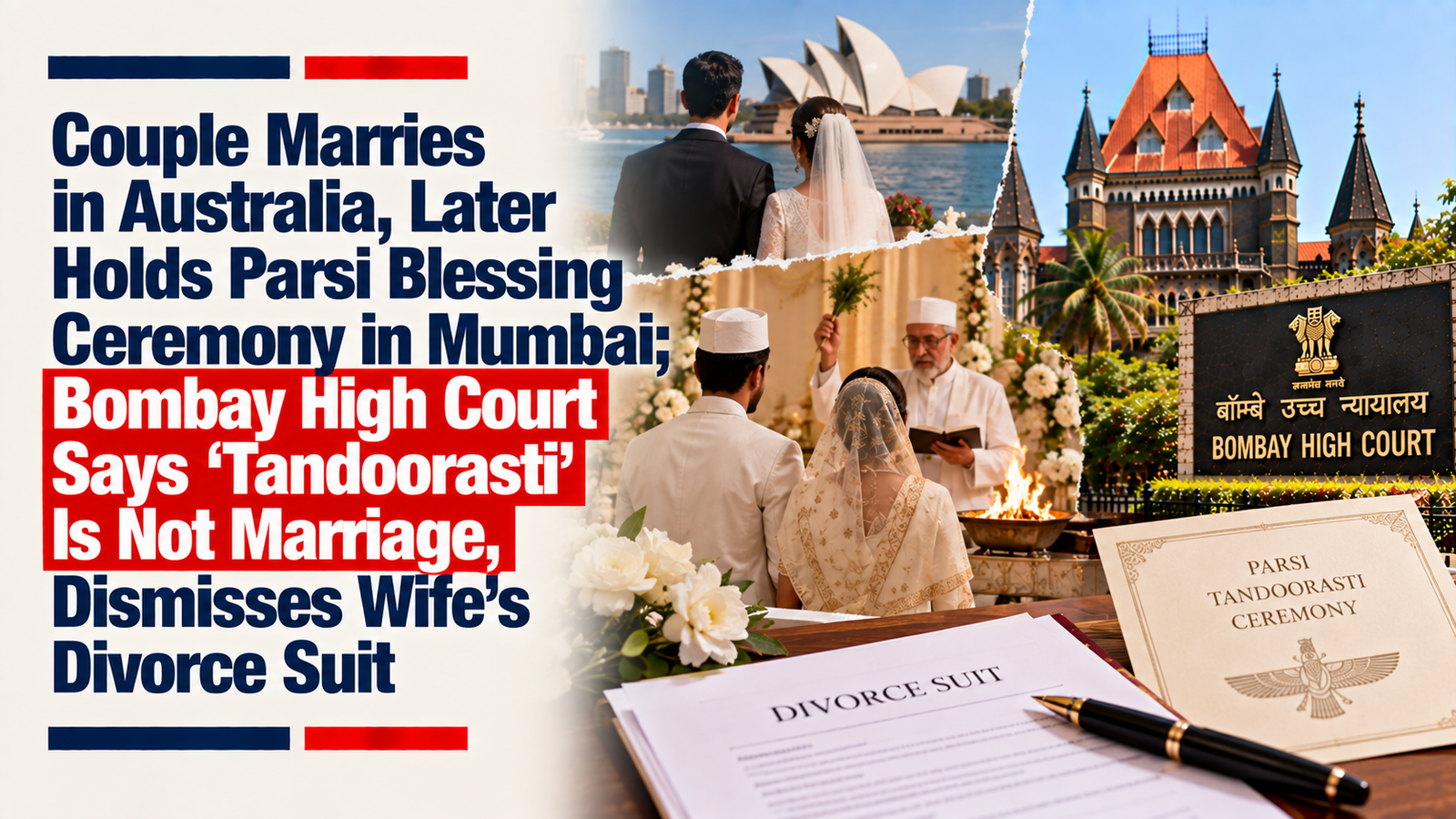
Wife Seeks Divorce and ₹5 Crore Alimony in Mumbai; Bombay High Court Says Parsi Marriage Was Never Solemnised Within Its Jurisdiction
Facts
Scherezade Hormuz Mubarakai filed Parsi Suit No. 2 of 2018 against her husband, Hormuz Kurush Mubarakai, before the Bombay High Court. She sought dissolution of the marriage, ₹5 crore as permanent alimony, ₹1 lakh per month as interim maintenance and costs. The husband filed an application under Order VII Rule 11(d) of the Code of Civil Procedure, 1908, seeking rejection of the suit as barred by law.
The parties had undergone a civil marriage in Perth, Western Australia, on 22 August 2010, where they resided. On 20 November 2010, they participated in another ceremony in Mumbai. The nature of this Mumbai event became decisive to the maintainability of the wife’s Parsi matrimonial suit.
The wife claimed that the Mumbai event was an “Ashirvad”, the Parsi marriage ceremony contemplated by Section 3 of the Parsi Marriage and Divorce Act, 1936 (“PMDA”). The husband maintained that it was merely a “Tandoorasti”, or blessing ceremony, commonly held when Parsi couples married abroad subsequently visit India.
The parties had also litigated in Australia concerning divorce, division of matrimonial assets and custody of their son, culminating in a final Australian divorce decree.
Issues
The Court principally considered whether the Mumbai ceremony was an Ashirvad constituting solemnisation of a Parsi marriage, thereby giving the Bombay High Court territorial jurisdiction under the PMDA.
It also considered whether the Parsi delegates’ unanimous determination regarding the ceremony could be relied upon while deciding an interlocutory application; whether Order VII Rule 11 CPC could operate in proceedings under the PMDA; and whether the prior Australian divorce proceedings rendered the Mumbai proceedings barred by res judicata.
Applicant/Husband’s Arguments
The husband contended that no Parsi marriage had been solemnised in Mumbai. The November 2010 event was merely a Tandoorasti ceremony involving blessings from elders, rather than the statutory Ashirvad ceremony. Therefore, the essential jurisdictional link with Mumbai was absent.
He additionally argued that the parties had already contested their divorce, property division and child-custody issues before the Australian courts, resulting in final adjudication, and therefore invoked principles of res judicata.
Respondent/Wife’s Arguments
The wife maintained that the November 2010 event was in substance an Ashirvad ceremony. According to her, whether it satisfied the requirements of a valid Parsi marriage required evidence and a full trial and could not be conclusively determined through the husband’s interim application.
She also argued that the husband was an Irani Zoroastrian, whose rituals could differ, making evidence concerning the practices of that sub-denomination relevant.
As regards Australia, she submitted that the Australian proceedings had expressly left the Indian proceedings outside their consideration and therefore did not operate as res judicata.
She further contended that Order VII Rule 11 CPC was inapplicable because Parsi matrimonial proceedings were initiated by a “petition” rather than a “plaint.” The Court rejected that technical distinction, holding that Section 45 PMDA makes the CPC applicable to suits under the Act so far as applicable.
Analysis of the Law
What constitutes a valid Parsi marriage?
Section 3(1)(b) PMDA provides that a Parsi marriage is not valid unless it is solemnised according to the Parsi form of ceremony called “Ashirvad” by a priest in the presence of two Parsi witnesses other than the priest.
The Court found this requirement critical because both parties lived in Perth. The only connecting factor with Bombay was the November 2010 event. Therefore, unless that event amounted to solemnisation of marriage under the PMDA, the jurisdictional basis for maintaining the suit in Bombay disappeared.
Role of the Parsi delegates
Under Section 46 PMDA, questions of law and procedure are determined by the presiding Judge, whereas questions of fact are decided by the majority of the Parsi delegates.
Here, importantly, the procedure was adopted with the consent of both parties. The wife herself supplied a video recording of the November 2010 ceremony. The video was shown to the Court and the delegates to determine whether the event constituted an Ashirvad or Tandoorasti.
The delegates were unanimous:
the ceremony was not a marriage ceremony, but a Tandoorasti/blessing ceremony.
The delegates specifically observed that an important component of a Parsi marriage—the signing of the relevant document by the parties with witnesses—was absent from the video. They regarded this as an integral feature of Parsi/Irani Zoroastrian marriage rituals in India.
Precedent / Statutory Analysis
The judgment contains an important interpretation of Sections 19 and 46 PMDA.
Section 19 ordinarily provides that the matrimonial court is aided by five delegates in trials, but creates exceptions for interlocutory applications, alimony, custody and proceedings other than regular hearings.
The Court harmonised Sections 19 and 46. It reasoned that the Section 19 exception means that taking assistance from delegates is not obligatory in interlocutory proceedings; it does not necessarily mean that such assistance is legally prohibited where a factual issue has been consensually referred to them.
The Court also held that Section 45 PMDA makes the CPC applicable mutatis mutandis. Consequently, the mere nomenclature of the originating proceeding as a “petition” rather than a “plaint” cannot prevent a party from seeking rejection or dismissal where the proceedings lack the necessary jurisdictional foundation.
Court’s Reasoning
The decisive question was a jurisdictional fact: was the Mumbai event an Ashirvad marriage ceremony?
The Court held that this factual issue had been placed before the delegates by consent. The wife herself supplied the video, the husband consented to its admission, and the delegates unanimously concluded that it depicted a Tandoorasti rather than an Ashirvad.
The Court refused to reduce “Ashirvad” merely to its literal meaning of “blessing.” It observed that the statutory institution of Parsi delegates exists precisely so that questions concerning the community’s customs, rituals and beliefs are not determined merely according to notions prevailing in wider society.
The wife’s argument that the delegates had merely given an “opinion” rather than a binding verdict was also rejected. On the factual question entrusted to them, their answer constituted their decision; the ultimate decision on the interim application remained with the Judge.
The priests who had actually conducted the 2010 event had also stated in 2017 that they had not performed an Ashirvad and had only performed a Tandoorasti ceremony.
Accordingly, once the ceremony was found not to be an Ashirvad, a fundamental statutory requisite of a Parsi marriage in Mumbai was absent. Even the description given to the ceremony on an invitation card could not substitute for the actual statutory requirements.
Interestingly, the Court did not accept the husband’s separate res judicata argument. It held that the Australian proceedings had expressly left the Bombay proceedings outside their consideration. The suit was therefore dismissed on the jurisdictional issue arising from the absence of an Ashirvad ceremony, rather than because the Australian divorce itself barred the proceedings.
Conclusion
The Bombay High Court held that the 20 November 2010 Mumbai event was a Tandoorasti/blessing ceremony and not the Ashirvad ceremony required for solemnisation of a Parsi marriage under Section 3 PMDA.
Since both spouses resided in Australia and the alleged Mumbai marriage was the crucial jurisdictional connection with Bombay, the absence of a valid Ashirvad meant that the Bombay High Court lacked the necessary jurisdictional foundation to entertain the wife’s matrimonial suit. The suit was consequently dismissed.
The judgment is particularly significant for distinguishing a religious blessing ceremony from the statutory solemnisation of a Parsi marriage and for explaining the unusual statutory role of Parsi delegates in determining questions concerning community customs.
Case: Scherezade Hormuz Mubarakai v. Hormuz Kurush Mubarakai
Court: Bombay High Court, Ordinary Original Civil Jurisdiction
Case: Parsi Suit No. 2 of 2018 with Interim Application (L) No. 30398 of 2023
Judge: Justice Somasekhar Sundaresan
Date: 23 September 2026
Citation: 2026:BHC-OS:20905
Result: Husband’s jurisdictional objection accepted; wife’s Parsi matrimonial suit dismissed.