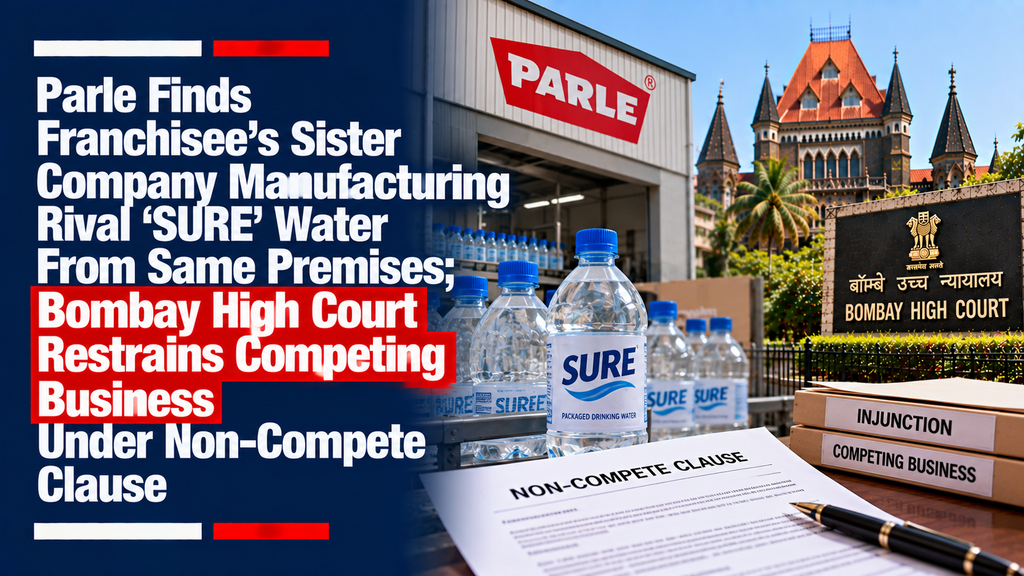
Parle Finds Franchisee’s Sister Company Manufacturing Rival ‘SURE’ Water From Same Premises; Bombay High Court Restrains Competing Business Under Non-Compete Clause

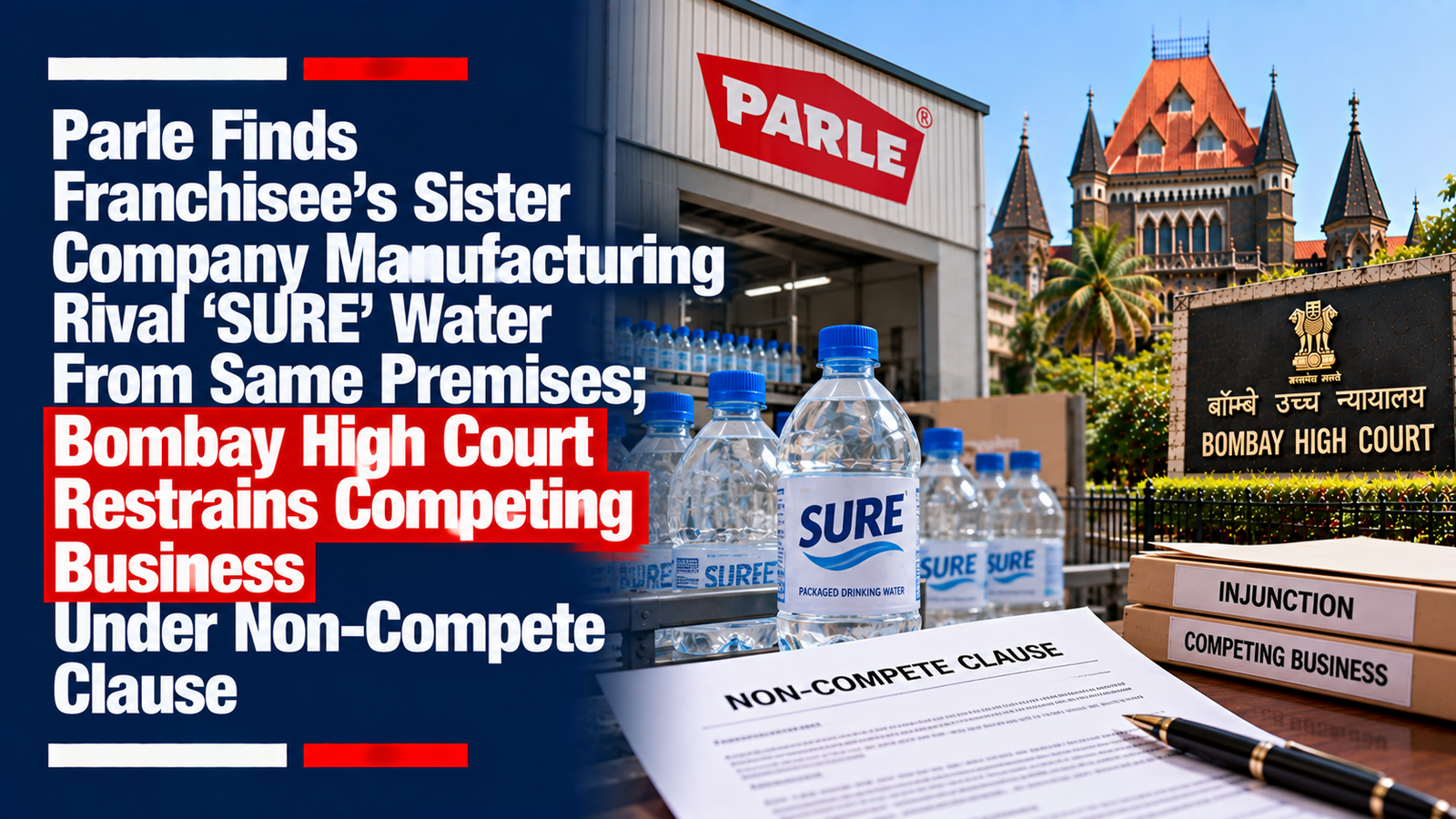
‘BAILLEY’ Franchisee’s Group Company Manufactures Competing ‘SURE’ Water; Bombay High Court Grants Interim Protection to Parle Agro
Facts
Parle Agro Private Limited (“PAPL”), proprietor of brands including BAILLEY, BAILLEY ONE, Frooti, Appy and Appy Fizz, filed a petition under Section 9 of the Arbitration and Conciliation Act, 1996 against Udayak Agro Products Pvt. Ltd. and KL Beverages LLP.
Udayak had been associated with Parle’s packaged drinking-water business since 2001. Under the subsisting franchise agreement dated 5 February 2014, Udayak manufactured BAILLEY and BAILLEY ONE in Assam and Meghalaya. KL Beverages, another entity of the same KL Group controlled by the Agarwal family, subsequently became Parle’s beverage franchisee under a 2018 agreement.
The agreements contained extensive non-compete, exclusivity, confidentiality and intellectual-property restrictions, including prohibitions against carrying on competing activities indirectly through associates, sister concerns or group entities.
The dispute arose after Parle conducted an audit on 18–19 March 2026 and discovered that KL Beverages was manufacturing and storing packaged drinking water under the rival brand “SURE”. KL Beverages admitted manufacturing SURE, while Udayak admitted that SURE and BAILLEY were competing packaged drinking-water products operating in the same market.
Significantly, Udayak’s franchise agreement remained valid until 31 March 2028.
Issues
The principal issues were:
- Whether Udayak’s contractual non-compete obligations could extend to competing business carried on through its sister concern/associate KL Beverages.
- Whether the corporate separation between Udayak and KL Beverages prevented interim relief against KL Beverages.
- Whether their common ownership, management, employees, premises, accounting and business operations demonstrated that the competing business was effectively being carried on indirectly through a related entity.
- Whether a Section 9 court could grant interim protection against a non-signatory/third party pending arbitration.
- Whether Parle established a prima facie case, balance of convenience and irreparable injury justifying an interim injunction.
Petitioner’s Arguments
Parle relied heavily upon Clauses 5 and 14(a) of Udayak’s franchise agreement. Clause 5 prohibited Udayak from directly or indirectly, including through an associate or sister concern, carrying on activities involving competing products. Clause 14(a) extended the restriction to sister concerns, group companies, associates and affiliates.
Parle argued that KL Beverages was not genuinely independent of Udayak. Both belonged to the KL Group and were controlled by members of the Agarwal family.
The material relied upon included striking operational overlaps: Udayak’s audited financial statements described KL Beverages as an “Associate”, and approximately ₹1.75 crore of related-party transactions were recorded between them. Both also operated from the same registered address and from buildings within the same KL Industries Estate compound.
They used the same KL Group email infrastructure, common purchase, accounts and logistics departments, and even common operational personnel.
There were instances where money payable to one group entity was sought to be adjusted against liabilities of another. For example, in October 2025, KL Beverages asked Parle to adjust amounts payable to it against Udayak’s outstanding dues.
Parle therefore argued that allowing KL Beverages to manufacture SURE would enable Udayak to accomplish indirectly what its franchise agreement expressly prohibited it from doing directly.
Respondents’ Arguments
The respondents essentially sought to maintain the distinction between the two legal entities and disputed the suggestion that KL Beverages’ competing business could automatically be treated as Udayak’s business.
They relied upon an alleged family arrangement entered into between July and September 2025, under which Udayak’s affairs were said to have been entrusted to Raj Shekhar Agarwal while KL Beverages’ affairs were entrusted to Uday Raj Agarwal.
Parle challenged that explanation, pointing out that the alleged family settlement itself had not been produced and that subsequent correspondence and business records continued to show substantial operational overlap.
Analysis of the Law
A particularly important feature of the judgment concerns the contractual expression “directly or indirectly.”
The non-compete clause did not merely prevent Udayak itself from manufacturing competing water. It expressly extended the prohibition to activity conducted through an associate, sister concern, group company or affiliate.
Parle relied upon Elster Instromet B.V. v. Mrunal Gandhi, where the Court had recognised that interpreting “directly” and “indirectly” too narrowly could defeat the commercial object of a non-compete covenant by permitting the prohibited activity to be shifted to an affiliate.
The Court was therefore required to look beyond the mere fact that Udayak and KL Beverages had separate corporate personalities and examine the actual contractual language and commercial relationship between the entities.
Precedent Analysis
Parle also relied upon Eveready Industries India Ltd. v. KKR India Financial Services Ltd. and ASF Buildtech (P) Ltd. v. Shapoorji Pallonji & Co. (P) Ltd. to support its contention that the relationship between group entities may become relevant where ownership, management and dealings demonstrate an integrated economic operation.
Reliance was further placed on Cox & Kings Ltd. v. SAP India (P) Ltd., Chloro Controls India (P) Ltd. v. Severn Trent Water Purification Inc. and Cheran Properties Ltd. v. Kasturi & Sons Ltd. on circumstances in which a non-signatory group entity may become connected with the contractual/arbitral relationship.
An additional proposition advanced by Parle was that a Section 9 court can, in an appropriate case, grant protective relief even against a third party, while the ultimate question whether that entity is contractually bound can be determined in arbitration.
Court’s Reasoning
The factual matrix was commercially significant.
There was no real dispute that KL Beverages was manufacturing SURE or that SURE and BAILLEY competed in the same packaged drinking-water market.
Further, the March 2026 audit showed SURE being manufactured at the franchise premises; storage facilities associated with BAILLEY were being used for SURE products, and infrastructure required for SURE manufacturing was available there.
The commercial figures strengthened Parle’s case. Its packaged-water sales in the relevant territory had fallen by approximately 32% in value and 24% in volume during FY 2025–26, while procurement of raw material for BAILLEY had stopped or reduced.
The respondents’ explanation based upon an internal family division was also weakened by the subsequent conduct. Even after the alleged separation, common personnel, correspondence, accounting adjustments and KL Group infrastructure continued to connect the entities. Udayak employees were even present inside KL Beverages’ premises during the March 2026 audit.
The contractual structure was designed precisely to prevent the franchisee from circumventing its non-compete obligation by shifting the competing activity to a related concern. The agreement therefore had to be examined according to its commercial purpose rather than merely the formal corporate identity of the entity physically manufacturing the rival product.
Conclusion
The Bombay High Court granted Parle Agro interim protection under Section 9 in the franchise dispute, treating the contractual restrictions against direct and indirect competition and the extensive operational relationship between the group entities as material at the interim stage.
The case is significant because the dispute was not simply “Parle versus another water manufacturer.” The core allegation was that a franchisee bound by a non-compete covenant could not sidestep that restriction by having a closely connected sister concern manufacture a directly competing product while the franchise relationship continued.
Case: Parle Agro Private Limited v. Udayak Agro Products Pvt. Ltd. & Anr.
Court: Bombay High Court, Commercial Division
Case No.: Commercial Arbitration Petition (L) No. 25994 of 2026
Judge: Justice Amit Borkar
Reserved: 16 September 2026
Pronounced: 23 September 2026
Citation: 2026:BHC-OS:20863
Result: Section 9 petition for interim protection against the competing business allowed/granted in terms determined by the Court.