

1. Court’s decision
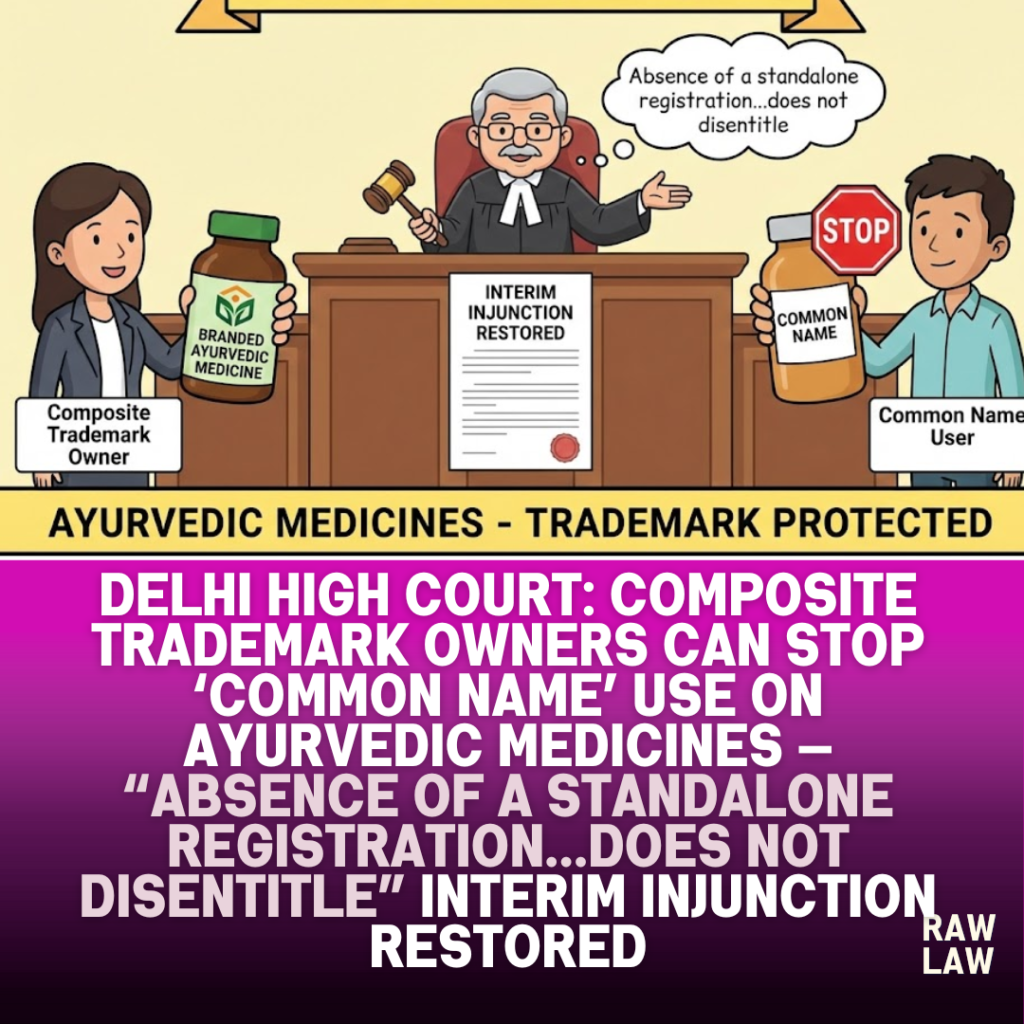
The Delhi High Court set aside a commercial court order that had vacated an earlier ex parte restraint and refused interim relief in a trademark infringement and passing off dispute involving Ayurvedic medicines. The High Court held that even where the plaintiff does not own a standalone word registration, it can still enforce statutory rights in registered composite/device trademarks if the defendant has lifted the essential and dominant feature, creating a likelihood of confusion. Finding a prima facie case, balance of convenience, and irreparable injury, the Court restrained the defendants—pending trial—from using the impugned “Dindayal” formative marks for Class 5 goods.
2. Facts
The plaintiff company manufactures Ayurvedic and herbal medicines and supplements and claimed continuous use of the “Dindayal” mark and its variants dating back decades, alongside multiple trademark registrations (largely composite/device marks) across classes, including Class 5. The defendants, also in Ayurvedic products, adopted and used “Dindayal” formative marks including a trade name/device label and a website domain. The plaintiff alleged the defendants copied the mark and replicated the product range to ride on reputation and goodwill. A trial court initially granted an ex parte restraint and appointed a local commissioner, but later vacated the restraint and dismissed the interim injunction request—prompting this appeal.
3. Issues
The High Court framed the dispute as raising a broader trademark question: how far a proprietor of composite trademark registrations can restrain use of a personal/common name when no standalone registration exists for that part. It narrowed the appeal to core questions: whether infringement can lie on the basis of registered composite marks where the defendant uses the dominant element; whether “Dindayal” is so common that exclusivity cannot be claimed; whether the defendants’ adoption is bona fide or an attempt to appropriate goodwill; and whether the trial court was justified in vacating the ex parte restraint and denying interim protection.
4. Petitioner’s arguments
The plaintiff argued that the defendants’ impugned device/labels and trading style prominently reproduce “Dindayal”, which is the essential, dominant, and source-identifying feature of the plaintiff’s registered device marks in Class 5. It asserted long, uninterrupted use, extensive product range and market presence, and pleaded that the defendants were passing off their goods as the plaintiff’s—allegedly misleading stockists into believing packaging had changed. The plaintiff also challenged the trial court’s reliance on a trade marks registry “no objection” used for copyright purposes, contending it was wrongly treated as an approval of trademark rights.
5. Respondent’s arguments
The defendants countered that the plaintiff repeatedly projected a standalone registration for “Dindayal” though its registrations were composite/device marks, and that the ex parte order had been granted without properly examining the actual registered marks. They argued a composite mark cannot be “split” to monopolise a single word; that “Dindayal” is a common personal name; and that their adoption was bona fide, tied to family lineage, attracting statutory protection for use of one’s own name. They also raised delay, laches, and acquiescence based on the plaintiff’s knowledge of the defendants’ trademark application and publication, and relied on differences in packaging/trade dress and alleged weak market presence to deny likelihood of confusion.
6. Analysis of the law
Applying infringement principles for similar (not identical) marks, the Court emphasised that the enquiry is whether the defendant’s mark is deceptively similar to the registered mark and likely to cause confusion or an impression of association for the average consumer. It reiterated that anti-dissection (looking at the mark as a whole) can coexist with identifying the dominant feature, because examining components may be a preliminary step to evaluating consumer reaction to competing composite marks. The Court then treated “Dindayal” as the recurring, prominent element in the plaintiff’s registered composites, while other phrases/suffixes were largely descriptive and not the true source identifiers.
7. Precedent analysis
The Court drew from established doctrine on deceptive similarity and “essential features” in infringement, and from Delhi High Court jurisprudence explaining how dominant-feature identification can be compatible with the overall-impression rule. It also relied on precedent recognising that, subject to facts, prior use of a larger composite mark can support protection of an essential part if that part has come to identify the trader’s goods in the market. For medicinal/therapeutic products, it invoked the stricter approach to confusion, noting that even a lower quantum of proof may suffice because consumer confusion can carry serious consequences.
8. Court’s reasoning
On infringement, the Court held the trial court erred in treating the lack of a standalone “Dindayal” registration as fatal. The High Court found the impugned marks deceptively similar because the defendants lifted the essential element, and because both sides sold Ayurvedic products through similar channels—making association likely for consumers of average intelligence with imperfect recollection. On the “common name” defence, it rejected an absolute bar: while a common name may not be monopolised in isolation, its distinctive market association can arise when used in relation to specific goods. On bona fides, the Court found the defendants’ lineage documents showed family naming, not trade use for Ayurvedic goods, and that awareness of the plaintiff’s mark undermined “honest adoption”.
9. Conclusion
The Court held that the plaintiff established a prima facie case of infringement and passing off, and that the balance of convenience lay decisively in the plaintiff’s favour. It rejected delay and acquiescence, noting the plaintiff’s steps before the registry, opposition, and cease-and-desist efforts, and accepted explanations including the pandemic and geographic separation of operations. It further held that copyright-related “no objection” and label approvals cannot determine trademark rights; an “NOC” is a prerequisite clearance for copyright registration, not a conferment of trademark entitlement. Accordingly, the impugned order was set aside and interim restraint was restored until final disposal of the suit.
10. Implications
This ruling is significant for trademark infringement disputes involving composite/device marks and “common name” elements. It strengthens the proposition that proprietors of registered composite trademarks can secure interim injunctions where the defendant adopts the dominant feature and markets identical or similar medicinal/Ayurvedic goods, even absent standalone registration. It also clarifies that personal-name defences and statutory “own name” protection hinge on bona fide trade use—not mere lineage documents—and that courts will scrutinise adoption in the context of market overlap and prior awareness. Finally, it cautions trial courts against treating copyright clearances, search certificates, or label approvals as proxies for trademark entitlement or as negating deceptive similarity.
Case law references
- Kaviraj Pandit Durga Dutt Sharma v. Navaratna Pharmaceutical (Supreme Court) — Set out the infringement comparison test for non-identical marks and the focus on “essential features” and likelihood of deception/confusion; applied to evaluate whether the dominant feature of the registered mark appears in the impugned mark.
- South India Beverages v. General Mills Marketing (Delhi High Court) — Explained that anti-dissection does not bar examining components; dominant-feature identification can aid the holistic “overall impression” assessment; relied on to justify focusing on the prominent “Dindayal” element.
- Wow Momo Foods v. Wow Burger; and K.R. Chinna Krishna Chettiar (Supreme Court) (as discussed) — Recognised that copying essential features can infringe even if the overall visuals differ; used to support infringement based on replication of the essential element.
- Goenka Institute of Education & Research v. Anjani Kumar Goenka (Delhi High Court) — Held that prior use of a larger composite mark can extend protection to an essential/predominant part where that part identifies the trader’s goods; applied to treat prior composite use as prior use of “Dindayal”.
- Cadila Health Care v. Cadila Pharmaceuticals (Supreme Court) — Adopted a stricter approach for medicinal products; lower proof may suffice due to consequences of confusion; applied to support injunction in relation to Ayurvedic medicinal goods.
- Montari Overseas v. Montari Industries (Delhi High Court) — Observed that commercial entities have greater freedom and responsibility in choosing names and must avoid confusion; used to weaken the defendants’ bona fide adoption plea.
- Pernod Ricard India v. Karanveer Singh Chhabra (Supreme Court) — Reaffirmed that passing off remains available as a common law remedy and prior use can protect unregistered marks; used while assessing passing off and prior use chronology.
- Midas Hygiene Industries v. Sudhir Bhatia (Supreme Court) — Held that where adoption is prima facie dishonest, delay alone should not defeat injunctive relief; applied to reject delay as a bar.
- Power Control Appliances v. Sumeet Machines (Supreme Court) — Noted that when defences like delay/acquiescence arise, balance of inconvenience and justice of the case must be considered; applied while weighing interim relief.
- Bodhisattva Charitable Trust v. Mayo Foundation (Delhi High Court, Division Bench) — Held that once a cease-and-desist notice is issued, continued use is at the alleged infringer’s peril and does not create equity; used to rebut acquiescence.
- Mohd. Ershad (Ek Agencies) v. Registrar of Copyrights (Delhi High Court) — Clarified that trade marks registry “NOC” for copyright is a prerequisite clearance and does not confer trademark rights; used to reject the trial court’s reliance on NOC/label approvals.
- Cases cited by defendants on non-exclusivity/common names and registry-related conduct (Delhi High Court decisions and others) — Relied on to argue against monopolising parts of composite marks, on common-name limits, and on laches; the Court distinguished them on facts and held the dominant-feature test, deception risk in medicines, and lack of bona fide adoption warranted protection.
FAQs
1. Can a registered composite trademark owner stop someone from using the dominant word if there is no standalone word registration?
Yes. The Delhi High Court held that absence of a standalone word registration does not bar enforcement of registered composite/device trademarks when the defendant adopts the essential and dominant feature in a manner likely to cause confusion, especially for medicinal/Ayurvedic goods.
2. Is a “common name” defence enough to defeat a trademark infringement or passing off claim for Ayurvedic medicines?
Not automatically. The Court rejected an absolute proposition that a common personal name can never be protected. It held that even if a word is common in isolation, it can acquire distinctiveness when used in relation to specific goods, and the “own name” protection depends on bona fide adoption and absence of deceptive association.
3. Does a trade marks registry NOC for copyright registration prove trademark legitimacy?
No. The Court clarified that an NOC obtained for the copyright process is a prerequisite clearance under copyright law and does not confer or validate trademark rights; infringement and passing off must be assessed on deceptive similarity and marketplace confusion.


