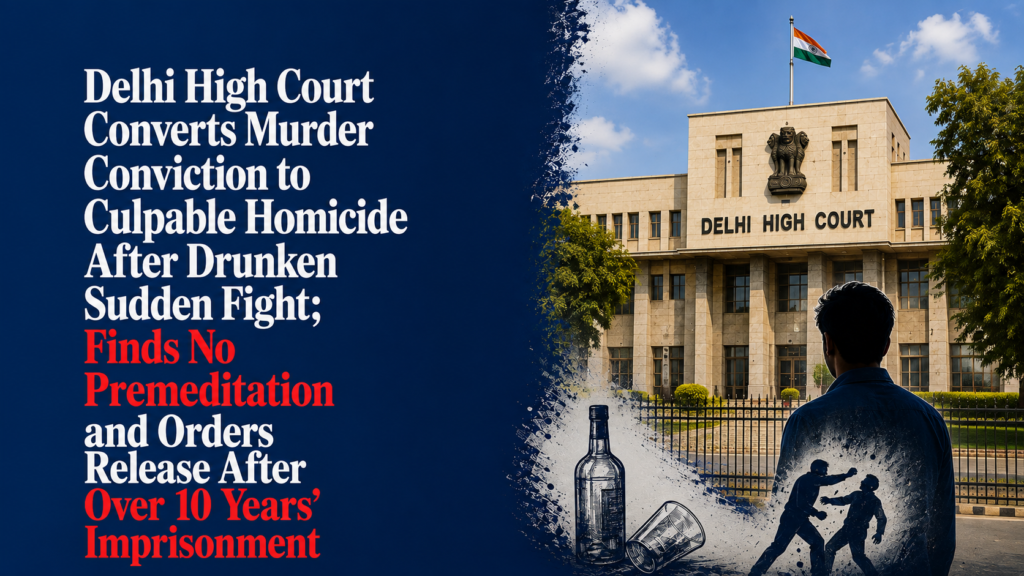
Delhi High Court Converts Murder Conviction to Culpable Homicide After Drunken Sudden Fight; Finds No Premeditation and Orders Release After Over 10 Years’ Imprisonment

Delhi High Court Sets Aside Section 302 Murder Conviction in Fatal Scissor Attack; Holds Sudden Drunken Fight Attracted Exception 4 to Section 300 IPC
Facts
The appellant, Mukesh, challenged his conviction under Section 302 IPC and the sentence of life imprisonment imposed upon him for the death of his co-worker, Rishi Pal. The case arose from an incident dated 13 December 2015. Mukesh and Rishi Pal worked as tailors and stayed together at night in the same tailoring shop.
At around 9:00–9:30 p.m., PW-1 Lalit heard screams and saw Mukesh and Rishi Pal scuffling outside their room. When he separated them, Rishi Pal suddenly fell down and was found bleeding from his abdomen. Before being taken to hospital, Rishi Pal stated that Mukesh had inserted an object into his abdomen. The FIR was initially registered under Section 307 IPC but was converted to Section 302 IPC after Rishi Pal succumbed to his injuries.
The Trial Court relied upon PW-1’s testimony, the deceased’s statements treated as dying declarations and the post-mortem report. It concluded that the fatal injury was sufficient in the ordinary course of nature to cause death and convicted Mukesh under Section 302 IPC, sentencing him to life imprisonment with a fine of Rs.2,000/-.
Before the High Court, the appellant did not seriously dispute that he had caused the injury. His challenge was confined to whether the offence constituted murder under Section 302 IPC or culpable homicide not amounting to murder under Section 304 Part II IPC.
Issues
The principal issue was whether the appellant’s act constituted murder under Section 300 Thirdly, punishable under Section 302 IPC, or whether the circumstances attracted Exception 4 to Section 300 IPC, thereby reducing the offence to culpable homicide not amounting to murder.
The Court specifically considered whether the absence of previous animosity, intoxication of both persons, sudden nature of the quarrel, availability of the scissors at the tailoring shop, single fatal injury, absence of premeditation and appellant’s conduct after the incident demonstrated an absence of intention to commit murder.
Appellant’s Arguments
The appellant confined his challenge to the nature of the offence and argued that the conviction ought to be altered from Section 302 IPC to Section 304 Part II IPC.
He relied principally upon the evidence of PW-1 Lalit, who admitted that the appellant and deceased had been residing and working together and had never previously been seen quarrelling. There was no prior animosity between them.
Both men were intoxicated when the scuffle occurred. The appellant did not flee after the incident and remained at the scene until the police arrived.
It was therefore contended that there was no premeditation or intention to kill and that the fatal incident occurred spontaneously in the course of a sudden drunken quarrel.
Respondent’s Arguments
The State defended the conviction under Section 302 IPC.
It argued that the appellant had used a sharp-edged weapon to inflict an injury upon a vital part of the deceased’s body. The medical evidence established that the injury was sufficient in the ordinary course of nature to cause death.
Accordingly, the State contended that the requirements of murder under Section 300 IPC stood established and that there was no justification for converting the conviction to Section 304 IPC.
Analysis of the Law
Section 300 Thirdly — Intention to Inflict the Particular Injury
The High Court considered the principles laid down by the Supreme Court in Virsa Singh v. State of Punjab.
For Section 300 Thirdly to apply, the prosecution must establish the existence and nature of the bodily injury, the accused’s intention to inflict that particular injury and that the injury was sufficient in the ordinary course of nature to cause death.
The High Court accepted that these requirements were prima facie satisfied. The deceased had sustained a stab wound in the abdomen, the scissors were recovered at the appellant’s instance, and the post-mortem report established that the injury was sufficient in the ordinary course of nature to cause death.
Exceptions to Section 300 Must Still Be Examined
The Court emphasised that establishing one of the four clauses of Section 300 does not end the inquiry.
Even where the act prima facie amounts to murder, the Court must independently determine whether any of the Exceptions to Section 300 apply. If an Exception applies, the offence falls back within culpable homicide not amounting to murder under Section 299 IPC.
Exception 4 — Sudden Fight
Exception 4 applies where culpable homicide occurs:
- without premeditation;
- during a sudden fight;
- in the heat of passion upon a sudden quarrel; and
- without the offender taking undue advantage or acting cruelly or unusually.
The Court examined the totality of circumstances rather than merely the fact that a sharp weapon was used or that the resulting injury was fatal.
Intention Must Be Gathered From All Circumstances
Relying upon Pulicherla Nagaraju v. State of A.P., the Court observed that intention has to be inferred from the cumulative circumstances, including the nature of the weapon, whether it was carried or picked up at the spot, whether the attack occurred during a sudden quarrel, prior enmity, heat of passion, number of blows, whether undue advantage was taken and whether the accused acted cruelly.
Precedent Analysis
Virsa Singh v. State of Punjab
The Supreme Court’s celebrated test under Section 300 Thirdly was applied. The Court accepted that the fatal abdominal injury was objectively sufficient in the ordinary course of nature to cause death.
However, satisfying Section 300 Thirdly did not prevent the Court from subsequently examining whether Exception 4 took the case outside the definition of murder.
Sita Ram Kuchhbedia v. Vimal Rana & Ors.
The Court relied upon this 2026 Supreme Court judgment for the structured approach to distinguishing murder from culpable homicide.
First, the Court must determine whether the accused’s act caused death; second, whether it constitutes culpable homicide under Section 299; third, whether it falls within any of the four clauses of Section 300; and finally, even if it does, whether any Exception to Section 300 applies.
Pulicherla Nagaraju v. State of A.P.
This judgment was relied upon for identifying factors relevant to determining intention, including the weapon used, whether it was brought or picked up at the spot, the body part targeted, force employed, suddenness of the quarrel, prior enmity, heat of passion, undue advantage and number of blows.
Sanjay Singh v. State (NCT of Delhi)
The Delhi High Court relied upon its recent decision where two friends drinking together suddenly fought over payment for liquor and one struck the other with a brick.
Because the incident arose spontaneously, without prior planning or intention to kill, the conviction in that case was altered from Section 302 to Section 304 Part II IPC. The Court found the principle applicable to Mukesh’s case.
Atul Thakur v. State of Himachal Pradesh
The Supreme Court had applied Exception 4 even where the accused inflicted six knife blows during a sudden fight.
The decision demonstrated that neither the use of a dangerous weapon nor multiple injuries is by itself decisive. What matters is whether the incident occurred suddenly, without premeditation, in the heat of passion and without the accused taking undue advantage or acting cruelly.
Court’s Reasoning
The High Court found several circumstances collectively inconsistent with a premeditated intention to murder.
First, Mukesh and Rishi Pal were co-workers who lived together in the tailoring shop and belonged to the same village. There was no evidence of previous animosity between them.
Second, both were under the influence of alcohol. The evidence indicated that the quarrel arose after the deceased knocked on the door and the appellant did not open it, leading to a sudden scuffle.
Third, the weapon was a pair of scissors readily available in the tailoring shop. The appellant had not carried or procured a weapon beforehand, which militated against pre-planning.
Fourth, PW-1 had not actually witnessed the appellant delivering the fatal blow. He saw the two men grappling and noticed the deceased’s injury only after separating them.
Fifth, only one stab injury was found sufficient to cause death.
Sixth, the appellant did not flee after the incident. He remained at the spot until the police arrived. This circumstance, along with the single injury and sudden nature of the fight, supported the conclusion that he had neither taken undue advantage nor acted in a cruel or unusual manner.
The High Court held that the Trial Court had improperly brushed aside these circumstances merely because the accused had not independently led evidence to prove absence of premeditation. The prosecution’s own evidence established the absence of prior animosity and the sudden nature of the occurrence.
The Trial Court’s finding that there was no evidence establishing absence of previous animosity was therefore held to suffer from perversity.
Accordingly, Exception 4 to Section 300 IPC was attracted.
Conclusion
The Delhi High Court held that although the appellant caused the fatal injury, the circumstances did not justify treating the offence as murder.
The incident occurred without premeditation, during a sudden drunken fight, in the heat of the moment, using scissors that were already available at the tailoring shop. There was no previous enmity, only one fatal stab injury was inflicted, and the appellant did not flee or take undue advantage.
The Court therefore altered the conviction from Section 302 IPC to Section 304 Part II IPC.
The appellant had already undergone more than 10 years of imprisonment, including remission. Since 10 years was the maximum punishment permissible under Section 304 Part II IPC, the Court directed that he be released forthwith, unless required in any other case.
Case Details
Case: Mukesh v. State (NCT of Delhi)
Court: High Court of Delhi at New Delhi
Case Number: CRL.A. 85/2025 and CRL.M.(BAIL) 154/2025
Judges: Justice Prathiba M. Singh and Justice Vikas Mahajan
Date: 10 August 2026
Result: Appeal partly allowed; conviction altered from Section 302 IPC to Section 304 Part II IPC. As the appellant had already served more than the maximum 10-year sentence, his immediate release was ordered unless required in any other case.