


Court’s decision
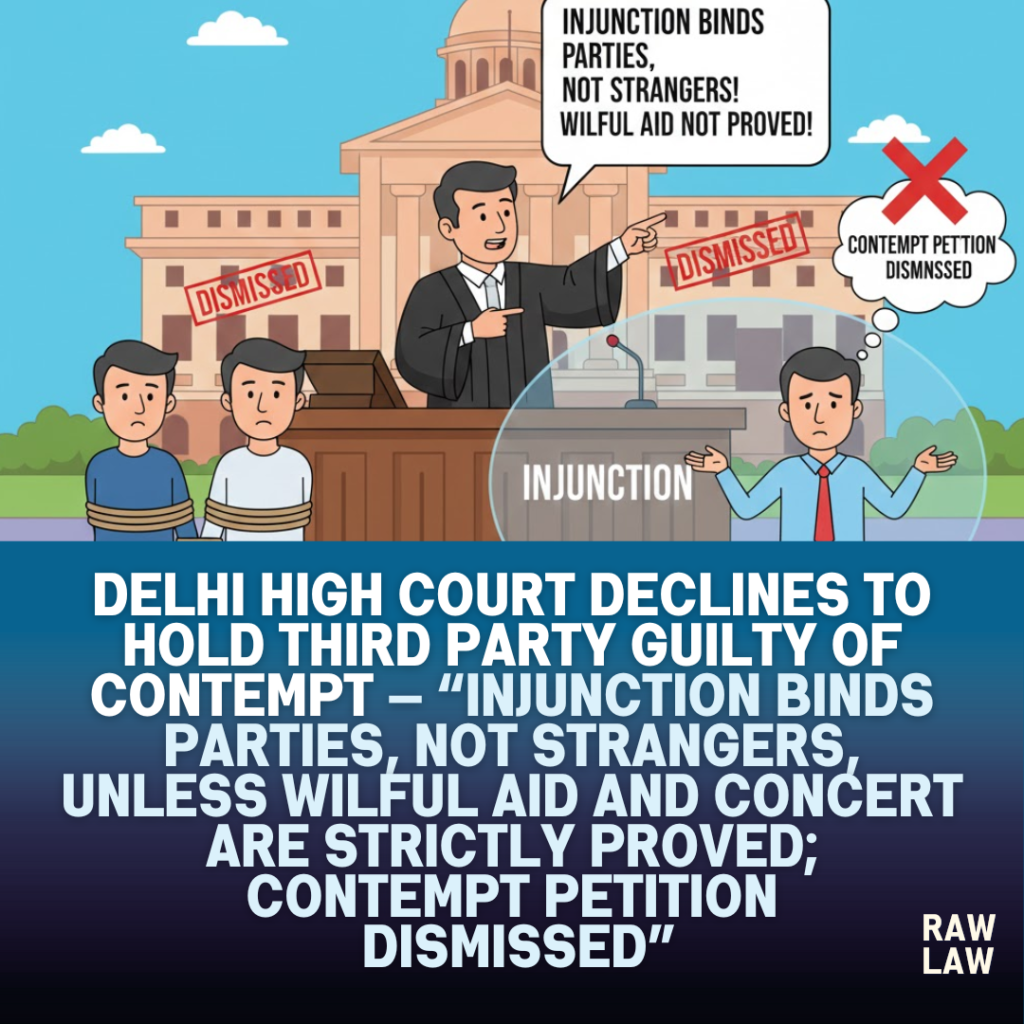
The Delhi High Court dismissed a long-pending contempt petition alleging violation of injunction orders in a corporate property dispute, holding that a person who was not a party to the original suit cannot be punished for contempt unless there is clear, cogent and unimpeachable evidence of knowledge, concert, and wilful disobedience. The Court underscored that contempt jurisdiction is exceptional and punitive, and cannot be used to adjudicate disputed civil rights or to indirectly bind persons who were consciously not impleaded in the suit.
Court’s decision
The Court refused to proceed against the proposed contemnor, a close relative of some defendants, despite allegations that she executed multiple sale deeds in violation of subsisting injunction orders. It held that the injunction dated 06.11.2009 expressly bound only the defendants, their agents, and employees, and not a third party acting in her asserted independent capacity. In the absence of strict proof that the alleged contemnor acted as an agent or in conscious concert with the restrained defendants, contempt jurisdiction could not be invoked.
Facts
The contempt proceedings arose out of a decades-old corporate and property dispute concerning control and assets of a private company. The plaintiffs alleged that certain defendants had falsely represented themselves as directors and had interfered with the company’s affairs. Interim injunctions were passed restraining the defendants from dealing with company assets. The Division Bench, by order dated 06.11.2009, finally restrained only the defendants and their agents from representing themselves as directors or dealing with the company’s assets. Several years later, the plaintiffs alleged that a non-party had executed multiple sale deeds between 2013 and 2014, thereby violating the injunction.
Issues
The central issue before the Court was whether a person who was not arrayed as a party to the suit could be proceeded against for contempt under Order XXXIX Rule 2-A of the Code of Civil Procedure, on the allegation that she violated an injunction by executing sale deeds. The Court also examined whether familial relationship with defendants, knowledge of the injunction, or professional association was sufficient to establish wilful disobedience warranting contempt action.
Petitioner’s arguments
The plaintiffs argued that the proposed contemnor had full knowledge of the injunction and deliberately violated it by executing twelve sale deeds, either personally or through an attorney. It was contended that she was closely related to the defendants, had represented them in legal proceedings, and therefore could not claim ignorance. The plaintiffs submitted that even a non-party could be held guilty of contempt if it was shown that such person knowingly aided or abetted violation of a court order. Reliance was placed on precedents holding that acts done in defiance of injunctions are void and that contempt jurisdiction extends to strangers acting in concert.
Respondent’s arguments
The proposed contemnor opposed the petition, contending that she was never a party to the suit, never named in the injunction, and was acting in her independent capacity based on asserted shareholding and directorship rights. It was argued that the plaintiffs were fully aware of her claimed status since 2006 but deliberately chose not to implead her or seek any restraint against her. The respondent submitted that the validity of sale deeds, shareholding, and authority were all matters pending in separate civil suits and could not be adjudicated in summary contempt proceedings.
Analysis of the law
The Court undertook an extensive analysis of contempt law under Order XXXIX Rule 2-A of the Code of Civil Procedure and the Contempt of Courts Act. It reiterated that contempt proceedings are penal in nature and require strict proof of wilful and deliberate disobedience. Injunctions operate in personam and ordinarily bind only parties to the proceedings. While a third party may be proceeded against in exceptional cases, the burden lies heavily on the applicant to establish knowledge of the order, active concert with a bound party, and intentional breach. Mere suspicion, inference, or familial proximity is insufficient.
Precedent analysis
The Court relied on settled Supreme Court and High Court jurisprudence holding that contempt jurisdiction cannot be expanded to decide disputed questions of fact or civil rights. Precedents recognise a narrow exception where a stranger knowingly aids or abets breach of an injunction, but also caution that such liability cannot be presumed. The Court reiterated that where a third party acts bona fide in exercise of an asserted independent legal right, contempt will not lie and the aggrieved party must pursue appropriate civil remedies.
Court’s reasoning
Applying these principles, the Court found that the injunction dated 06.11.2009 expressly restrained only the defendants, their agents, and employees. The proposed contemnor was not impleaded despite plaintiffs’ admitted knowledge of her claimed shareholding and role. The sale deeds were executed by her in her own asserted capacity, and whether such authority was valid was a matter pending in civil suits. The Court held that contempt jurisdiction could not be used to indirectly bind a non-party or to adjudicate complex disputes on title, authority, or agency. The plaintiffs failed to discharge the heavy burden of proving wilful aid or concert.
Conclusion
The Court dismissed the contempt petition, holding that no case of wilful disobedience was made out against the proposed contemnor. It clarified that contempt proceedings cannot substitute for civil trials or cure defects such as non-impleadment in the original suit. Liberty was reserved to the plaintiffs to pursue other remedies in accordance with law, and it was clarified that the observations were confined to contempt and would not affect the merits of the underlying civil disputes.
Implications
This judgment is a significant reaffirmation of the limited and exceptional nature of contempt jurisdiction. It cautions litigants against using contempt as a strategic tool to expand injunctions against non-parties or to short-circuit pending civil litigation. The ruling underscores the importance of impleading all necessary parties at the outset and reinforces that injunctions bind only those expressly covered, unless strict proof of wilful third-party aid is established.
Case law references
- Third-party liability in contempt: A non-party can be proceeded against only on strict proof of knowledge, concert, and wilful disobedience. Applied to reject contempt against a stranger.
- Contempt jurisdiction under Order XXXIX Rule 2-A: Penal and summary in nature; requires strict and unimpeachable evidence. Applied to confine scope of inquiry.
- Independent civil rights vs contempt: Disputed questions of title, authority, and agency cannot be decided in contempt proceedings. Applied to relegate parties to civil remedies.
FAQs
1. Can a non-party be punished for contempt of an injunction?
Only in exceptional cases. The applicant must strictly prove that the non-party had knowledge of the injunction and wilfully aided or abetted its breach.
2. Does knowledge of an injunction alone attract contempt?
No. Mere knowledge, familial relationship, or professional association is insufficient without proof of deliberate disobedience or concert.
3. Can contempt proceedings decide property or shareholding disputes?
No. Contempt jurisdiction is summary and penal and cannot be used to adjudicate complex civil disputes, which must be resolved in regular civil proceedings.