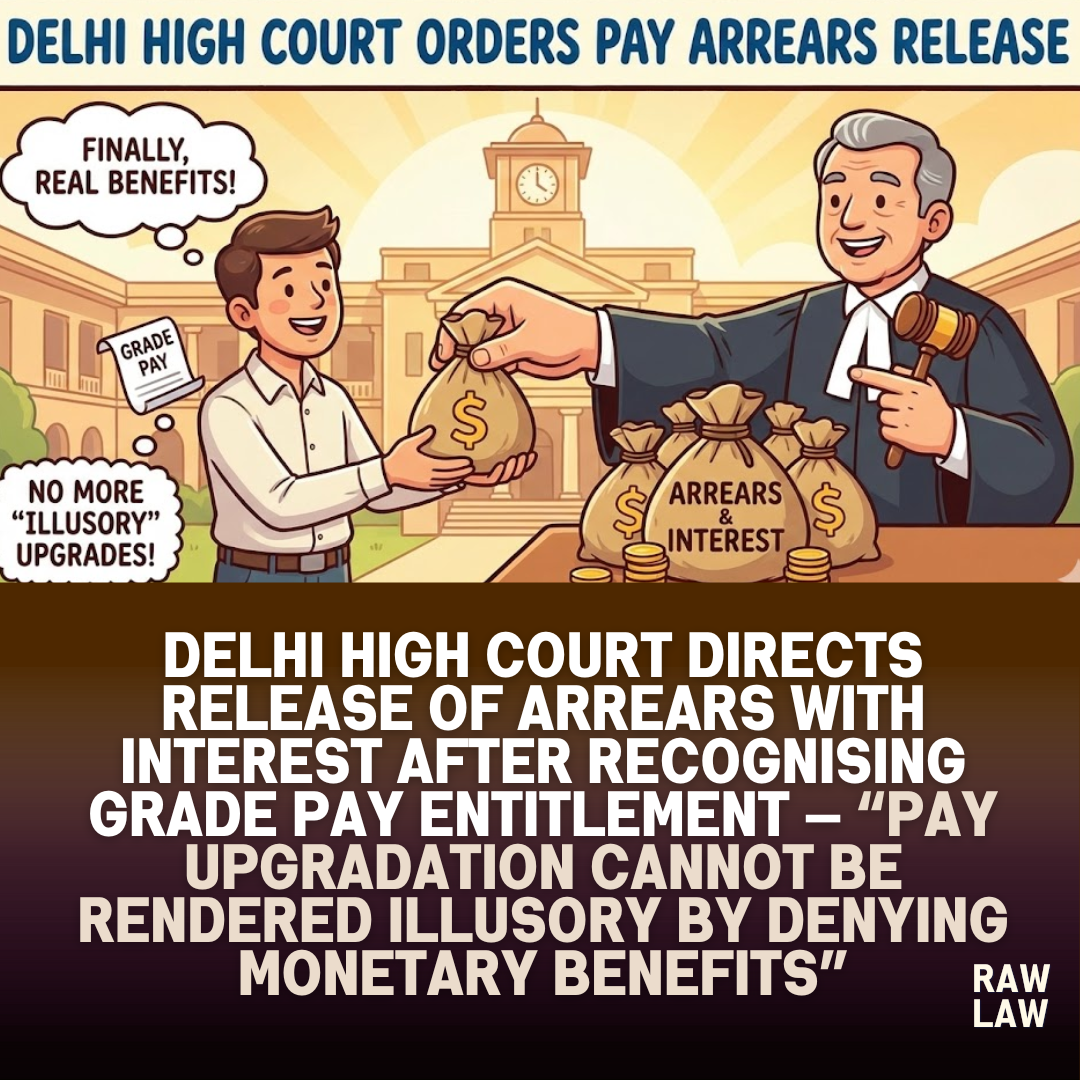
Delhi High Court directs release of arrears with interest after recognising Grade Pay entitlement — “Pay upgradation cannot be rendered illusory by denying monetary benefits”

Headnote
Central Civil Services (Revised Pay) Rules, 2008 – Grade Pay ₹5400 – Automatic upgradation on completion of four years – Arrears of pay – Pension revision – Continuing wrong – Delay and laches – Equality in service benefits.
Held, once a government servant’s entitlement to higher Grade Pay accrues automatically under statutory pay rules upon completion of the prescribed service period, such entitlement cannot be confined to a notional or symbolic recognition without monetary consequences. Denial of arrears after acknowledging eligibility amounts to a continuing civil wrong affecting salary and pension. In pay-fixation matters, delay does not extinguish the substantive right, though arrears may be restricted to a reasonable period. Where similarly placed officers have been granted identical benefits with arrears, selective denial violates Articles 14 and 16 of the Constitution. The Court held that administrative delay or belated consideration of representations cannot be used to defeat statutory financial entitlements. The respondents were directed to release arrears for three years prior to filing of the writ petition, revise pension and retiral benefits accordingly, and pay interest, thereby restoring full financial effect to the Grade Pay upgradation.
Court’s decision
The Delhi High Court partly allowed a writ petition filed by a retired Central Industrial Security Force officer, setting aside the Central Administrative Tribunal’s denial of arrears despite recognising entitlement to Grade Pay ₹5400. The Court held that once eligibility to the upgraded Grade Pay stood admitted, consequential monetary benefits could not be withheld. It directed the Union of India to release arrears for a limited period, revise pension and retiral dues, and pay interest.
Facts
The petitioner joined the Central Industrial Security Force in 1971 and rose through successive promotions to the post equivalent to Private Secretary. Under the 5th Central Pay Commission, he was placed in the pay scale of ₹6500–10500. Subsequently, pursuant to departmental and DoPT notifications, his post stood upgraded retrospectively, resulting in entitlement to higher pay scales.
After implementation of the 6th Central Pay Commission, the petitioner’s pay was fixed with Grade Pay ₹4800. He contended that having completed four years in the upgraded post by April 2005, he became automatically entitled to Grade Pay ₹5400 from 1 January 2006. Despite repeated representations before and after retirement, his pay was not refixed correctly. Ultimately, the Central Administrative Tribunal recognised his entitlement to Grade Pay ₹5400 but denied arrears on the ground of delay, granting only notional benefit for pensionary purposes.
Issues
The principal issue before the Court was whether a government servant, whose entitlement to a higher Grade Pay stands recognised under statutory rules, can be denied arrears of pay and allowances on grounds of delay. Ancillary issues included whether such denial constitutes a continuing wrong, whether parity with similarly placed officers was breached, and whether pension and retiral benefits must be revised accordingly.
Petitioner’s arguments
The petitioner confined his challenge to denial of arrears. He argued that Grade Pay ₹5400 was a rule-based, automatic upgradation and not a discretionary benefit. Once entitlement accrued from 1 January 2006, monetary consequences necessarily followed. He contended that denial of arrears rendered the upgradation illusory. Relying on Supreme Court judgments on continuing wrong and parity, the petitioner submitted that he had diligently pursued his claim and could not be penalised for administrative inaction. He also highlighted that similarly placed officers in other central organisations were granted arrears along with pension revision, and denial in his case amounted to discrimination.
Respondents’ arguments
The Union of India argued that the petitioner’s pay fixation under the 6th Pay Commission was correct at the relevant time and that subsequent recognition of eligibility to Grade Pay ₹5400 did not create a right to retrospective arrears. It was contended that the petitioner had already availed promotions and upgradations, and reopening past periods would impose undue financial burden. The respondents further relied on delay and limitation, asserting that arrears dating back to 2006 were barred and that parity with officers of other organisations was misconceived.
Analysis of the law
The Court analysed service jurisprudence governing pay fixation and recurring causes of action. It reiterated that upgradation to Grade Pay ₹5400 upon completion of four years is automatic under the CCS (Revised Pay) Rules, 2008 and does not depend on discretion. Financial entitlements flowing from statutory rules constitute vested rights. Denial of correct pay fixation impacts salary and pension every month and therefore constitutes a continuing wrong.
The Court applied the principle that while stale claims may justify restriction of arrears, recognition of entitlement cannot be divorced from its financial incidence. Administrative delay cannot defeat statutory rights, particularly in pay and pension matters which do not affect third-party rights.
Precedent analysis
The Court relied on Supreme Court decisions such as Union of India v. Tarsem Singh and M.R. Gupta v. Union of India to hold that incorrect pay fixation is a continuing wrong and relief may be granted notwithstanding delay, though arrears may be limited. It also relied on Chairman, Railway Board v. C.R. Rangadhamaiah to emphasise that benefits already accrued cannot be retrospectively diluted. Delhi High Court precedent recognising automatic grant of Grade Pay ₹5400 with consequential arrears was also applied.
Court’s reasoning
The Bench found that the petitioner completed the qualifying service period well before implementation of the 6th Pay Commission and thus became entitled to Grade Pay ₹5400 from 1 January 2006. Once this entitlement was recognised by the Tribunal, denial of arrears was legally unsustainable. The Court rejected the plea of delay, noting that the petitioner had consistently pursued his claim and that pay fixation errors constitute continuing wrongs. It also found discriminatory treatment, as similarly situated officers had been granted arrears. However, applying settled limitation principles, the Court restricted arrears to three years prior to filing of the writ petition.
Conclusion
The writ petition was allowed in part. The Delhi High Court directed the respondents to release arrears of pay and allowances arising from grant of Grade Pay ₹5400, limited to three years preceding the filing of the writ petition, along with interest at 6% per annum. The respondents were also directed to revise the petitioner’s pension and all retiral benefits accordingly.
Implications
The judgment reinforces that statutory pay upgradations cannot be reduced to notional benefits. It strengthens protections for retirees facing delayed or incorrect pay fixation and clarifies that administrative delay cannot defeat vested financial rights. The ruling also reiterates parity and equality principles in service law, particularly where identical benefits have been extended to similarly placed employees.
Case-law references
- Union of India v. Tarsem Singh – Continuing wrong doctrine in pay and pension matters.
- M.R. Gupta v. Union of India – Incorrect pay fixation gives rise to recurring cause of action.
- Chairman, Railway Board v. C.R. Rangadhamaiah – Accrued service benefits cannot be retrospectively withdrawn.
- Hari Ram v. Registrar General, Delhi High Court – Automatic Grade Pay upgradation carries consequential arrears.
FAQs
1. Can arrears be denied after recognising entitlement to higher Grade Pay?
No. Once entitlement accrues under statutory rules, monetary benefits must follow, subject only to reasonable limitation on arrears.
2. Does delay bar claims for correct pay fixation?
Incorrect pay fixation is a continuing wrong. Courts may restrict arrears but will not deny correct fixation and pension revision.
3. Are retired employees entitled to revision of pension based on corrected pay?
Yes. Correct pay fixation necessarily entails revision of pension and other retiral benefits.