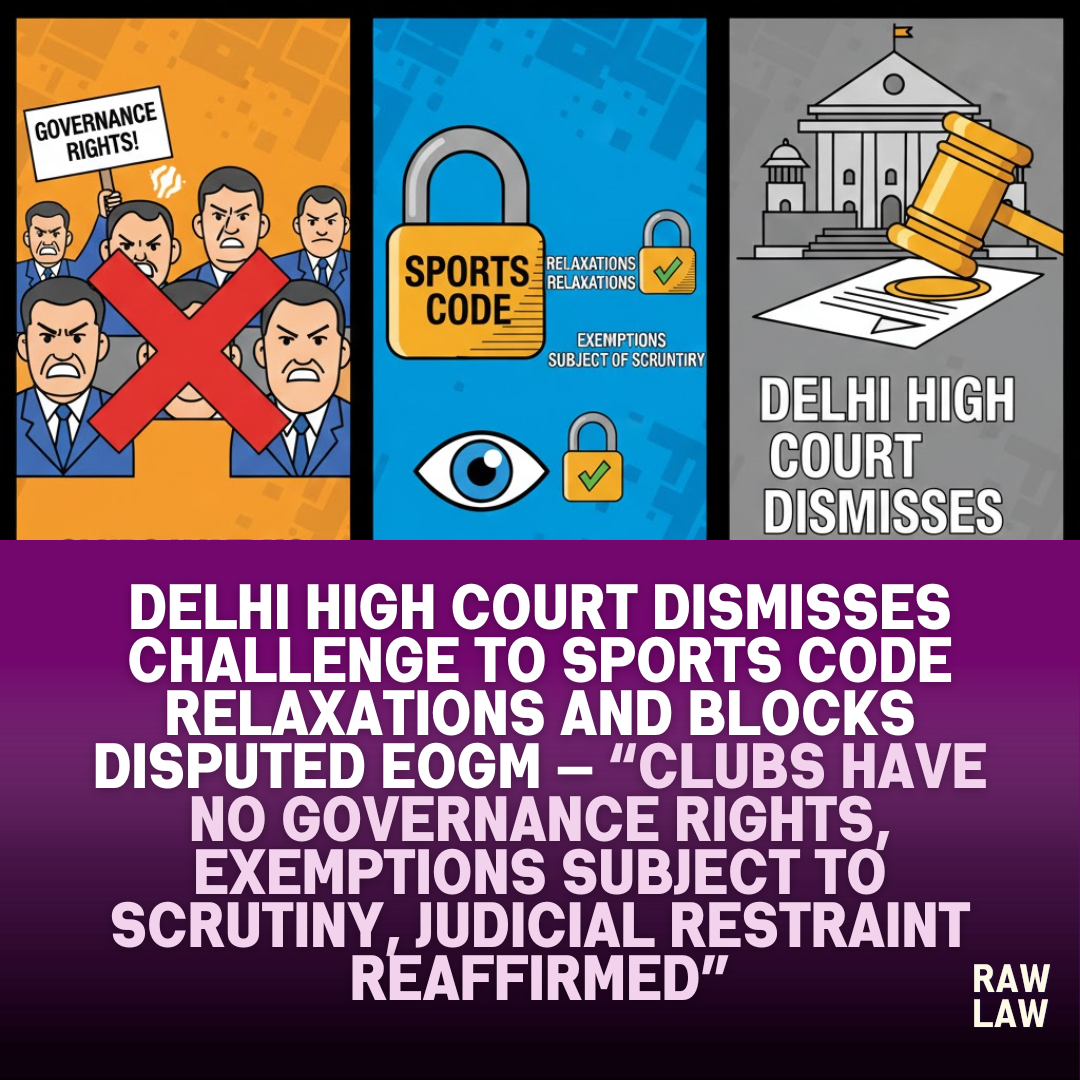
Delhi High Court dismisses challenge to Sports Code relaxations, and blocks disputed EOGM — “Clubs have no governance rights, exemptions subject to scrutiny, judicial restraint reaffirmed”

Headnote
National Sports Development Code of India, 2011 – Relaxation Clause – Sports governance – Judicial review of policy decisions – Role of clubs – National Sports Federations – Extra-Ordinary General Meeting – Compliance with statutory procedure.
Held, the Relaxation Clause inserted in the National Sports Development Code of India, 2011 is neither arbitrary nor unconstitutional, and empowers the Central Government to grant conditional exemptions to National Sports Federations to address sport-specific difficulties. However, exemptions granted without a clear factual foundation or in derogation of the representative, pyramidal governance structure envisaged under the Sports Code are liable to judicial scrutiny. Clubs, being outside the statutory governance framework of National Sports Federations, possess no enforceable right to participate in national-level decision-making or to interfere with electoral processes reserved exclusively for State and Union Territory Associations. An Extra-Ordinary General Meeting convened in violation of the federation’s statute—by a suspended office-bearer, without valid requisitions, notice, or Executive Committee approval—is legally unsustainable. Upholding the Single Judge’s orders, the Court dismissed the appeals, reinforcing transparency, accountability, and rule-based governance in Indian sports administration.
Court’s decision
The Delhi High Court dismissed a batch of Letters Patent Appeals challenging orders passed in writ proceedings concerning the governance of the Equestrian Federation of India. The Division Bench upheld the validity of the Relaxation Clause in the National Sports Development Code while affirming that the specific exemptions granted to the federation lacked adequate factual justification and warranted further scrutiny through a fact-finding exercise. The Court also upheld the stay on a proposed Extra-Ordinary General Meeting, holding that it was convened in breach of the federation’s statute and established governance norms.
Facts
The litigation arose from long-standing disputes concerning governance of the Equestrian Federation of India, the recognised National Sports Federation for equestrian sports. The Ministry of Youth Affairs and Sports had granted temporary exemptions to the federation from strict compliance with the Sports Code, citing the peculiar and infrastructure-intensive nature of equestrian sport. These exemptions related primarily to electoral composition and affiliation requirements.
A State Equestrian Association challenged these relaxations, alleging that they entrenched control of the federation in favour of clubs and institutional members, particularly those affiliated with the Indian Army, at the cost of State Associations envisaged as the backbone of sports governance under the Sports Code. Parallelly, a club claiming membership sought to convene an Extra-Ordinary General Meeting to assert governance rights, leading to further litigation.
Issues
The Court considered whether the Relaxation Clause in the Sports Code was constitutionally valid, whether the exemptions granted to the federation conformed to the objectives of the Sports Code, whether a club had locus to challenge or influence national sports governance, and whether the convening of the Extra-Ordinary General Meeting complied with the federation’s statutory framework.
Appellant’s arguments
The appellants argued that the Single Judge exceeded the limits of judicial review by interfering with executive policy decisions. It was contended that equestrian sport has unique characteristics requiring flexibility in governance norms, and that similar relaxations had been granted to other sports federations. The appellants also asserted democratic rights of members to requisition and convene an Extra-Ordinary General Meeting, arguing that denial of such meetings undermined internal democracy within sports bodies.
Respondents’ arguments
The respondents contended that the Sports Code mandates a pyramidal governance structure centred on State and Union Territory Associations, excluding clubs from voting or governance at the national level. It was argued that the exemptions diluted transparency and accountability, allowing domination by non-representative entities. Regarding the Extra-Ordinary General Meeting, it was submitted that it was convened by a suspended office-bearer, without valid requisitions, Executive Committee approval, or statutory notice, rendering it illegal.
Analysis of the law
The Court reiterated that while policy decisions enjoy deference, they are subject to judicial review where they undermine statutory objectives or lack rational basis. The Sports Code, though not a statute, binds recognised sports federations and the Government in matters of governance. Clauses reserving voting and governance rights to State and Union Territory Associations were held to be explicit and mandatory. Clubs, though contributors to sports development, cannot claim governance rights contrary to the Code.
Precedent analysis
Relying on Supreme Court decisions emphasising limited judicial interference in policy matters, the Court distinguished cases where executive discretion is exercised inconsistently with governing norms. The Court also relied on precedents affirming that internal democracy must operate within the framework of an association’s statute and that meetings convened in breach thereof are void.
Court’s reasoning
The Bench held that the Relaxation Clause itself was a valid enabling provision. However, the exemptions granted to the federation were found to lack a demonstrable factual foundation justifying deviation from the representative structure mandated by the Sports Code. The Court endorsed the Single Judge’s direction for a fact-finding inquiry to assess ground realities. On the Extra-Ordinary General Meeting, the Court found multiple statutory violations, including issuance of notice by a suspended official, absence of valid requisitions, and denial of notice to members, justifying judicial intervention.
Conclusion
The appeals were dismissed in entirety. The Court upheld the validity of the Relaxation Clause, sustained scrutiny of the exemptions granted to the federation, and affirmed the stay on the proposed Extra-Ordinary General Meeting.
Implications
The judgment is a significant reaffirmation of rule-based governance in Indian sports administration. It clarifies that flexibility under the Sports Code cannot be used to erode representative structures or entrench control by non-statutory entities. The ruling also underscores that internal democracy in sports bodies must operate strictly within statutory and constitutional boundaries.
Case-law references
- Peerless General Finance v. Reserve Bank of India – Limits of judicial review over policy decisions.
- All India Football Federation v. Rahul Mehra – Binding nature of the Sports Code on federations.
- Delhi Lawn Tennis Association v. Shyam Minotra – Scope of requisitioned general meetings.
FAQs
1. Are relaxations under the Sports Code unconstitutional?
No. The Relaxation Clause is valid, but exemptions must be factually justified and consistent with governance principles.
2. Do clubs have voting rights in National Sports Federations?
No. Governance and voting rights are reserved for State and Union Territory Associations under the Sports Code.
3. Can courts stop internal meetings of sports federations?
Yes, where meetings are convened in violation of statutory provisions or association rules.