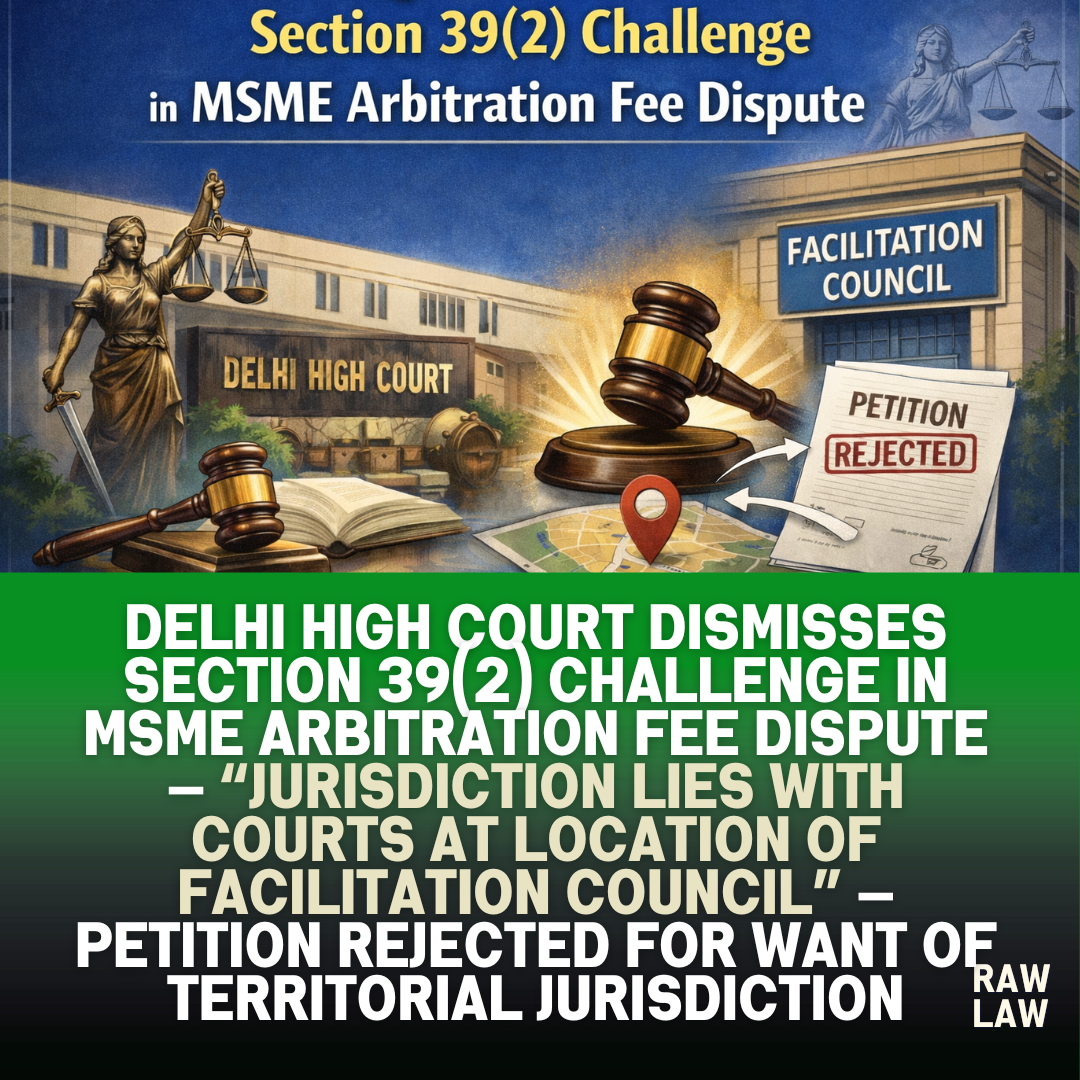
Delhi High Court dismisses Section 39(2) challenge in MSME arbitration fee dispute — “Jurisdiction lies with courts at location of Facilitation Council” — petition rejected for want of territorial jurisdiction

Court’s decision
The Delhi High Court dismissed a petition under Section 39(2) of the Arbitration and Conciliation Act, 1996 challenging an order directing the petitioner to pay the entire arbitral fee for adjudication of its counter-claim in MSME arbitration proceedings. The Court held that it lacked territorial jurisdiction since the arbitration arose from proceedings before the MSME Facilitation Council at Panchkula, Haryana. Applying the Supreme Court’s ruling in Harcharan Dass Gupta and Mahakali Foods, the Court concluded that jurisdiction vests in courts where the Facilitation Council is located.
Facts
The petitioner, a micro enterprise registered under the MSMED Act, entered into a Service Agreement with the respondent for supply of apparel and raw materials. The agreement contained arbitration clauses stipulating Delhi as the seat and venue of arbitration with exclusive jurisdiction of Delhi courts.
Between April 2022 and December 2023, the petitioner advanced approximately ₹2.37 crore and raised invoices aggregating ₹1.88 crore. An Affiliate Agreement dated 30 June 2023 acknowledged liability of over ₹3.12 crore.
Upon alleged default of ₹4.25 crore, the petitioner initiated proceedings under the Insolvency and Bankruptcy Code before the NCLT. Meanwhile, the respondent invoked Section 18 of the MSMED Act before the MSME Facilitation Council at Panchkula seeking recovery.
After conciliation failed, the Council converted the matter into arbitration and appointed a former High Court judge as “Expert.” The Expert directed the petitioner to deposit ₹18,04,057 as arbitral fees for adjudication of its counter-claim.
Issues
The High Court was required to determine:
- Whether Delhi High Court had territorial jurisdiction under Section 39(2) of the Arbitration Act.
- Whether the arbitration clause specifying Delhi as seat prevailed over proceedings initiated under the MSMED Act.
- Whether the Expert’s direction requiring the petitioner to bear full fee for its counter-claim violated Sections 31A and 38 of the Arbitration Act.
- Whether inclusion of interest in calculating “sum in dispute” for fee purposes was permissible.
However, the Court confined itself primarily to the jurisdictional question.
Petitioner’s arguments
The petitioner argued that Delhi courts had exclusive jurisdiction based on the arbitration clause specifying Delhi as seat and venue. It contended that Section 38(2) of the Arbitration Act mandates equal sharing of arbitral costs unless otherwise decided at the award stage.
It was further submitted that directing the petitioner to pay the entire fee for adjudicating its counter-claim violated Section 18 of the Arbitration Act (equal treatment of parties). The petitioner also challenged inclusion of interest in computing “sum in dispute” for fee determination.
The petitioner relied on contractual exclusivity and argued that the impugned fee order was contrary to statutory cost-sharing principles.
Respondent’s arguments
The respondent raised a preliminary objection of territorial jurisdiction, contending that arbitration proceedings were conducted pursuant to reference under Section 18 of the MSMED Act before the Panchkula Facilitation Council.
It was argued that the seat of arbitration was effectively Panchkula/Faridabad, Haryana, since the statutory reference and appointment of arbitrator emanated therefrom. Reliance was placed on Supreme Court decisions in BGS SGS Soma JV, Indus Mobile Distribution, and BALCO.
The respondent also argued that the petitioner engaged in forum shopping by initiating proceedings before NCLT, MSME Council, arbitration, and then Delhi High Court.
Analysis of the law
The Court examined Section 18 of the MSMED Act, which provides a statutory mechanism for conciliation and arbitration of disputes involving micro and small enterprises. Section 18(4) contains a non-obstante clause conferring jurisdiction on the Facilitation Council where the supplier is located.
Relying on the Supreme Court’s decision in Gujarat State Civil Supplies Corporation Ltd. v. Mahakali Foods Pvt. Ltd., the Court reiterated that the MSMED Act is a special legislation overriding the Arbitration Act in case of inconsistency.
The Court further applied Harcharan Dass Gupta v. Union of India, where the Supreme Court clarified that once Section 18 proceedings are triggered, the Facilitation Council’s jurisdiction overrides contractual arbitration clauses.
Thus, even if parties contractually agreed to Delhi as the seat, statutory reference under the MSMED Act supersedes such agreement.
Precedent analysis
In Mahakali Foods, the Supreme Court held that Chapter V of the MSMED Act overrides the Arbitration Act and that private arbitration agreements cannot defeat the statutory mechanism under Section 18.
In Harcharan Dass Gupta, the Supreme Court clarified that arbitration under Section 18(3) is deemed to be “as if” under Section 7 of the Arbitration Act, but jurisdiction flows from the location of the Facilitation Council under Section 18(4).
The Delhi High Court applied these binding precedents and held that jurisdiction lies with courts where the Facilitation Council is situated.
The petitioner’s reliance on Gammon Engineers v. Rohit Sood was rejected as it preceded the authoritative pronouncement in Harcharan Dass Gupta.
Court’s reasoning
The Court noted that the Facilitation Council at Panchkula conducted conciliation, converted proceedings into arbitration, and appointed the Expert. Therefore, the arbitration emanated from the statutory regime under the MSMED Act.
Given Section 18(4)’s overriding effect, jurisdiction vested in courts at the location of the Facilitation Council. The contractual seat clause designating Delhi stood overridden.
Since the Council and arbitration proceedings were conducted in Haryana, Delhi High Court lacked territorial jurisdiction to entertain a petition under Section 39(2).
The Court expressly refrained from examining the merits of the fee apportionment dispute.
Conclusion
The Delhi High Court dismissed the petition for want of territorial jurisdiction. The petitioner was granted liberty to approach the competent court in Haryana.
An interim stay granted earlier was extended for four weeks to enable the petitioner to seek appropriate relief before the competent forum.
Implications
This ruling reinforces that MSMED Act proceedings override contractual arbitration clauses regarding seat and jurisdiction.
Key takeaways:
- Section 18 MSMED Act has overriding effect over the Arbitration Act.
- Jurisdiction lies with courts where the Facilitation Council is located.
- Contractual seat clauses cannot displace statutory jurisdiction.
- Challenges under Section 39(2) must be filed before courts having supervisory jurisdiction over the statutory arbitration.
The judgment strengthens the autonomy of MSME Facilitation Councils and limits forum shopping in MSME disputes.
Case law references
- Gujarat State Civil Supplies Corporation Ltd. v. Mahakali Foods Pvt. Ltd. (2023) 6 SCC 401
Held MSMED Act overrides Arbitration Act; statutory mechanism prevails over private agreement. - Harcharan Dass Gupta v. Union of India (2025 SCC OnLine SC 1111)
Clarified that arbitration under Section 18 MSMED Act vests jurisdiction with courts where Facilitation Council is located. - BGS SGS Soma JV v. NHPC Ltd. (2020) 4 SCC 234
Seat of arbitration determines exclusive supervisory jurisdiction (distinguished in MSME context).
FAQs
1. Does an MSME arbitration override contractual arbitration clauses?
Yes. Once proceedings are initiated under Section 18 of the MSMED Act, statutory provisions override private arbitration agreements.
2. Which court has jurisdiction in MSME arbitration?
The court where the Facilitation Council is located has supervisory jurisdiction under Section 18(4) MSMED Act.
3. Can parties rely on a contractual seat clause in MSME disputes?
No. The statutory framework under the MSMED Act prevails over contractual seat provisions.