

Court’s decision
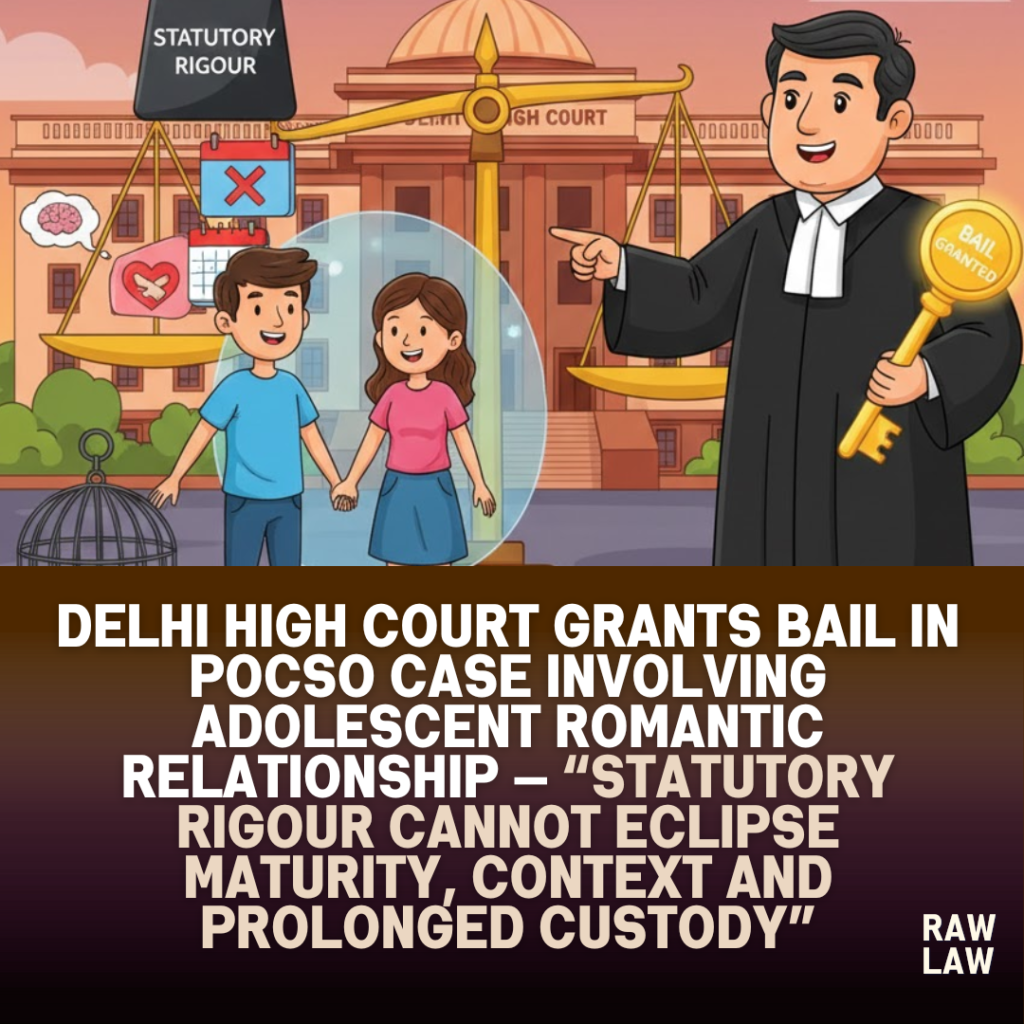
The Delhi High Court granted regular bail to an accused charged under provisions of the Indian Penal Code and the Protection of Children from Sexual Offences Act, 2012, holding that the case prima facie reflected a consensual adolescent romantic relationship rather than forcible sexual exploitation. While reiterating that consent of a minor has no legal value, the Court held that factors such as the prosecutrix’s age being close to majority, absence of violence, completion of prosecution evidence, and prolonged incarceration of over two and a half years tilted the balance in favour of bail. The Court clarified that the statutory presumption under Section 29 of the POCSO Act raises the threshold but does not impose an absolute bar on grant of bail.
Facts
The prosecution case arose from an FIR registered in August 2023 on the complaint of the father of the prosecutrix. It was alleged that the prosecutrix, aged about 14½ years at the time, went out to buy tea near a hospital in central Delhi and was taken away by the petitioner, who was described as her friend. Both were later traced to a hotel in Agra, Uttar Pradesh, where they had stayed for four to five days.
During investigation, the prosecutrix disclosed that she had voluntarily gone with the petitioner, with whom she shared a personal relationship. Medical examination was conducted, counselling was undertaken through the Delhi Commission for Women, and her statement under Section 164 of the Code of Criminal Procedure was recorded. As the prosecutrix had never attended school and no documentary proof of age was available, a bone ossification test was conducted, which assessed her age to be more than 14 years but less than 17 years.
The petitioner was arrested in August 2023 and remained in judicial custody thereafter. Charges were framed for offences including kidnapping, sexual assault, and penetrative sexual assault under the POCSO Act. By the time the bail application was considered, the prosecutrix, her mother, and other public witnesses had already been examined.
Issues
The central issue before the High Court was whether the petitioner was entitled to regular bail in a case under the POCSO Act, considering the statutory presumption of guilt under Section 29. The Court also examined whether the surrounding facts—particularly the nature of the relationship, the age and maturity of the prosecutrix, absence of violence, and the stage of trial—constituted exceptional circumstances justifying grant of bail despite the seriousness of the charges.
Petitioner’s arguments
The petitioner argued that the relationship between him and the prosecutrix was consensual and romantic, a fact borne out from the prosecutrix’s statements under Sections 161 and 164 CrPC as well as her cross-examination during trial. It was contended that she had voluntarily accompanied him to Agra and that no coercion or force was involved.
The petitioner emphasised that he had been in custody since August 2023 and had already undergone more than two years of incarceration. All material prosecution witnesses, including the prosecutrix and her family members, had been examined, eliminating any possibility of influencing witnesses or tampering with evidence. It was further submitted that the petitioner had no prior criminal antecedents and that his continued detention would amount to pre-trial punishment.
Respondent’s arguments
The State opposed the bail plea, submitting that the prosecutrix was a minor at the time of the incident and that her consent, even if claimed, had no legal sanctity under the POCSO Act. It was argued that in her statement under Section 164 CrPC and examination-in-chief, the prosecutrix had alleged that the petitioner took her forcibly and established sexual relations with her.
Counsel for the prosecutrix supported the State’s stand, relying on Supreme Court and High Court precedents emphasising the strict protective object of the POCSO Act. It was contended that the seriousness of the offence and the statutory presumption under Section 29 should weigh against grant of bail.
Analysis of the law
The High Court examined the legal framework governing bail under the POCSO Act. It reiterated that Section 29 creates a presumption of guilt once charges are framed, thereby raising the threshold for grant of bail. However, the Court clarified that the presumption does not oust judicial discretion and must be applied in a manner consistent with constitutional guarantees of personal liberty.
The Court also analysed principles governing age determination under POCSO. Relying on binding precedent of the Delhi High Court, it held that where age is determined through a bone ossification test, the upper limit of the assessed range must be taken. Accordingly, the prosecutrix’s age was treated as 17 years for the purpose of bail consideration.
Precedent analysis
The Court relied on its earlier decisions recognising that the POCSO Act was enacted to protect children from sexual exploitation and was not intended to criminalise consensual romantic relationships between adolescents close in age. Reference was made to Ajay Kumar v. State (NCT of Delhi), where bail was granted in similar circumstances involving a near-major prosecutrix.
The Court also drew extensively from Dharmender Singh v. State, which laid down a structured framework for considering bail under POCSO after framing of charges. That decision identified real-life considerations such as comparative age of the parties, absence of violence, maturity of the prosecutrix, and completion of witness examination as relevant factors that may tilt the balance in favour of bail, notwithstanding Section 29.
Further reliance was placed on later Delhi High Court decisions where prolonged incarceration and completion of evidence were held to justify bail in cases arising out of adolescent romantic relationships.
Court’s reasoning
Applying these principles, the High Court found that the material on record prima facie indicated a consensual romantic relationship. The FIR itself described the petitioner as a friend of the prosecutrix. Her statements suggested that she went with the petitioner of her own free will. While reiterating that consent of a minor is legally irrelevant for the offence, the Court held that her maturity and proximity to majority were relevant considerations for bail.
The Court attached significant weight to the fact that the prosecutrix, her mother, and other public witnesses had already been examined, thereby neutralising the risk of witness intimidation. It also noted that the petitioner had been in custody for about two years and five months, had no criminal antecedents, and that the trial was likely to take further time. The absence of violence, brutality, or repeat offending further persuaded the Court that continued incarceration was not warranted.
Conclusion
The Delhi High Court held that the petitioner had made out a case for grant of regular bail. Without expressing any opinion on the merits of the case, the Court directed his release on bail subject to conditions, including furnishing of personal bond and surety, restriction on leaving the NCR without intimation, and compliance with conditions ensuring his availability during trial.
Implications
This judgment adds to the growing body of jurisprudence recognising the need for contextual and humane application of the POCSO Act at the bail stage. While reaffirming that the statute offers uncompromising protection to minors, the decision underscores that prolonged pre-trial incarceration in cases arising out of adolescent romantic relationships may violate the balance between statutory protection and personal liberty. The ruling is likely to guide trial courts in adopting a nuanced approach when dealing with bail pleas involving near-major prosecutrixes and completed prosecution evidence.
Case law references
- Ajay Kumar v. State (NCT of Delhi)
Held: POCSO Act is not meant to criminalise consensual romantic relationships between adolescents.
Applied: Relied upon to contextualise the relationship for bail purposes. - Dharmender Singh v. State
Held: Section 29 POCSO raises the threshold for bail but does not create an absolute bar; courts must consider real-life factors.
Applied: Framework used to assess age, maturity, violence, and stage of trial. - Prasanta Kumar Sarkar v. Ashis Chatterjee
Held: Laid down general parameters governing grant of bail.
Applied: Used to assess flight risk, antecedents, and likelihood of witness influence.
FAQs
Q1. Can bail be granted in POCSO cases involving minors?
Yes. While Section 29 raises the threshold, courts may grant bail based on factors such as age proximity to majority, absence of violence, and stage of trial.
Q2. Does consensual relationship matter in POCSO cases?
Consent of a minor has no legal value for determining guilt, but the nature of the relationship may be relevant at the bail stage.
Q3. How does prolonged custody affect bail decisions?
Courts often consider long periods of pre-trial incarceration, especially when key witnesses have already been examined.


